AI’s ROI Paradox

As radiology AI slowly moves from pilot projects to widespread clinical adoption, a new survey reveals a paradox: The technology is popular with radiologists, but few imaging facilities using AI have collected hard data showing its return on investment.

AI’s slow clinical adoption has frustrated both clinicians and algorithm developers alike, but the technology is gaining steam.

  • Despite growing clinical evidence, research on AI’s financial value and ROI has been slower in coming. 

To remedy that situation, AI governance startup Croviz.ai conducted a study of 445 radiology AI users on the economics and evaluation of AI. The full report is available here.

  • Survey respondents came from 12 different countries and included a variety of professional roles, including vendor executives, radiologists, and IT and informatics personnel.

Croviz founders Ayman Talkani and AadilMehdi Sanchawala found that while radiology AI power users loved the technology – and some refused to work without it – few had determined a positive financial return from it. Findings included…

  • 95% of sites already using AI had renewed at least one contract with an AI vendor in the last 12 months.
  • But only 30% had quantified a positive financial ROI from AI.
  • 54% cited better quality of life for radiologists as their main reason for renewing an AI contract.

So if AI’s value hasn’t been demonstrated, why are radiology sites renewing AI contracts?

  • The number one reason cited by 54% of those renewing contracts was because their radiologists felt AI improved their quality of life – the only outcome measure leadership could quickly measure with qualitative user feedback.
  • Lower on the scale was reduced turnaround time (18%), more scans per reader (10%), reduced downstream patient costs (10%), and better diagnostic accuracy (8%). 
  • Just 6% paid attention to hard metrics like staff retention rates.

What’s the best way out of the AI ROI paradox? The Croviz researchers recommended more frequent and transparent AI governance.

  • Survey respondents who monitored AI performance more closely – such as more often than once per quarter – exhibited more trust in AI.

The Takeaway

The new survey offers an intriguing look at AI adoption and the question of ROI for the technology. It suggests that – much like another digital technology, PACS – AI adoption is being driven more by its popularity among radiologists than hard ROI considerations.

Mammo AI Momentum Builds

Momentum is building toward routine clinical use of AI for breast cancer screening. Several new studies offer even more support for mammography AI, including research published today in Nature Medicine in which AI reduced radiologist workload by over 60% by excluding low-risk studies from human review.

Breast screening has become one of the most promising use cases for AI, with the potential to reduce radiologists’ workload while improving their ability to detect cancer. 

  • For example, the recent MASAI study found that ScreenPoint Medical’s Transpara AI algorithm could replace the second human reader in a double-reading protocol, reducing workload by 44% and improving cancer detection rates by 28%.

The new research in Nature Medicine also used Transpara, as part of the AITIC study in Spain with the goal of seeing if AI could triage low-risk studies so they don’t require review by human radiologists. 

  • AITIC had a prospective design, involving 31k women with screening exams split between 2D mammography (17k) and digital breast tomosynthesis (14k). 

Women in the control arm of the study got conventional double reading by two radiologists – the standard mammography paradigm in Europe.

  • The intervention arm used a partially autonomous AI approach: cases that AI interpreted as low risk were classified as normal and were not reviewed by radiologists, while all other cases were double-read by radiologists using AI support.

In analyzing the results, researchers found…

  • Workload in the AI arm was 64% lower than conventional double reading.
  • AI’s workload reduction was similar between DBT and conventional digital mammography (-66% and -62%, respectively).
  • The AI arm’s cancer detection rate per 1k women was 15% higher (7.3 vs. 6.3 cancers).
  • But the recall rate was also 15% higher.

It’s worth noting that the AITIC study differed from MASAI in its inclusion of DBT screening exams, whereas MASAI only included 2D digital mammography. 

  • While 2D mammography is the norm in Europe, much of the U.S. has switched to DBT for breast screening, so the AITIC results offer good news for U.S. breast imaging practices considering AI adoption.

The Takeaway

The AITIC study’s new results are powerful confirmation of findings from the recent MASAI trial and support broader clinical deployment of mammography AI. Taken together with positive findings from last week’s Nature Cancer articles (see The Wire section in this newsletter), they paint a picture of a technology that’s ready for prime time.

FDA Updates AI List with New Clearances

The FDA last week updated its list of cleared AI-enabled medical devices, with the new list showing AI marketing authorizations through the end of 2025. The updated list reveals that radiology is maintaining its lead as the medical specialty with the most clearances.

The FDA’s previous update featured data through the end of September 2025, and showed the number of AI-enabled medical devices for radiology crossed the 1k mark. The new numbers show continued momentum for medical imaging.

  • The agency’s data go all the way back to 1995 (the first cleared radiology device on the list was ImageChecker from R2 Technology/Hologic in 1998). 

The new list tracks authorizations through the end of December 2025, and indicates the agency has…

  • Authorized 1,451 AI-enabled medical devices since it began keeping track in 1995.
  • Approved 1,104 radiology devices, or 76% of total AI-enabled medical authorizations.
  • In the fourth quarter of 2025, the FDA cleared 72 AI-enabled medical devices, of which 55 (76%) were radiology devices. 
  • For all of 2025, radiology secured 75% of authorizations, compared to 73% for all of 2024 and 80% for 2023. 
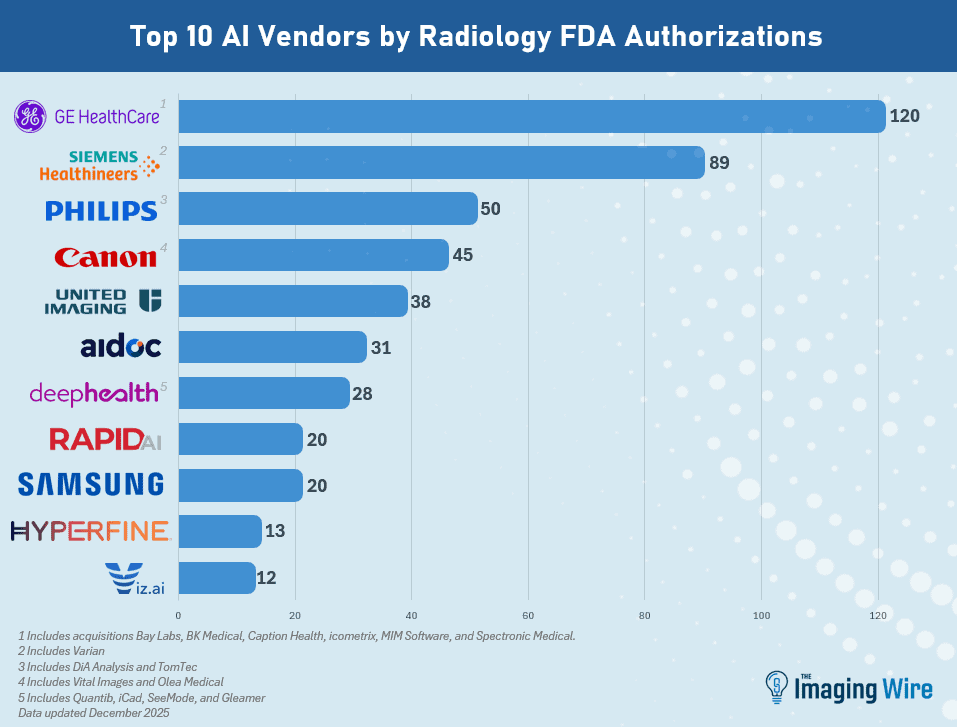
  • GE HealthCare retained the top spot as the company with the most radiology AI authorizations at 120 (including acquisitions Bay Labs, BK Medical, Caption Health, MIM Software, icometrix, and Spectronic Medical).
  • Next is Siemens Healthineers at 89 (including Varian), then Philips at 50 (including DiA Analysis and TomTec), Canon at 45 (including Vital Images and Olea), United Imaging at 38, Aidoc at 31, and DeepHealth at 28 (including Quantib and iCAD). 

As we’ve noted in the past, the FDA’s list includes not only standalone software applications, but also imaging hardware with embedded AI applications, such as a mobile X-ray system with AI algorithms for detecting emergent conditions. 

The Takeaway

The new FDA list shows radiology’s continued dominance when it comes to AI-enabled medical device technology. But an interesting subtext is the ongoing consolidation in the radiology AI space, which could mean that some firms may be climbing the list quickly.

Agentic AI for Radiology Follow-Up

Agentic AI has quickly become one of the hottest topics in radiology. But what is it really good for? Texas researchers offer one possible use case in a new study in NEJM Catalyst: scouring radiology reports to identify patients who require follow-up. 

Agentic AI is a new flavor of artificial intelligence that’s capable of working autonomously to complete tasks with minimal human supervision.

  • In healthcare, it’s being applied to a wide range of tasks, from improving health system operations to clinical and administrative jobs.

In the current study, researchers from Parkland Health in Dallas assigned agentic AI to one of the trickiest tasks in radiology: making sure patients with suspicious findings comply with recommendations for follow-up procedures.  

  • Previous studies have documented low rates of adherence to radiologist recommendations for follow-up imaging (possibly as low as 50%), creating the uncomfortable possibility of missed opportunities that could have major patient-care ramifications.

The dilemma can be compounded with the use of structured note templates in EHRs, as improper use or modification of these macros can lead to missed notifications. 

  • To address the problem, Parkland clinicians developed an AI agent based on a pretrained open-source large language model (Meta’s LLM Llama 3 70B) that reviews clinical impressions, extracts important details for follow-up, and integrates its findings into departmental workflow to enable patient outreach.

In tests on 10k radiologist notes, Parkland researchers found that their AI agent…

  • Had an overall detection rate of ~5.1%, slightly lower than other published studies (8% to 12%).
  • Had far higher sensitivity than Parkland’s previous macro-based follow-up notification system (99% vs. 16%), correctly flagging 6X more cases (513 vs. 83).
  • Achieved higher accuracy (99% vs. 58%), and 94% accuracy for characterizing follow-up timing, recommended procedure, and underlying abnormality. 

Considering Parkland’s annual volume of 500k imaging studies, the AI agent could identify 21.5k follow-up cases a year. 

  • Many of these could be serious issues, such as new cancer diagnoses or pathologies that require surgical intervention. 

The Takeaway

The new study shows that agentic AI isn’t some technogeek’s far-off dream – it’s a useful tool on the verge of real-world implementation, with the potential to improve patient care without overburdening radiology staff.

Simpler Radiology Reports from LLMs

Can large language model AI algorithms write simpler radiology reports for patients than clinicians? A study published in European Radiology found that LLM-produced reports were more readable, but there are areas of concern that will require fine-tuning.

Patients are taking greater interest in managing their own healthcare, requesting direct access to medical information like images and reports.

  • That’s a good thing, but it creates challenges for healthcare professionals more used to communicating with other providers.

Taking the time to draft a report just for patients is a non-starter for many radiology professionals in a time of workforce shortages.

  • But this could be an excellent use case for AI, especially the LLMs that have sprung up over the past few years. 

So researchers from Germany tested three LLMs to draft patient-friendly versions of 60 radiology reports from X-ray, CT, MRI, and ultrasound modalities. 

  • The LLMs included the ubiquitous ChatGPT-4o, as well as two open-source LLMs (Llama-3-70B and Mixtral-8x22B) that had been deployed on-premises within their hospitals.

The authors wanted to know not only how well the LLMs performed in drafting patient reports, but also whether there were differences between the black-box ChatGPT 4o and the two open-source LLMs.

  • The LLMs were instructed to generate layperson summaries at the eighth-grade reading level, preserving key clinical information. 

In comparing original radiology reports to LLM-produced summaries, researchers found…

  • Original reports had much lower ease-of-reading scores on the Flesch readability scale (17 vs. 44-46).
  • Original reports were judged much less understandable on a five-point scale (1.5 vs. 4.1-4.4). 
  • The two open-source LLMs had higher rates of critical errors that could lead to patient harm (8.3%-10%), while ChatGPT 4o had no critical errors. 
  • Original reports had shorter total reading time versus LLM versions (15 vs. 64-73 seconds).
  • There was no difference in understandability based on modality.

The findings on critical errors are particularly concerning. 

  • Clinicians may see on-premises open-source LLMs as having patient privacy advantages over cloud-based ChatGPT 4o, but such models may require more clinical oversight to avoid patient harm. 

The Takeaway

The new study on LLM-generated patient radiology summaries is encouraging, pointing to a future in which a cumbersome task could be offloaded to generative AI algorithms. But much work remains to ensure patient safety and privacy before this can happen.

VC Funding Bounces Back in 2025

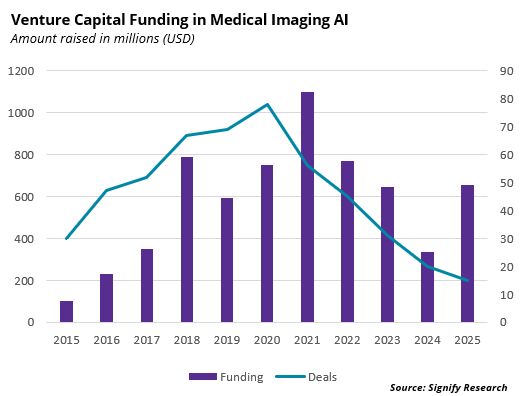
After a long slide, venture capital funding for medical imaging AI companies bounced back in 2025. That’s according to the latest report from market intelligence firm Signify Research. 

VC funding of AI startups has declined steadily since 2020, when cheap money fueled by low pandemic-era interest rates spurred a boom in both the total dollar value of investments as well as the number of funding rounds getting done.

  • Previous Signify reports documented the trend well, with the number of funding rounds peaking at nearly 80 in 2020 and total funding crossing the $1B mark in 2021. But by 2024, funding rounds had fallen by 64% and their dollar value by 70%.

But the numbers for 2025 show a turnaround starting, at least with respect to dollar value…

  • Total funding more than doubled compared to the year before ($709M vs. $336M).
  • While the number of funding rounds fell 17% (19 vs. 23).
  • But the size of the average funding round grew 112% ($39M vs. $19M).

In analyzing the numbers, Signify found that while funding momentum is coming back, investors are being more selective. 

  • Capital is concentrating in companies that have a clear enterprise fit, a strong integration pathway, and the ability to operate within platform and imaging IT ecosystems.

Funding rounds of note in 2025 included…

  • Aidoc’s haul of $150M.
  • An Ultromics funding that put the company in Signify’s coveted $100M club.
  • Cerebriu gaining over $10M in a Series A round.
  • a2z pulling in $4.5M in seed funding for its multi-triage platform. 

The report addresses turbulence in the AI platform sector, which saw significant disruption in 2025 after Bayer’s withdrawal from the market. 

  • Platform companies will need to move beyond AI orchestration and show they can actively improve radiology workflows and deliver better clinical decisions and measurable impact. 

The Takeaway

The 2025 bounceback in VC funding for AI firms is welcome news that the correction that followed the sugar high of 2020/2021 may have worked its way through the system. AI investments in 2026 are likely to be smarter and more focused, and in companies that have demonstrated their value in helping radiologists work more efficiently. 

More Positive News on Mammo AI from MASAI

The latest results from the landmark MASAI study of AI for mammography screening show a favorable trend toward reducing the rate of interval cancers, or breast cancers that appear between screening rounds. The new findings – published Friday in The Lancet – also confirm mammography AI’s sharp workload reduction and trend toward higher sensitivity. 

MASAI is a large randomized controlled trial conducted in Sweden that examined the impact of ScreenPoint Medical’s Transpara AI algorithm on breast screening.

  • It’s an important issue, because mammography is one of the radiology segments where AI can provide the most help by reducing radiologist workload while improving cancer detection.

Previous MASAI studies demonstrated that AI can reduce radiologist workload by 44% and improve cancer detection rates by 28%.

  • The findings suggest that AI could eliminate the need for double-reading of most mammograms, a practice that’s common in European screening programs.

The new findings focus specifically on interval cancers, cancers that are missed in one screening round, only to be found later. 

  • Like other MASAI studies, the patient population consisted of 106k women screened with mammography and Transpara AI in Sweden’s national program in 2021 and 2022. 

Results indicated that AI-aided mammography…

  • Cut interval cancer rates by 12% per 1k women (1.55 vs. 1.76).
  • Reduced invasive interval cancers by 16% (75 vs. 89) with 27% fewer cancers of aggressive subtypes (43 vs. 59).
  • Detected 9% more cancers at screening (81% vs. 74%) with comparable specificity (99% for both) and recall rates (1.5% vs. 1.4%).

The researchers acknowledged that the study was not powered to show a statistically significant difference in the interval cancer rate. 

  • But its positive trend indicates that AI can be used to replace double-reading without negative consequences for patients – resulting in a sharp workload reduction for radiologists. 

The Takeaway

Results from the MASAI study on mammography AI just keep on getting better. Last week’s findings indicate that there’s really no reason for European breast screening programs to not dive in and replace their second readers with AI for the majority of exams.

Doctors Adopt ‘Shadow AI’ for Efficiency Gains

Doctors under pressure to work more efficiently are looking for help from “shadow AI” – artificial intelligence applications adopted outside a formal hospital approval process. A new survey of U.S. healthcare personnel found that many administrators have encountered unauthorized AI tools in their organizations, including some used for direct patient care. 

U.S. healthcare providers are struggling under rising patient volumes in the midst of an ongoing workforce shortage, a situation that’s leading to burnout among clinicians. 

  • AI is often touted as a possible solution by enabling providers to do more with less, but the jury is still out on whether this works in the real world. 

The new survey was conducted by Wolters Kluwer Health to assess usage of what the report described as “shadow AI,” or AI that’s adopted without proper hospital authorization processes. 

  • Shadow AI introduces risk to data, security, and privacy, and providers should better understand the need for an enterprise approach to AI with appropriate controls.

It’s worth noting that the report’s use of the term “authorization” applies primarily to an institution’s internal approval and governance processes for AI rather than formal FDA regulatory authorization. 

  • AI algorithms that aren’t used for direct patient care don’t require FDA authorization, as the agency pointed out in a guidance just a few weeks ago. 

Researchers surveyed 518 health professionals, finding…

  • 41% were aware of colleagues using unauthorized AI tools.
  • 17% said they had personally used an unauthorized tool.
  • 10% said they had used an unauthorized AI tool for direct patient care.

While the report’s recommendation for stronger AI governance is valid, there could be a competitive subtext to the findings. Wolters Kluwer offers healthcare clinical decision support solutions, and the company is currently locked in a fierce battle with OpenEvidence for dominance in the CDS space.

  • OpenEvidence’s CDS solution is wildly popular with clinicians, many of whom install and consult with the software on their own, outside an enterprise-level governance – exactly the kind of “unauthorized” model the new report criticizes.

The Takeaway

The Wolters Kluwer report could be shedding light on a concerning new trend, or it could represent an effort by an established player to shut out a competitive threat. Either way, its warning on the need for appropriate enterprise-level AI governance should not be ignored.

FDA AI Approvals Surge Past 1k for Radiology

The number of AI-enabled medical devices granted FDA marketing authorization for radiology surged past the 1k mark in the latest update from the agency. The numbers show that radiology’s share of authorizations remains stable at just over three-quarters of total approvals.

The FDA regularly releases the list in what’s become a closely watched barometer of both total approvals as well as which medical specialties are most active in AI.

  • Radiology has historically garnered the lion’s share of approvals – perhaps no surprise given the discipline’s early adoption of both digital image management and AI – with the first authorization granted in 1998 (for ImageChecker mammography CAD from R2 Technology/Hologic). 

The new list tracks authorizations through the end of September 2025, and indicates the agency has…

  • Authorized 1,356 AI-enabled devices since it started tracking, up 8.5% since its last report.
  • Approved 1,039 AI-enabled radiology devices, with imaging accounting for 77% of total medical authorizations since 1998.
  • Radiology secured 75% of total authorizations from June to September (83/110), compared to 78% from January to May 2025, 73% for all of 2024, and 80% for 2023. 
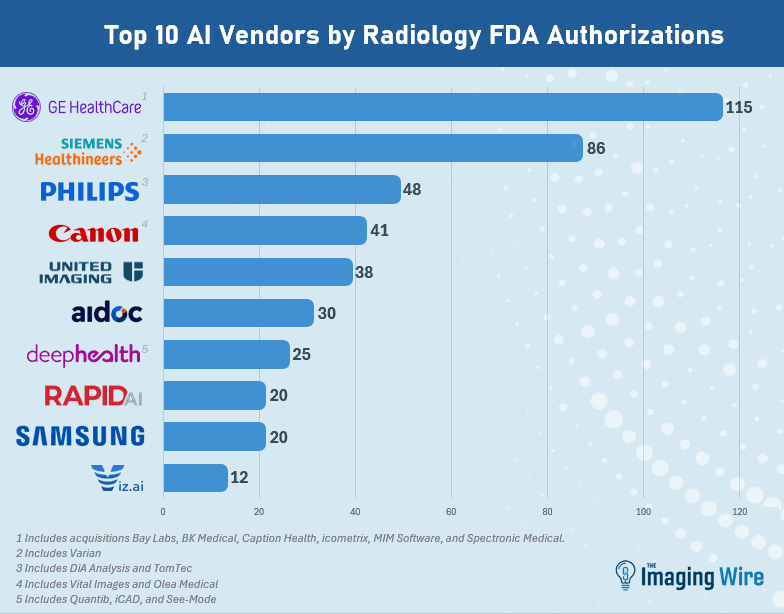
  • GE HealthCare retains the top spot as the company with the most radiology AI authorizations, at 115 (including recent acquisitions Bay Labs, BK Medical, Caption Health, MIM Software, icometrix, and Spectronic Medical).
  • Next is Siemens Healthineers at 86 (including Varian), then Philips at 48 (including DiA Analysis and TomTec), Canon at 41 (including Vital Images and Olea), United Imaging at 38, and Aidoc at 30. 

As always, it’s worth noting that the FDA’s list includes not only standalone software applications, but also imaging equipment that might have AI applications embedded into it, such as a mobile X-ray system with AI algorithms for detecting emergent conditions. 

  • Also, the agency noted that it is exploring ways to identify and tag AI-based devices that use foundation models and large language models. The FDA has yet to approve an LLM-based medical device.

The Takeaway

The new numbers indicate that radiology’s dominance of medical AI continues. But they also show that the FDA has returned to a regular twice-yearly cadence of updating its list of AI-enabled medical devices after a break of nearly a year – news that’s welcome to AI developers.

Next-Generation AI Platform Redefines Radiology Workflow Standards

AI is no longer being viewed as a diagnostic aid but as essential medical infrastructure. Nowhere is that more apparent than in lung screening, with Germany and other European Union countries increasingly embedding AI into their lung cancer screening guidelines and pilot programs.

This evolution will be on display at RSNA 2025, where Coreline Soft will introduce its groundbreaking chest AI platform AVIEW 2.0.

  • The solution demonstrates how unified AI automation is fundamentally transforming radiology workflows and elevating diagnostic precision across pulmonary, cardiac, and airway pathologies.

AVIEW 2.0 represents a paradigm shift from task-specific tools to an integrated diagnostic ecosystem. 

  • The platform seamlessly combines lung-cancer screening (LCS), coronary-artery calcium (CAC) scoring, and COPD quantification into a single, continuous analytical pipeline. 

Clinical validation shows radiologists using AVIEW 2.0 achieve 89% increase in case throughput and 60% reduction in interpretation time compared to the previous generation. 

  • This effectively consolidates multi-disease CT assessment into one streamlined, automated workflow.

AVIEW’s clinical foundation extends far beyond pilot studies. The platform has processed over 2.5M cases across 19 countries, establishing itself as a proven solution in diverse healthcare ecosystems. 

  • Most notably, AVIEW has been selected as the AI platform for major government-led lung cancer screening pilots and programs in Germany, France, and Italy.

Beyond Europe, AVIEW solutions are already integrated into major U.S. medical centers, where their clinical reliability has been independently validated in real-world settings…

  • UMass Memorial Medical Center has deployed the system as an integrated platform for LCS, CAC, and COPD diagnosis, supporting full-spectrum thoracic screening in daily radiology operations.
  • Temple Lung Center, 3DR Labs, and ImageCare Radiology have incorporated AVIEW products into their research and diagnostic environments – each adapting AI functions to site-specific workflows and physician preferences.

SOL Radiology, a fast-growing radiologist-owned practice serving communities across California and Illinois, has deployed AVIEW LCS Plus across its outpatient centers and hospital network, leveraging the platform for high-confidence nodule detection, rapid turnaround, and integrated COPD/CAC assessment. 

  • The group reports significant gains in diagnostic efficiency and consistency within one week of implementation, supporting its vision for technology-driven, high-quality community radiology.

With national-scale validation in Europe, clinical adoption across top-tier U.S. institutions, and 2.5M cases processed globally, Coreline Soft is positioning AVIEW 2.0 as the new benchmark for AI-driven thoracic imaging – where efficiency, accuracy, and scalability converge.

The Takeaway

Coreline Soft will conduct an end-to-end AI workflow demonstration in the “Radiology Reimagined” demo zone at RSNA 2025, using real-world clinical scenarios. With AVIEW and HUB, the full pathway – from triage and interpretation to reporting and quality management – will be validated against standards such as IHE and FHIR, allowing attendees to experience integrated flow firsthand. Learn more or book an appointment on Coreline Soft’s website.

Get every issue of The Imaging Wire, delivered right to your inbox.