VA Radiologist Exodus ‘Tip of Iceberg’

A “mass exodus” of radiologists from the VA’s medical center in Washington, DC, represents just the tip of the iceberg for the health system’s radiology personnel woes. Other VA centers are reported to have seen similar departures, and the VA’s teleradiology program appears to be buckling under the strain. 

News about radiologist staffing problems in the VA came to light in July with the publication of news articles claiming that the Trump administration’s 2025 ban on remote work for federal employees had prompted most radiologists at the VA Washington DC Medical Center to quit.

  • While the ban was later rescinded for radiologists, the edict reportedly “spooked” many radiologists who were already chafing under VA salaries that were far lower than what they could find in the private sector.  

An investigation by the VA’s Office of Inspector General confirmed the Washington, DC, medical center’s problems, documenting the departure of four of the facility’s five full-time radiologists as well as its chief of radiology.

  • But the question remained – how widespread are the VA’s radiologist staffing woes, and have the same problems occurred at other VA medical centers?

Indications are that it’s a growing problem. A VA employee who contacted The Imaging Wire reported that VA radiology departments around the U.S. “got decimated,” with some losing 50% of their radiologist staff.

  • This includes VA medical centers in Houston, Dallas, and San Antonio, and a number in Florida. 

Interestingly, the source claims that the return-to-office edict has only been a “minor” contributor to the exodus, instead attributing the departures to a vicious cycle of lower salaries and higher workload. 

  • The VA’s salary cap of $400k simply isn’t competitive with private-sector radiology, where a recent compensation survey pegged average U.S. radiologist compensation at $610k – a 53% difference. 

The shortage of in-person radiologists is prompting the VA to lean more heavily on its National Teleradiology Program, an operation headquartered in Menlo Park, California, that employs dozens of radiologists to interpret imaging studies overnight and on weekends.

  • But NTP is facing a personnel exodus of its own, especially after NTP officials required daytime radiologists to pick up the slack by also working nights and every other weekend. The source estimated that, at its peak, NTP had about 120 radiologists. That number now stands at 62.

What impact are the departures having on VA patient care? The VA mandates a one-hour turnaround time (TAT) for STAT imaging exams. 

  • But the source claims that TAT has ballooned to as high as 10 hours. “Imagine not getting critical diagnoses for ER patients until 10-12 hours later!” the source said.

The Takeaway

The new revelations suggest that the problems reported at the VA Washington DC Medical Center are actually endemic throughout the VA system. And given the growing gap between VA and private radiologist salaries, they aren’t likely to recede anytime soon, regardless of the agency’s work-from-home policies.
VA Probes Radiologist ‘Mass Exodus’

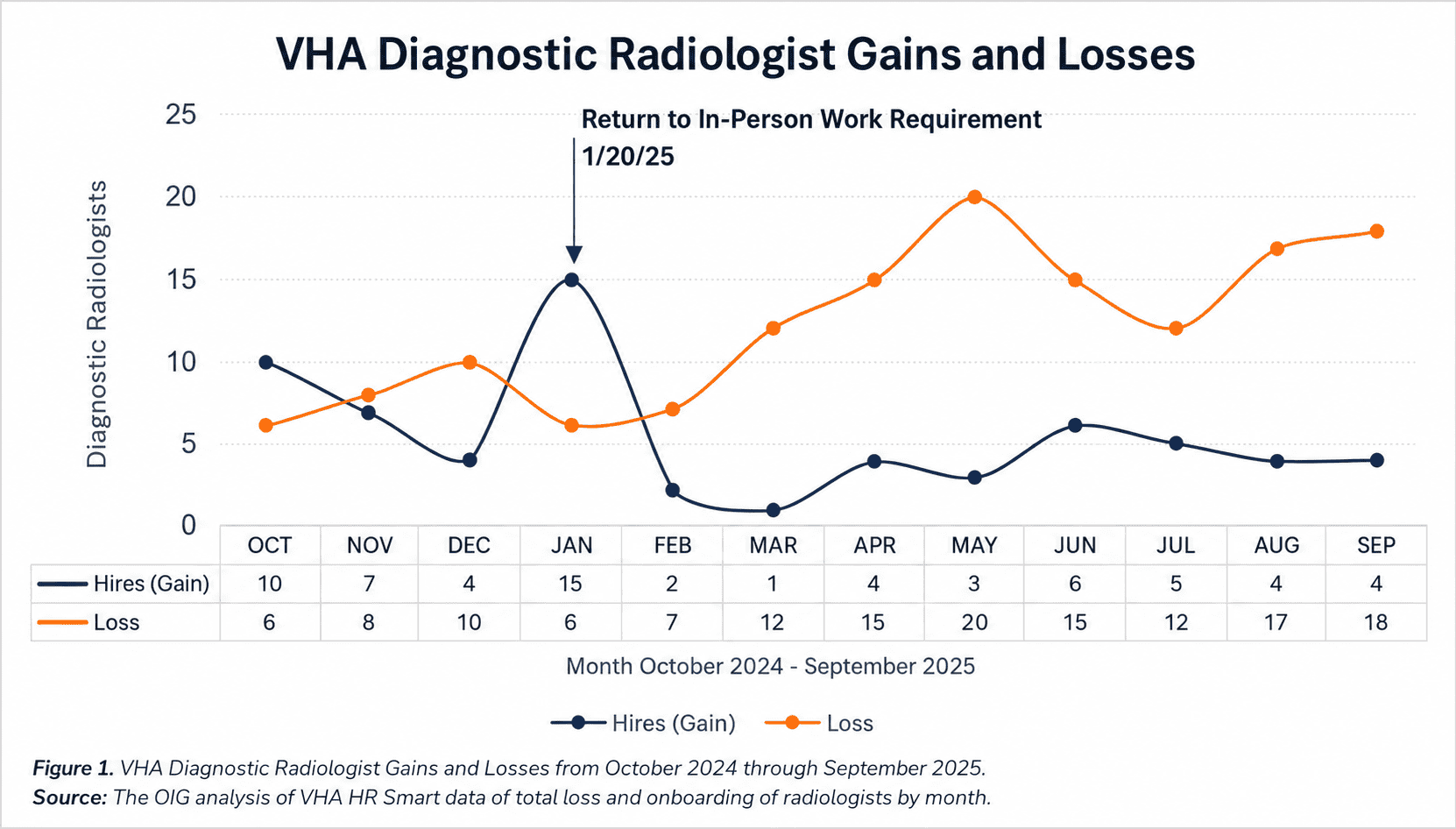
A new federal investigation confirms that a “mass exodus” of radiologists occurred at the VA hospital in Washington, DC, causing a backlog of imaging exams. The departures occurred in response to “return-to-office” requirements implemented in the early days of the second Trump administration. 

Reports began surfacing in late July of turmoil among VA radiologists that centered on the Washington DC VA Medical Center.

  • The departures were linked to changing federal policies on remote work, which has become commonplace in radiology.

The VA supported remote radiology work dating back to the COVID-19 pandemic under a policy that began as a temporary measure and subsequently “became standard practice” as radiologists were allowed to work from home several days a week. 

  • Indeed, teleradiology and remote radiology interpretations “have become factors in employment decisions for many radiologists, influencing recruitment and retention strategies across the industry,” noted a report issued in early August by the VA’s Office of Inspector General (OIG) investigating the turmoil. 

But all that changed on January 20, 2025, when a presidential memo was issued ordering heads of all federal departments and agencies to “take all necessary steps to terminate remote work arrangements and require employees to return to work in-person at their respective duty stations on a full-time basis.”

  • This sparked the departure of most of the Washington DC VA’s diagnostic radiologists, as four of the facility’s five full-time radiologists – including the chief of radiology – resigned over the next six months. 

The OIG report confirms that the return-to-office memo was a “tipping point” that “spooked” radiologists into leaving the Washington DC VA. 

  • While the VA later issued an exemption allowing remote work for radiologists, it wasn’t clear whether the exemption would be extended beyond one year, creating uncertainty and undermining the VA’s ability to recruit new radiologists. 

The turmoil has had several ramifications…

  • Body MRI scans were shut down in July 2025.
  • A backlog of CT exams developed in September 2025.
  • Imaging exams were sent out to community imaging centers.
  • The delays created the risk of patient harm, with the OIG report identifying six patient cases of particular concern.

The Takeaway

The new OIG report on radiologist departures from the VA provides a stunning look at the turmoil caused within one VA hospital by misguided government policies. The question is whether the facility’s challenges in retaining radiologists are just the tip of the iceberg, and whether similar problems extend throughout the VA health system.

Rads Flee VA After Agency Banned Remote Work

A new report claims that radiologists fled the U.S. Department of Veterans Affairs health system after the agency eliminated policies allowing remote work in 2025. While the VA has since rescinded the ban, the article in The American Prospect claims that plummeting morale continues to plague the health system’s radiologists.

The VA’s Veterans Health Administration operates one of the largest health systems in the U.S., serving some 9.1M veterans through 170 VA medical centers and affiliated outpatient sites across the country.

  • While there are no official figures, estimates suggest the VA employs at least 1.5k radiologists, or 4%-5% of all active U.S. radiologists.

While radiologist salaries at the VA don’t approach levels found in the private healthcare sector, many imaging specialists are drawn to the system thanks to perceptions that it offers more job security and stability, as well as its mission in serving the nation’s veterans.

  • But the VA’s image of stability began changing in January 2025, the article claims, when the Trump Administration ordered federal employees to return to working in offices.

The order hit VA radiology particularly hard. Thanks to PACS and teleradiology, remote image interpretation has become a staple of the average radiologist’s workday.

  • Remote reading is even seen as a possible solution to radiology’s rising imaging volume and stagnant workforce. 

So it’s no surprise that VA radiologists recoiled against the new policy, which “ignored the realities of radiology work” and caused morale to plummet among the health system’s imaging specialists.

  • The VA eventually recognized its mistake and rescinded the in-office requirement for radiologists. But by then the damage was done. 

The article claims that VA radiology has experienced ongoing repercussions from the turmoil…

  • Many radiologists have left for the private sector, where average salaries are over 40% higher. 
  • Workloads for the remaining VA radiologists have skyrocketed.
  • Primary care physicians are reporting it now takes “days, not hours,” to get imaging results.
  • VA medical centers are being forced to outsource some specialized scans like amyloid PET exams, for which turnaround times are stretching to two or three months.

The Takeaway

It’s hard to tell exactly how many radiologists have left the VA health system, but any job loss is significant for a provider with a mission as important as the VA’s. While the agency’s turnaround on remote work is welcome, it’s likely that the country’s veterans will bear the brunt of the VA’s misguided policy change for years to come.

Get every issue of The Imaging Wire, delivered right to your inbox.