A new federal investigation confirms that a “mass exodus” of radiologists occurred at the VA hospital in Washington, DC, causing a backlog of imaging exams. The departures occurred in response to “return-to-office” requirements implemented in the early days of the second Trump administration.
Reports began surfacing in late July of turmoil among VA radiologists that centered on the Washington DC VA Medical Center.
- The departures were linked to changing federal policies on remote work, which has become commonplace in radiology.
The VA supported remote radiology work dating back to the COVID-19 pandemic under a policy that began as a temporary measure and subsequently “became standard practice” as radiologists were allowed to work from home several days a week.
- Indeed, teleradiology and remote radiology interpretations “have become factors in employment decisions for many radiologists, influencing recruitment and retention strategies across the industry,” noted a report issued in early August by the VA’s Office of Inspector General (OIG) investigating the turmoil.
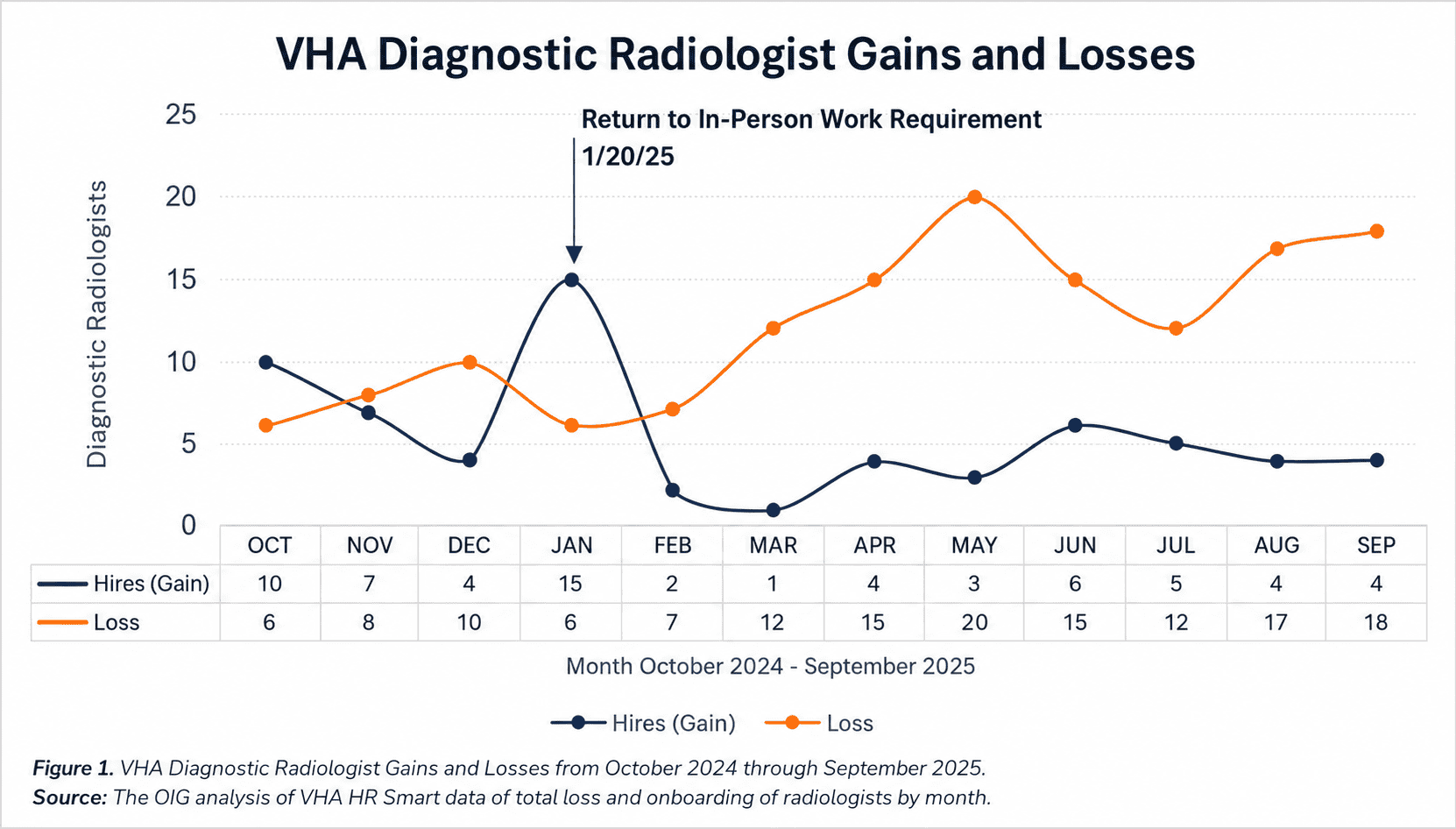
But all that changed on January 20, 2025, when a presidential memo was issued ordering heads of all federal departments and agencies to “take all necessary steps to terminate remote work arrangements and require employees to return to work in-person at their respective duty stations on a full-time basis.”
- This sparked the departure of most of the Washington DC VA’s diagnostic radiologists, as four of the facility’s five full-time radiologists – including the chief of radiology – resigned over the next six months.
The OIG report confirms that the return-to-office memo was a “tipping point” that “spooked” radiologists into leaving the Washington DC VA.
- While the VA later issued an exemption allowing remote work for radiologists, it wasn’t clear whether the exemption would be extended beyond one year, creating uncertainty and undermining the VA’s ability to recruit new radiologists.
The turmoil has had several ramifications…
- Body MRI scans were shut down in July 2025.
- A backlog of CT exams developed in September 2025.
- Imaging exams were sent out to community imaging centers.
- The delays created the risk of patient harm, with the OIG report identifying six patient cases of particular concern.
The Takeaway
The new OIG report on radiologist departures from the VA provides a stunning look at the turmoil caused within one VA hospital by misguided government policies. The question is whether the facility’s challenges in retaining radiologists are just the tip of the iceberg, and whether similar problems extend throughout the VA health system.