Top 10 Radiology Stories of 2025

What were the top 10 radiology news stories of 2025 in The Imaging Wire? This year’s top 10 list as measured by reader views is as follows…

  1. Bayer Steps Back from Blackford. Pharmaceutical giant Bayer in September announced it would deprioritize its investment in AI platform company Blackford Analysis as part of a general move away from the platform business, including its Calantic Digital Solutions subsidiary. The move sent shockwaves through the radiology AI segment as algorithm developers adjusted their commercialization strategies.
  1. Radiology Workforce Shortage Tightens. A report published in June showed that radiologist attrition rates have jumped 50% since 2020, and new workforce projections suggest the shortage will only worsen as imaging demand continues to outpace supply. The report projected a tighter supply of radiologists by 2037, a forecast that’s guiding the development of AI-based tools to help radiologists work more efficiently. 
  1. Lunit Acquires Prognosia Breast Cancer Risk AI. AI developer Lunit ramped up its position in breast cancer risk prediction in September by acquiring Prognosia, the developer of a risk prediction algorithm spun out from Washington University School of Medicine in St. Louis. The move complemented Lunit’s existing AI models for 2D and 3D mammography analysis, and Lunit filed for 510(k) clearance in December for a risk prediction model based on Prognosia technology called Insight Risk.
  1. RadPartners + Envision Consolidate Imaging Services. In a stunning consolidation of the imaging services segment, Radiology Partners took over imaging contracts held by debt-laden national medical group Envision Healthcare. The agreement brought up to 100 imaging sites and hundreds of radiologists into the RadPartners fold, making the country’s biggest private-practice imaging services provider even bigger. 
  1. Radiology AI Approvals Near 1k in New FDA Update. The FDA in July released the long-awaited update to its list of AI-enabled medical devices that have received marketing authorization. The closely watched list showed the number of AI-enabled radiology authorizations approaching the 1k mark, a milestone that was surpassed in December
  1. MRI Accident Turns Deadly. A tragic MRI accident in Long Island, New York, turned deadly after a man who was pulled into a mobile MRI scanner by a heavy chain he was wearing died of his injuries. The incident once again raised the question of whether everything possible is being done to keep patients safe during MRI scans.
  1. Getting Paid for AI – Will It Get Easier? Reimbursement is one of the major stumbling blocks holding back wider clinical adoption of artificial intelligence. But new legislation was introduced into the U.S. Congress in April that could ease AI’s reimbursement path. As of December, it was still working its way through Congress. 
  1. RP Builds AI Mosaic as Company’s IT Foundation. Radiology Partners in July announced a new initiative to guide the rollout of AI across its nationwide network of radiology practices. MosaicOS is the IT foundation connecting RP practices and supporting clinical uses from AI-assisted reporting to report generation and even image management. RP followed up by acquiring vision language model developer Cognita Imaging in November. 
  1. Radiology’s VC Funding Boom? Radiology venture capital funding appeared to be gaining momentum in the first few weeks of 2025 with the release of six funding rounds, led by a massive $260M Series B from preventive medicine firm Neko Health. Unfortunately, that momentum didn’t seem to carry through the rest of the year as most of the radiology VC funding deals got smaller and were spread farther apart.
  1. FDA AI Approvals Surge Past 1k for Radiology. The number of AI-enabled medical devices granted FDA marketing authorization for radiology surged past the 1k mark in the latest update from the agency. The numbers show that radiology’s share of authorizations remains stable at just over three-quarters of total approvals.

The Takeaway

The Imaging Wire top 10 radiology news stories for 2025 shows that our subscribers remain interested in bread-and-butter issues like the radiologist shortage, but also found favor with industry news, especially consolidation in the radiology AI segment. Stay tuned for coverage of healthcare’s most interesting discipline in 2026.

Top 10 Radiology Videos of 2025

If a picture tells a thousand words, then how much more does a video tell you? Here at The Imaging Wire, we believe there’s nothing like having healthcare professionals and industry executives tell you in their own words what’s really going on in radiology.

That’s why video has been an important part of our story since the early days of The Imaging Wire. And over the course of 2025, we published over 80 videos, including on-the-showfloor reports from ECR, HIMSS, SIIM, and RSNA.  

Below are the best of the best – The Imaging Wire’s top 10 radiology videos for 2025 – as measured by views on our YouTube channel. We hope you’ve enjoyed watching our interviews as much as we’ve enjoyed producing them, and we look forward to bringing you more top-notch radiology video content in 2026. 

The Imaging Wire Team

Risk-Based Mammo Screening – Ready for Prime Time?

Is mammography screening based on patient risk ready to take over for age-based screening? Results from the WISDOM study presented at last week’s San Antonio Breast Cancer Symposium and published simultaneously in JAMA suggest that while risk-based screening has its merits, more work may need to be done. 

Cancer screening exams like mammography have reduced disease-specific mortality, but (with the exception of lung cancer screening) all use exclusively age-based criteria to determine who should get screened.

  • Age isn’t a great tool for determining who’s at higher risk of getting cancer, but it’s the best tool we’ve had – up to now.

New cancer risk prediction tools are now becoming available, prompting debate over whether these techniques could make screening more precise by directing it to those most at risk.

  • Higher-risk people could get more frequent screening, while lower-risk individuals might be directed to longer screening intervals.

The WISDOM study presented at SABCS 2025 investigates this question. WISDOM is a randomized clinical trial that compared risk-based breast screening to age-based annual screening in 28.4k women followed for five years. 

  • Risk categorization was performed with genetic testing, polygenic risk scores, and BCSC scores, which incorporate family history and imaging results. 

Women in the risk-based screening group were directed into one of four screening strategies, from alternating mammography and MRI every six months for high-risk women to no screening until age 50 for low-risk women.

  • The study’s primary outcomes were detection rates for breast cancers rated as stage IIB or higher and effectiveness in reducing biopsy rates – a proxy for screening-caused morbidity.

Across the study population, researchers found…

  • The rate of mammograms per 100k person-years was lower in the risk-based cohort compared to age-based screening (43.1k vs. 46.9k). 
  • The rate of stage IIB or higher cancers per 100k person-years was also lower in the risk-based cohort (30 vs. 48).
  • But there was no statistically significant difference in biopsy rates, with a rate difference of 99 per 100k person-years (p = 0.10).

One problem with the WISDOM trial was that the actual screening exams were performed outside the study, and some patients did not comply with screening recommendations, potentially confounding results. 

The Takeaway

The WISDOM authors concluded that a risk-based screening approach is safe, but the lack of a difference in biopsy rates makes one wonder if veering from established age-based criteria is worth it. In any event, the coming arrival of risk stratification based on AI mammogram analysis could make the genetic testing-based approach used in WISDOM obsolete.

FDA AI Approvals Surge Past 1k for Radiology

The number of AI-enabled medical devices granted FDA marketing authorization for radiology surged past the 1k mark in the latest update from the agency. The numbers show that radiology’s share of authorizations remains stable at just over three-quarters of total approvals.

The FDA regularly releases the list in what’s become a closely watched barometer of both total approvals as well as which medical specialties are most active in AI.

  • Radiology has historically garnered the lion’s share of approvals – perhaps no surprise given the discipline’s early adoption of both digital image management and AI – with the first authorization granted in 1998 (for ImageChecker mammography CAD from R2 Technology/Hologic). 

The new list tracks authorizations through the end of September 2025, and indicates the agency has…

  • Authorized 1,356 AI-enabled devices since it started tracking, up 8.5% since its last report.
  • Approved 1,039 AI-enabled radiology devices, with imaging accounting for 77% of total medical authorizations since 1998.
  • Radiology secured 75% of total authorizations from June to September (83/110), compared to 78% from January to May 2025, 73% for all of 2024, and 80% for 2023. 
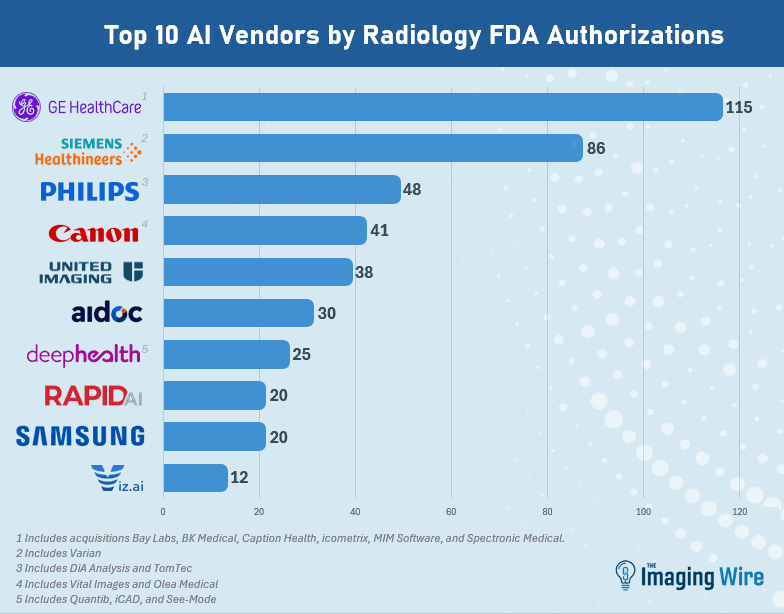
  • GE HealthCare retains the top spot as the company with the most radiology AI authorizations, at 115 (including recent acquisitions Bay Labs, BK Medical, Caption Health, MIM Software, icometrix, and Spectronic Medical).
  • Next is Siemens Healthineers at 86 (including Varian), then Philips at 48 (including DiA Analysis and TomTec), Canon at 41 (including Vital Images and Olea), United Imaging at 38, and Aidoc at 30. 

As always, it’s worth noting that the FDA’s list includes not only standalone software applications, but also imaging equipment that might have AI applications embedded into it, such as a mobile X-ray system with AI algorithms for detecting emergent conditions. 

  • Also, the agency noted that it is exploring ways to identify and tag AI-based devices that use foundation models and large language models. The FDA has yet to approve an LLM-based medical device.

The Takeaway

The new numbers indicate that radiology’s dominance of medical AI continues. But they also show that the FDA has returned to a regular twice-yearly cadence of updating its list of AI-enabled medical devices after a break of nearly a year – news that’s welcome to AI developers.

RSNA 2025 Video Highlights

RSNA 2025 is a wrap, and this year’s meeting offers an intriguing look at the forces that are shaping radiology – especially AI and imaging informatics.

It’s no secret that AI has come to dominate recent RSNA conferences, with its promise of fundamentally reshaping how radiologists do their jobs.

  • The hope is that by making radiologists more efficient, AI will help radiologists manage rising imaging volumes with a workforce that’s been largely stagnant.

But that dream has been a long time in coming, and the AI sector is being forced to make adjustments as it waits for broader clinical adoption. Many of these trends were on display at RSNA 2025, including…

  • Industry consolidation as AI developers make acquisitions to build out integrated suites of AI algorithms.
  • New questions about the commercial viability of the AI platform model given Bayer’s step back from Blackford.
  • The rise of AI network alliances as alternatives to the integrated suite or platform approaches.
  • Building excitement over the performance of foundation and vision language models for clinical tasks.
  • Renewed attention on radiology reporting as perhaps the primary use case where AI can truly help radiologists work more efficiently. 

Our video interviews from RSNA 2025 explore many of these topics and more, giving you an as-it-happened look at news from McCormick Place.

The Takeaway

We hope you enjoy watching our coverage as much as we enjoyed producing it! Check out the links below, on our YouTube page, or visit the Shows page on our website.

Risks of Rising Contrast Use

The use of contrast media in medical imaging procedures has been rising steadily in recent years, a trend that creates environmental risks. So says a new study in JAMA Network Open that documents growth in contrast use over the past 13 years. 

Contrast is an essential part of many imaging exams, helping radiologists better visualize pathology that might be harder to see on unenhanced scans.

  • But contrast use also comes with a wide array of risks, from patient reactions that on rare occasions can be fatal to environmental buildup of contrast that’s excreted from patients after exams and makes its way into local waterways – including drinking water.

This latter phenomenon is what’s explored in the new paper, authored by researchers from the ACR’s Harvey L. Neiman Health Policy Institute. 

  • They analyzed Medicare claims from 2011 to 2024 for 169M contrast-enhanced imaging exams that involved the use of 13.5B milliliters of contrast for both CT and MRI studies. 

HPI’s analysis found…

  • Iodinated CT contrast use grew 5.2% and gadolinium MRI was up 3.5% from 2014 to 2019.
  • Contrast use fell 9.6% for CT and 15.6% for MRI during the COVID-19 pandemic in 2020, but then rebounded afterward.
  • A small number of exams accounted for most of the CT contrast usage, such as CT abdomen and pelvis (4.4B mL) and CT chest (2.7B mL).
  • MRI numbers were far lower, such as for brain MRI scans (221M mL) and abdominal MRI studies (70M).

So what can radiology do? Simply reducing contrast use for environmental reasons isn’t much of a solution, as it has implications not only for patient care but also for medical malpractice risk. 

  • But ongoing efforts to reduce inappropriate imaging would have a follow-on effect of also lowering contrast use, as would protocols to reduce contrast use for patient safety reasons (the introduction of high-relaxivity gadolinium-based agents that cut MRI contrast dose by 50% is a great example).

The authors also cite the development of AI-based techniques that could create contrast-like exams from existing non-contrast data, offering AI developers another possible segment to target. 

The Takeaway

The new study offers an interesting twist in the debate over contrast reduction, pointing out that efforts to reduce unnecessary contrast use promise to benefit not only patients but also the planet.

Snow Doesn’t Slow RSNA 2025

RSNA 2025 is wrapping up this week in what’s been a cold and snowy Chicago. While many attendees experienced travel delays getting into the show on Sunday, the disruptions didn’t slow the blistering pace of radiology innovation on display.

As has been the case all year in radiology, AI has been a hot topic at McCormick Place, both in the presentation rooms and on the technical exhibit floor.

  • Much of the conversation is shifting away from individual point sources of AI – such as for analyzing images – and toward solutions that provide operational efficiencies such as faster radiology reporting.

But big iron has always been RSNA’s bread and butter, and RSNA 2025 didn’t disappoint. 

  • Major new product launches took place in the vendor exhibits, especially in helium-free MRI, photon-counting and spectral CT, and angiography, showing that vendors continue to invest in hardware development. Check out our coverage of the major OEMs in The Wire section below.

What were the other trends at RSNA 2025? They included…

  • Growing buzz around new AI technologies like foundation and vision language models.
  • Real-world clinical applications of AI such as triaging mammography screening.
  • Growing momentum of CT lung cancer screening, both internationally and in the U.S.
  • Use of generative AI to improve radiology reporting.
  • Imaging’s contribution to greenhouse gas emissions – and how to reduce them. 
  • Imaging-based biomarkers that can predict future disease incidence.
  • Opportunistic screening with imaging tests that can detect multiple diseases in one exam.

The Takeaway

Despite weather-related challenges, RSNA 2025 once again showed the importance of radiology’s showcase annual conference for bringing together academics, private-practice providers, vendors, and allied health professionals to meet, exchange ideas, and work together toward providing better patient care. It was great seeing everyone in Chicago – safe travels home!

Get every issue of The Imaging Wire, delivered right to your inbox.