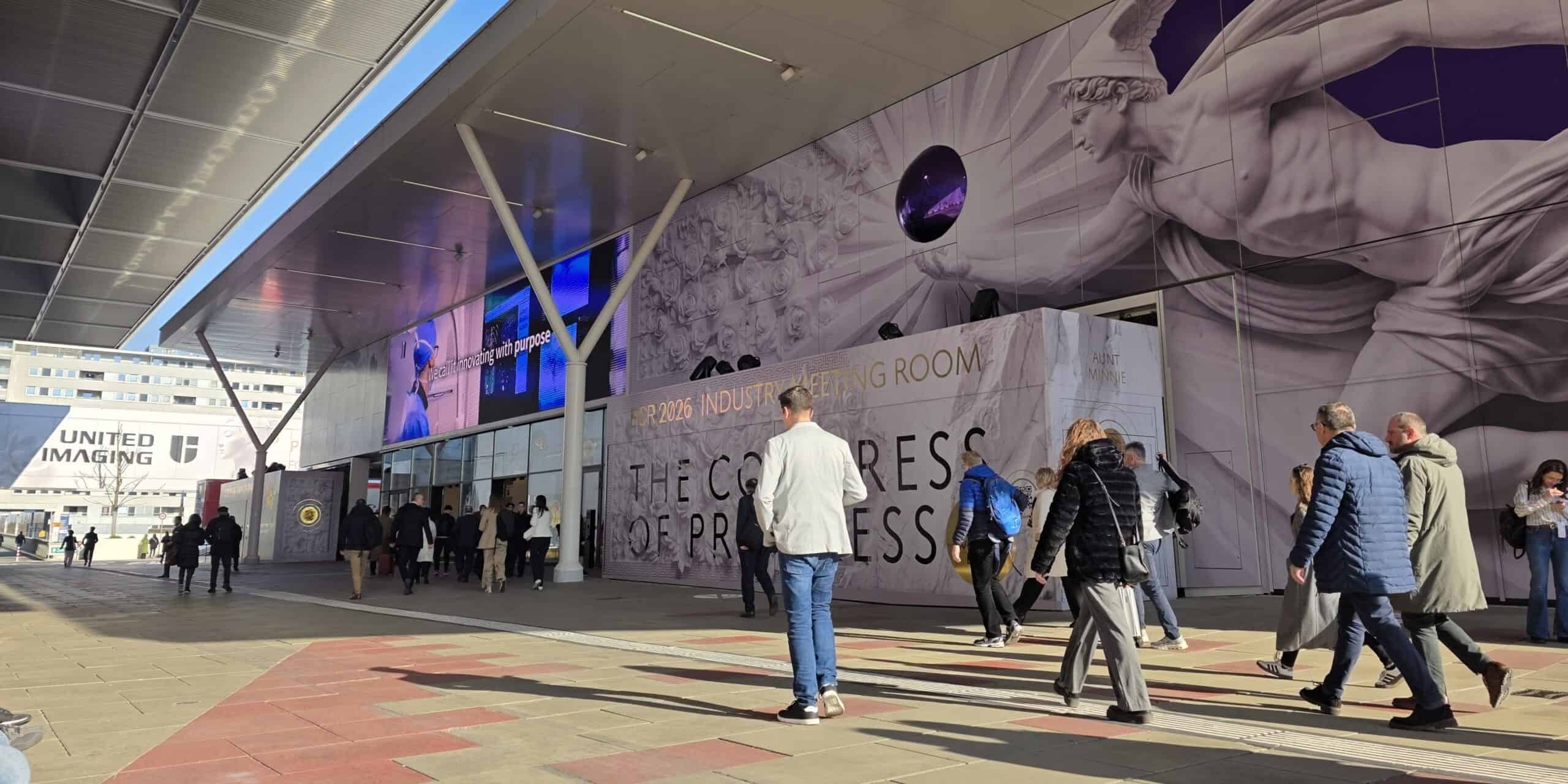
ECR 2026 Video Highlights

The 2026 edition of the European Congress of Radiology wrapped up last weekend, and the conference was full of breaking business and clinical news.

Artificial intelligence dominated the proceedings in Vienna, with researchers presenting the latest work in applying AI to breast and lung screening, neuroradiology, fracture detection, and other clinical use cases.

AI was also a hot story in the technical exhibits, with no fewer than three mergers/acquisitions announced during the show.

In this special edition of The Imaging Wire newsletter, we offer a recap of our ECR 2026 video interviews with thought leaders and imaging vendors from the exhibit floor. 

We hope you enjoy watching our ECR 2026 video coverage as much as we enjoyed producing it! 

Check out the ECR 2026 video links below or visit the Shows page on our website, and keep an eye out for our next Imaging Wire newsletter on Thursday.

Top Trends from ECR 2026

The 2026 edition of the European Congress of Radiology wrapped up last week, and both clinical and business news dominated the discussion in Vienna. 

Below are the top trends from ECR 2026…

  1. AI Consolidation Heats Up: ECR week saw no fewer than three merger/acquisition agreements between AI developers, a sign that consolidation in the segment is heating up. DeepHealth acquired Gleamer, Sectra bought Oxipit, and Medimaps and Radiobotics agreed to merge, indicating that a major shakeup could be in the offing as venture capital funding shifts toward larger AI players and smaller firms struggle for relevance.
  2. Mammography AI Nears Real-World Implementation: Large-scale prospective studies like MASAI demonstrated the ability of mammography AI to reduce radiologists’ workloads and improve their interpretive performance. ECR attendees learned of new AI applications for breast screening – like image-based risk assessment – that move AI ever closer to real-world implementation.
  3. CT Lung Cancer Screening Ramps Up: Numerous European countries are rolling out population-based CT lung cancer screening programs, and a number of ECR presentations discussed the progress being made as well as technologies like AI that can make lung screening more effective.
  4. ECR As a Vendor Showcase: In terms of vendor news, ECR has always operated in the shadow of radiology’s largest conference, RSNA, but this year’s meeting showed that may be changing. AI companies timed a raft of M&A announcements with ECR 2026, and other vendors coordinated product launches for the Vienna meeting.
  5. Radiology Refines Sustainability Message: Environmental sustainability and how to reduce radiology’s global footprint was a major theme at ECR 2025, and that carried over to ECR 2026. Vendors are offering new solutions like helium-free MRI scanners, while researchers are showing how power-saving scanning protocols can help radiology save patients and the planet at the same time.
  6. Geopolitical Turmoil Affects Attendance: Ongoing geopolitical turmoil definitely affected attendance at ECR 2026 as flights from the Middle East and India to Europe were canceled during the meeting. But as with the weather delays at RSNA 2025, conference proceedings continued on and the halls of Austria Center Vienna seemed as crowded as in past years.

The Takeaway

Last week’s ECR 2026 cemented the meeting’s reputation as a European counterpoint to radiology’s other major conference, RSNA. In some areas like mammography AI and CT lung cancer screening, European radiologists are moving ahead of their colleagues across the Atlantic.

Early News from ECR 2026

ECR 2026 opened yesterday with a light-filled opening ceremony that beautifully illustrated this year’s theme, “Rays of Knowledge.” The ceremony was conducted before an overflow audience in the Austria Center Vienna, with ECR 2026 President Prof. Minerva Becker proudly presiding over a mix of speeches, honorary awards, and musical performances for which ECR is famous.

ECR 2026 is taking place as European radiology reaches an inflection point. The region has workforce shortages that are as serious (if not more so) than the U.S., and it must also accommodate rising demand for medical imaging. 

As in the U.S., artificial intelligence is being held up as a potential solution to enable radiologists to do more with less. 

  • In some ways, Europe is ahead of the U.S., having conducted large-scale prospective trials like MASAI to test AI’s value for tasks like breast screening. One country – Italy – has even recommended that AI be used routinely for breast screening.  

But from a regulatory standpoint, skepticism toward AI may be even stronger in Europe than in the U.S. 

  • The European Union in 2024 implemented the AI Act to promote human-centered and trustworthy AI, and the act classifies AI algorithms as among the highest-risk devices. Some industry observers believe the act may already be slowing the introduction of new algorithms into the European market, even as the U.S. is removing regulatory guardrails on clinical AI.

Be that as it may, the ECR continues to reinforce its reputation as a forum for top-notch clinical content, and the first day of sessions did not disappoint. In particular, AI for lung cancer screening was a prominent focus, including the following sessions…

  • Harrison.ai’s chest CT AI algorithm turned in 91% sensitivity for detecting pulmonary nodules in 1.1k LDCT scans, with an average of 1.12 false positives per case.
  • Results from the RELIVE study of lung cancer screening in France showed that AI from Median Technologies boosted AUC for radiologists (0.843 vs. 0.828), with less experienced radiologists seeing a 4.8% AUC improvement. 
  • A survey of patients and clinicians in Northern Ireland found both groups were positive about using AI for lung cancer to reduce waiting times, but neither group liked the idea of autonomous AI.
  • The LUNA25 challenge tested AI algorithms developed by five teams for estimating malignancy risk of lung nodules, finding that the top AI had standalone AUC performance better than the average of 75 radiologists (0.78 vs. 0.69).
  • Dutch researchers tested four commercially available AI algorithms for LDCT lung screening, finding wide variation in sensitivity (77% to 92%).
  • Carebot’s AI CXR software was used to analyze 96.5k chest X-rays from nine Czech hospitals over six months, finding 54 previously undiagnosed thoracic cancers.

The Takeaway

ECR 2026 continues through Sunday, and we’ll be on hand in Vienna to bring you the latest news from radiology’s premier pan-European conference. Stay tuned for our wrap-up newsletter next week, or follow along with our daily video reports on our LinkedIn and YouTube channels.

Get every issue of The Imaging Wire, delivered right to your inbox.