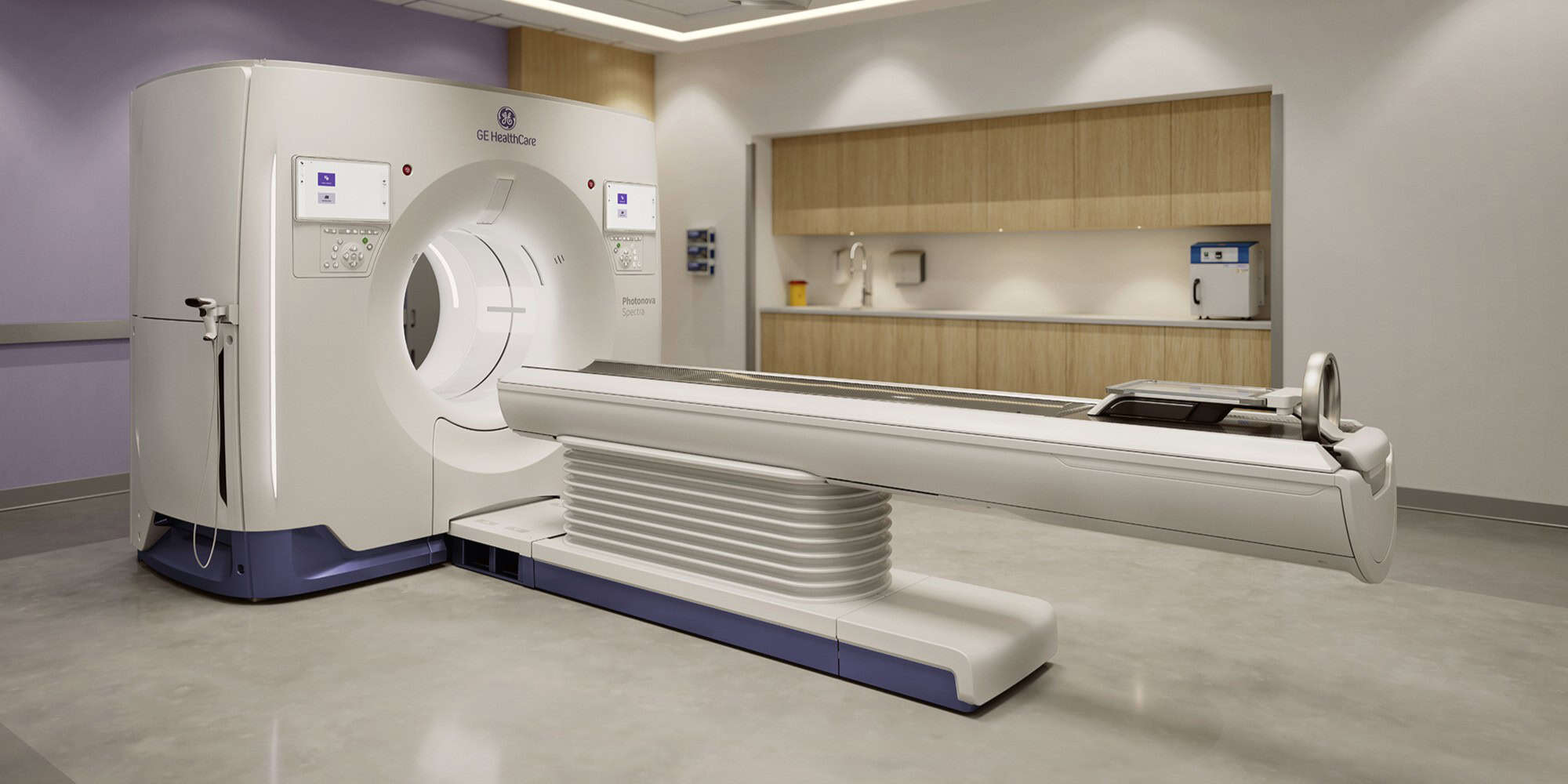
GE’s Photon-Counting CT Clearance

GE HealthCare this week announced FDA clearance for Photonova Spectra, the company’s first photon-counting CT scanner. While GE isn’t the first vendor with a commercially available PCCT scanner, it’s hoping to differentiate the system by highlighting the combination of ultrahigh-resolution scanning with spectral imaging.

Photon-counting CT represents a huge leap forward in CT instrumentation that’s not only driving new clinical applications but is also helping radiologists perform routine CT exams with better resolution and lower radiation dose. 

  • PCCT scanners directly convert photons to digital data, instead of using conventional CT’s two-step energy-integrating technique, resulting in images with less noise and supporting acquisition protocols with lower radiation dose. 

Siemens Healthineers brought the first photon-counting CT scanner to market with the 2021 FDA clearance of Naeotom Alpha.

  • Since then, Siemens has had the market for whole-body PCCT to itself, with only niche photon-counting scanners getting FDA clearance.

But we’re here to talk about GE’s Photonova Spectra, so let’s get to it. The system is based on GE’s Deep Silicon detector technology, which uses a novel semiconductor detector material that’s particularly suited for spectral imaging.

  • Spectral CT acquires images at different energy levels, which is useful for detecting disease because malignant and benign tissue respond differently to different energy spectra.    

GE is highlighting Photonova Spectra’s 8-bin energy resolution, which means the scanner separates incoming photons into eight distinct energy ranges – or bins – rather than grouping them into one or two. 

  • This enables Photonova Spectra to deliver much more precise spectral imaging than previously possible, with better quantitative accuracy and improved differentiation between materials like bone and soft tissue, according to GE CT executive Chad Rowland.

Spectral CT has developed a reputation as a technology that’s powerful but complex, and GE addressed this issue with workflow tools that make spectral imaging “always on” and easier than ever to perform. 

  • GE is banking on the combination of spectral imaging with Photonova Spectra’s ultrahigh-resolution images being a game-changer for many sites considering adopting their first PCCT scanner.

The Takeaway

FDA clearance for GE HealthCare’s Photonova Spectra photon-counting CT scanner is great news for the vendor that puts it on a level competitive footing with Siemens as a CT innovator. But it’s also good news for imaging providers, giving them another option for delivering to patients the benefits of PCCT – lower radiation dose and better image quality. 

NeuroLogica’s Photon Counting CT

Samsung’s NeuroLogica subsidiary announced the FDA 510(k) clearance of its photon counting-based OmniTom Elite PCD, significantly expanding the mobile head/neck CT system’s diagnostic potential and adding to photon counting technology’s recent momentum.

About the OEPCD – The OmniTom Elite with PCD is now available as an optional upgrade (including field upgrades), swapping the standard OmniTom Elite’s energy integrating detector (EID) for a single-source cadmium telluride-based photon counting detector. Beyond the OmniTom Elite with PCD’s imaging advantages (2x higher spatial resolution, spectral CT images at multiple energy levels), all other key features are shared between the two configurations (16 row, 40cm bore, 30cm FoV).

The Photon Counting Race – NeuroLogica’s photon counting CT launch comes about six months after Siemens Healthineers’ NAEOTOM Alpha became the first FDA-cleared PCCT. The OmniTom Elite with PCD’s launch also comes amid major R&D and M&A efforts from essentially all major OEMs, as they compete for photon counting CT leadership. 

The Photon Counting Advantage – Those efforts seem warranted, as PCCTs produce far higher quality images and provide far more imaging data, while potentially allowing lower radiation exposure and contrast dosage. For the OmniTom Elite’s head and neck applications, that could mean improved visualization and segmentation of bones, blood clots, plaques, hemorrhages, and intracranial tumors.

NeuroLogica’s Next Steps – Even if photon counting’s advantages are widely agreed upon, its potential clinical applications are still being explored. Because of that, NeuroLogica’s announcement emphasized ongoing research efforts to evaluate the OmniTom Elite with PCD’s performance with certain patients (e.g. post-trauma and post-surgical patients) and its plans to develop the mobile PCCT’s “full potential.”

The Takeaway

The OmniTom Elite PCD’s head/neck imaging design (vs. whole body) and use of a single-source detector (vs. dual) make it quite different from the other PCCTs being developed, but it’s launch is still a notable milestone for photon counting CT technology. It’s also a testament to Samsung/NeuroLogica’s R&D efforts, coming 4.5 years after showing the detector at RSNA 2017, and reaching the market before most of the biggest CT players released their own PCCTs.

Siemens’ Healthineers Hardware Evolution

Siemens Healthineers’ Shape 22 pre-RSNA event featured a pair of ambitious hardware announcements that stand to expand what can be done with CT exams and where MRIs can be performed.

NAEOTOM Alpha PCCT – Siemens Healthineers confirmed its pole position in the Photon-Counting CT race, officially launching its NAEOTOM Alpha scanner. Although the NAEOTOM Alpha already received a rare marketing head-start from the FDA, this week’s launch begins its official 2022 rollout, and provides new details about this milestone product:

  • Far higher image quality than CT
  • Provides much more imaging data and new levels of CT-based insights
  • Expands CT to new cardiac, oncology, and pulmonology use cases
  • Allows 50% lower radiation dosage, could shift exams to non-contrast
  • Supports Siemens’ core solutions, including operability and AI-based diagnosis
  • Cleared in US and Europe, 20 systems already installed, 8k patients scanned
  • PCCT expected to become the main CT technology within 10 years
  • Siemens is holding another NAEOTOM Alpha event today (Nov. 18)
  • Siemens might be first, but we’re seeing more PCCT activity from GE Healthcare, and Canon and Philips aren’t far behind

MAGNETOM Free.Star MRI – One year after introducing the MRI-expanding MAGNETOM Free.Max, Siemens continued its MRI accessibility push, revealing the “disruptively simple” MAGNETOM Free.Star. The new Free.Star MRI will inherit much of the MAGNETOM Free.Max’s accessibility-friendly qualities (0.55T, small/light, low helium & installation requirements), and will have the ambitious goal of supporting the half of the world’s population that doesn’t have MRI access. The MAGNETOM Free.Star is still early-stage (it hasn’t begun the FDA process), but it’s massive healthcare ambitions make it worth keeping an eye on.

The Takeaway – The NAEOTOM Alpha is expected to be the start of a major shift towards Photon-Counting CT, while the new MAGNETOM Free.Max and Free.Star could expand where MRIs are used. That makes these extremely significant products.

Siemens’ First Photon-Counting CT

The FDA announced the 510(k) clearance of Siemens Healthineers’ NAEOTOM Alpha photon-counting CT scanner, calling it “the first new major technological improvement for Computed Tomography (CT) imaging in nearly a decade.” Those are some big words from a federal agency not known for hyperbole, and it doesn’t appear they are exaggerating.

About Photon-Counting CTs – Photon-counting CTs (PCCTs) produce far higher quality images than traditional CTs, with lower radiation and contrast dosage. Unlike standard CTs that simultaneously measure the total energy from many X-rays (at the expense of image info, clarity, and contrast), photon-counting CT detectors directly convert each individual X-ray photon into digital electrical signals that are then “counted.”

The NAEOTOM Alpha – The NAEOTOM Alpha might be the first PCCT scanner, but the star of this announcement is its detector. The new photon-counting detector leverages a CdTe active detection layer to achieve PCCT’s targeted image/dosage/contrast advantages, and it could be the foundation of Siemens’ PCCT portfolio for years to come. 

The PCCT Race – The other major OEMs seem to be doing everything they can to earn a spot among the PCCT leaders. GE Healthcare and Canon both acquired PCCT detector makers within the last year and are planning their own PCCT launches, while Philips appears to have ramped up its PCCT R&D.

The Takeaway – PCCT has been viewed as the “future” of CT technology for quite a while, and that future just became a lot closer with last week’s announcement. We’re going to see similar PCCT launches from the other major OEMs, but Siemens Healthineers will enjoy its role as the only player with an FDA-approved PCCT scanner until then.

Get every issue of The Imaging Wire, delivered right to your inbox.