FDA AI Approvals Surge Past 1k for Radiology

The number of AI-enabled medical devices granted FDA marketing authorization for radiology surged past the 1k mark in the latest update from the agency. The numbers show that radiology’s share of authorizations remains stable at just over three-quarters of total approvals.

The FDA regularly releases the list in what’s become a closely watched barometer of both total approvals as well as which medical specialties are most active in AI.

  • Radiology has historically garnered the lion’s share of approvals – perhaps no surprise given the discipline’s early adoption of both digital image management and AI – with the first authorization granted in 1998 (for ImageChecker mammography CAD from R2 Technology/Hologic). 

The new list tracks authorizations through the end of September 2025, and indicates the agency has…

  • Authorized 1,356 AI-enabled devices since it started tracking, up 8.5% since its last report.
  • Approved 1,039 AI-enabled radiology devices, with imaging accounting for 77% of total medical authorizations since 1998.
  • Radiology secured 75% of total authorizations from June to September (83/110), compared to 78% from January to May 2025, 73% for all of 2024, and 80% for 2023. 
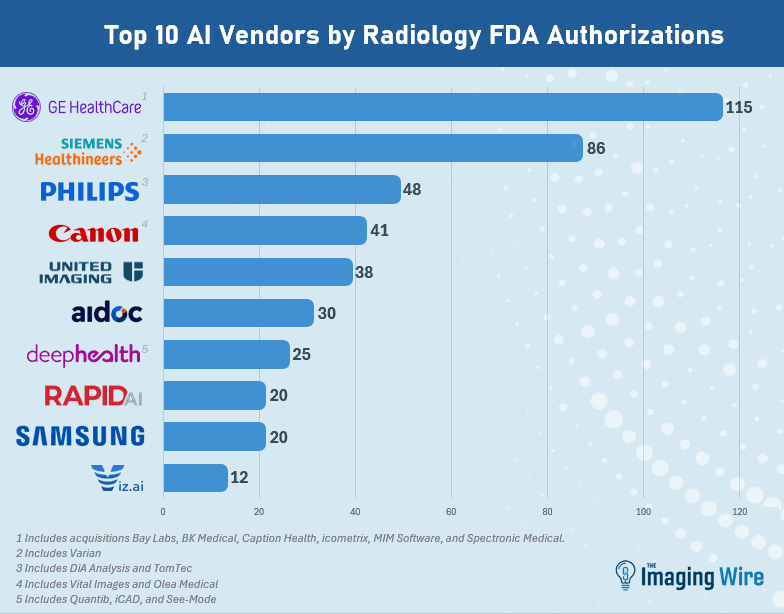
  • GE HealthCare retains the top spot as the company with the most radiology AI authorizations, at 115 (including recent acquisitions Bay Labs, BK Medical, Caption Health, MIM Software, icometrix, and Spectronic Medical).
  • Next is Siemens Healthineers at 86 (including Varian), then Philips at 48 (including DiA Analysis and TomTec), Canon at 41 (including Vital Images and Olea), United Imaging at 38, and Aidoc at 30. 

As always, it’s worth noting that the FDA’s list includes not only standalone software applications, but also imaging equipment that might have AI applications embedded into it, such as a mobile X-ray system with AI algorithms for detecting emergent conditions. 

  • Also, the agency noted that it is exploring ways to identify and tag AI-based devices that use foundation models and large language models. The FDA has yet to approve an LLM-based medical device.

The Takeaway

The new numbers indicate that radiology’s dominance of medical AI continues. But they also show that the FDA has returned to a regular twice-yearly cadence of updating its list of AI-enabled medical devices after a break of nearly a year – news that’s welcome to AI developers.

Radiology AI Approvals Near 1k in New FDA Update

The FDA last week released the long-awaited update to its list of AI-enabled medical devices that have received marketing authorization. The closely watched list shows the number of AI-enabled radiology authorizations approaching the 1k mark.

The FDA has been tracking authorizations of AI-enabled devices going back to 1995, and the list gives industry watchers a feel for not only how quickly the agency is churning out reviews but also which medical specialties are generating the most approvals.

  • But the last time the FDA released an updated list was August 2024, and recent turmoil at the agency had some observers wondering if it would continue the tradition – as well as whether it could stay on pace for new approvals.

Those fears should be assuaged with the new release. The numbers indicate that through May 2025 the FDA has…

  • Granted authorization to 1.2k AI-enabled medical devices since it started tracking.
  • Approved 956 AI-enabled radiology products, or 77% of total medical authorizations.
  • Radiology’s share of overall authorizations from January to May 2025 ticked up to 78% (115/148), compared to 73% in the 2024 update, and 80% in all of 2023.
  • GE HealthCare remains the company with the most radiology AI authorizations, at 96 (including recent acquisitions like Caption Health and MIM Software), with Siemens Healthineers in second place at 80 (including Varian). 
  • Other notable mentions include Philips (42 including DiA Analysis), Canon (35), United Imaging (32), and Aidoc (30). 

In a significant regulatory development, the FDA said it was developing a plan to identify and tag medical devices that use foundation models, including large language models and multimodal architecture. 

  • The agency said the program would help healthcare providers and patients know when LLM-based functionality was included in a medical device (the FDA has yet to approve a medical device with LLM technology). 

In another interesting change, the FDA dropped “machine learning” from the title of its list, apparently with the idea that “AI” was sufficient as an umbrella term. 

The Takeaway

The FDA’s release of its AI approval list is a welcome return to past practices that should reassure agency watchers that recent turmoil isn’t affecting its basic operations. The LLM guidance suggests the agency may be changing its approach to the technology in favor of disclosure and transparency instead of more stringent regulation that could delay some LLM solutions from reaching the market.

Get every issue of The Imaging Wire, delivered right to your inbox.