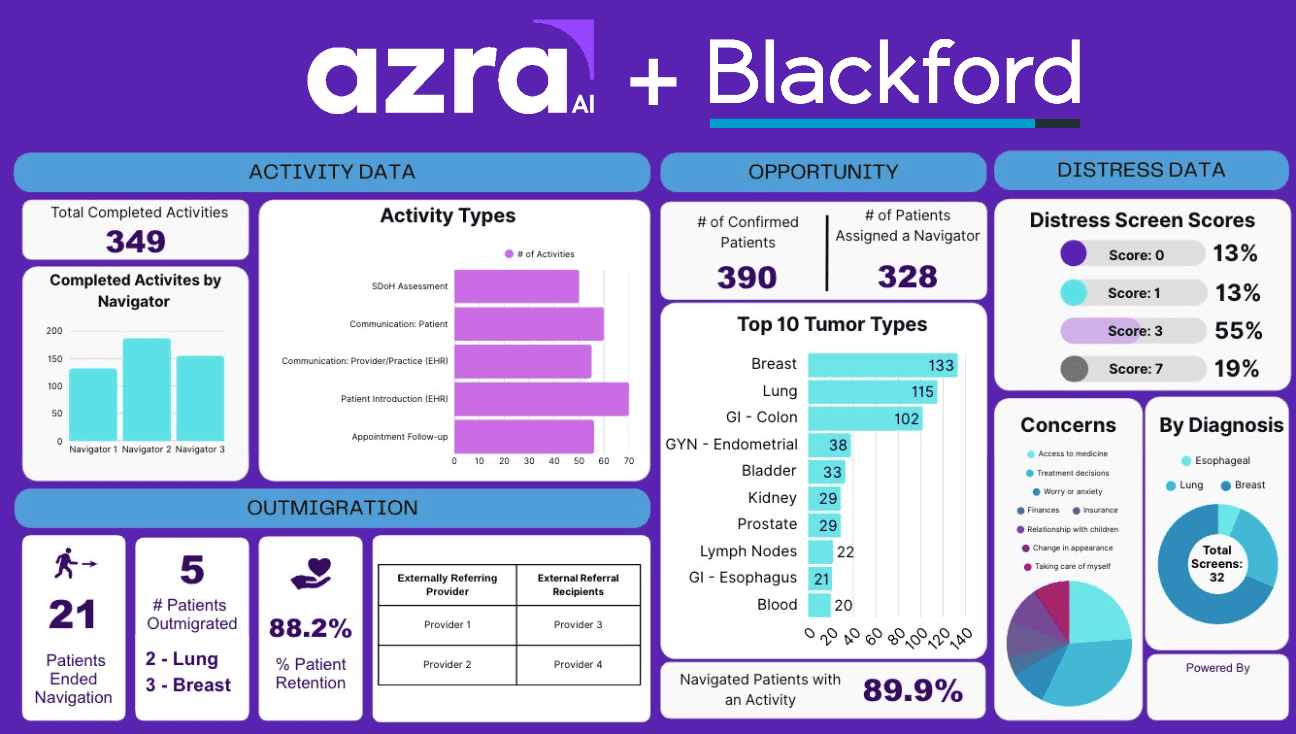
Azra AI’s Blackford Plans

What are Azra AI’s plans for its new acquisition, AI platform company Blackford Analysis? Azra AI sees Blackford as a key piece in its effort to leverage artificial intelligence to ensure that patients with incidental findings or a cancer diagnosis don’t fall through healthcare’s cracks. 

Azra AI announced on October 9 that it would be merging with Blackford after Azra’s primary investor, private equity firm Sopris Capital, acquired the Scotland-based platform AI company. 

  • The announcement capped a year of uncertainty for Blackford that began in September 2025, when parent company Bayer announced it was stepping away from the digital platform business. 

In an interview with The Imaging Wire, Azra AI CEO John Marshall described the factors that attracted the company to Blackford…

  • A large stable of about 135 AI algorithm companies on Blackford Platform.
  • Strong relationships with OEM companies, for whom Blackford provides its AI orchestration platform on a white-label basis.
  • Contracts with major U.S. health systems, including the Veterans Health Administration. 

But who is Azra AI? The company offers solutions for one of the biggest challenges in healthcare – tracking patients with incidental findings or a diagnosis like cancer and managing their care. 

  • Azra AI emerged in 2022 after Sopris Capital funded the acquisition of healthcare assets from Digital Reasoning. The company got a major boost earlier this year when it acquired Thynk Health, which developed software for performing CT lung cancer screening and tracking incidental findings.

Marshall is a longtime imaging industry veteran (he attended his first RSNA at age 23) who took the helm at Azra AI in 2024, and since then revenues have grown 12X.

  • Patients with incidental findings or a cancer diagnosis are often lost to follow-up care, but Azra AI’s software helps bring them into an organized system where they can be followed and tracked. Where implemented, it has boosted patient retention rates for various conditions from 43%-69% to 90%-96%. 

One of the combination’s immediate advantages is synergy – patients flagged for a disease by a point-source algorithm on Blackford Platform can then be directed to Azra AI solutions for follow-up care. 

  • What’s more, Azra AI will now be able to sell its oncology tracking software to Blackford customers – both OEMs and healthcare providers.

Despite the turmoil of the past year, Marshall said Blackford’s team deserves praise for keeping the lights on and the servers humming. 

  • “The team that was there did a Herculean job,” he said. 

The Takeaway

Azra AI’s takeover of Blackford raises exciting prospects for the radiology AI sector, uniting point-source AI available through Blackford with Azra AI’s patient tracking expertise. It’s a synergy that looks set to leverage the power of AI for better patient care. 

Blackford Finds Buyer with Sopris Acquisition

One of radiology’s longest-running mysteries was resolved late last week when a U.S. private equity firm acquired AI platform company Blackford Analysis from Bayer. Sopris Capital said it would fold Blackford into another radiology AI property it owns, Azra AI, as it builds its healthcare technology portfolio. 

The news comes just over a year after Bayer made the stunning announcement that it was backing away from the AI platform business and would “discontinue offerings and services” in the sector, including Blackford. 

  • The move reversed several years of Bayer’s investment in digital platforms, including the company’s own Calantic Digital Solutions division, which had been formed in 2022. 

The announcement left Blackford twisting in the wind. Some industry experts questioned the long-term viability of the AI platform model, in which platform companies act as middlemen between algorithm developers and end-users, adding a markup that made AI deployment more expensive. 

  • But others still see AI platforms and algorithm orchestration as a necessary foundation for successful AI deployment, especially given the explosion of clinical algorithms and the complexity of IT integration.

For its part, early reports following last year’s Bayer announcement suggested that Blackford’s business model was sound, with the company reporting a strong pipeline of prospective customers. 

  • And despite the departure of key executives like founder Ben Panter, Blackford continued operations under new managing director James Holroyd. The company even exhibited at SIIM 2026 – not exactly a sign of a firm about to go under. And not long after SIIM, Blackford announced a new partnership with Azra AI – perhaps a portent of last week’s announcement. 

So what do we know about Sopris? With its main offices in Colorado and Florida, Sopris first invested in Azra AI in 2022 to help the company acquire Digital Reasoning and expand into oncology. 

Sopris sees the Blackford acquisition as adding an AI orchestration capability to its growing imaging IT portfolio, combining Blackford with Azra AI. 

  • Blackford will remain a separate legal entity with operations in Scotland and the U.S., and will continue serving its existing OEM partners and health system customers “with no disruption to current deployments or operations.” 

The Takeaway

The Sopris acquisition of Blackford means that one of the radiology AI sector’s most established companies will continue operations for the foreseeable future. It also raises the intriguing prospect that a new player is entering the game to drive AI consolidation. 

Bayer Establishes AI Platform Leadership with Blackford Acquisition

Six months after becoming radiology’s newest AI platform vendor, Bayer accelerated its path towards AI leadership with its acquisition of Blackford Analysis.

The acquisition might prove to be among the most significant in imaging AI’s short history, combining Blackford’s many AI advantages (tech, expertise, relationships) with Bayer’s massive radiology presence and AI ambitions. 

After closing later this year, Blackford will operate independently through Bayer’s well-established “arm’s length” model, allowing Blackford to preserve its entrepreneurial culture, while leveraging Bayer’s “experience, infrastructure and reach” to drive further expansion.

Bayer’s Calantic platform and team will operate separately from Blackford, providing Bayer customers with two distinct AI platforms to choose from, while giving Bayer two ways to drive its AI business forward. 

Although few would have predicted this acquisition, it makes sense given Bayer and Blackford’s relatively long history together and their complementary situations. 

  • Blackford was part of Bayer’s 2019 G4A digital health accelerator class
  • The companies have been working together to develop Calantic since 2020
  • Bayer has big AI goals, but its AI customer base and reputation were unestablished
  • Blackford’s AI customer base and reputation are solid, but it needed a new way to scale and a positive exit for its shareholders

Even fewer would have predicted that imaging contrast vendors would be the driving force behind AI’s next consolidation wave, noting that Guerbet invested in Intrasense just last week. However, imaging contrast and imaging AI could serve increasingly interrelated (or alternative) roles in the diagnostic process, and there’s surely advantages to being a leader in both areas for Bayer and Guerbet.

Speaking of AI consolidation, it appears that all those 2023 AI consolidation forecasts are proving to be correct, while bringing some of radiology’s largest companies into an AI segment that’s historically been dominated by startups. It wouldn’t be surprising if that trend continued.

The Takeaway

Bayer and Blackford have been working on their AI strategies for years, and this acquisition appears to give both companies a much better chance of achieving long-term AI leadership. Considering that AI is still in its infancy and could eventually play a dominant role in radiology (and across healthcare), AI leadership might be a far more significant market position in the future than many can imagine today.

Get every issue of The Imaging Wire, delivered right to your inbox.