A federal push to alleviate the U.S. physician shortage by adding more resident training slots appears to have skipped radiology. Of the more than 400 residency programs awarded funding so far, only two diagnostic radiology programs got funds.
The ongoing doctor shortage has become a major issue in U.S. healthcare, as physicians face rising patient volume from an aging population with a workforce that’s largely stagnant.
- Physicians are already experiencing high burnout rates, and the Association of American Medical Colleges predicts there will be a shortage of as many as 86k doctors by 2036.
Part of the problem is that physician training is tightly controlled in the U.S. Residency programs get most of their funding from Medicare, and there’s been a cap on the number of slots Medicare can fund since 1997.
- So it takes an act of Congress – literally – to get more money to add residency slots.
That’s actually happened in recent years, with federal budget bills in 2021 and 2023 specifically allocating more money for Direct Graduate Medical Education to help train more residents through what’s commonly known as Section 126.
- In all, the legislation is funding 1.2k new residency slots, with the positions released through five rounds of funding.
But the fourth round of new resident positions under Section 126, announced in December, skipped diagnostic radiology entirely.
- A list of the new positions by Becker’s Hospital Review found no diagnostic radiology slots added to U.S. resident training programs, while 20 interventional radiology positions were added.
And over the course of the Section 126 program, only 0.5% of residency programs getting funding were diagnostic radiology.
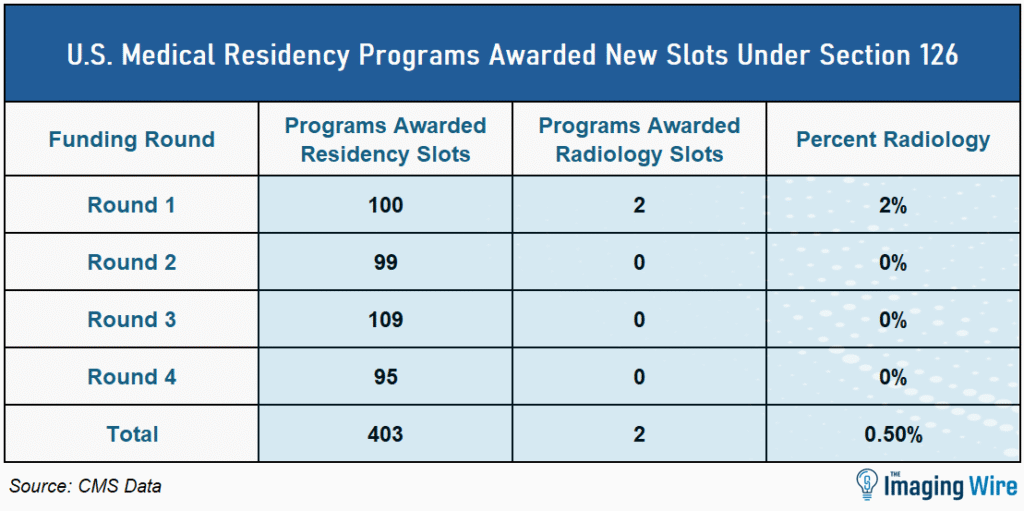
It’s unclear how the omission occurred. Hospitals with resident training programs have to apply for the additional funding, and it’s possible that diagnostic radiology’s low (or nonexistent) numbers simply reflect fewer DR applications.
- But it’s widely known that the federal government has prioritized training primary care physicians, as well as hospitals in rural areas. Indeed, being in a rural area or health professional shortage area are two of four ways for residency programs to qualify for Section 126 funding.
Legislation currently languishing in Congress – the Resident Physician Shortage Reduction Act of 2025 – would add 14k residency positions over the next seven years.
- But even such a large expansion in residency training won’t help medical imaging much if diagnostic radiology continues to get passed over when allocating new positions (the application period for the fifth and final round just opened).
The Takeaway
The fact that diagnostic radiology is getting skipped over in Section 126 residency funding shows that there’s no cavalry coming over the hill to help the specialty deal with its workforce shortage. Help will have to come from somewhere else, be it AI, teleradiology, or some other kind of technology.