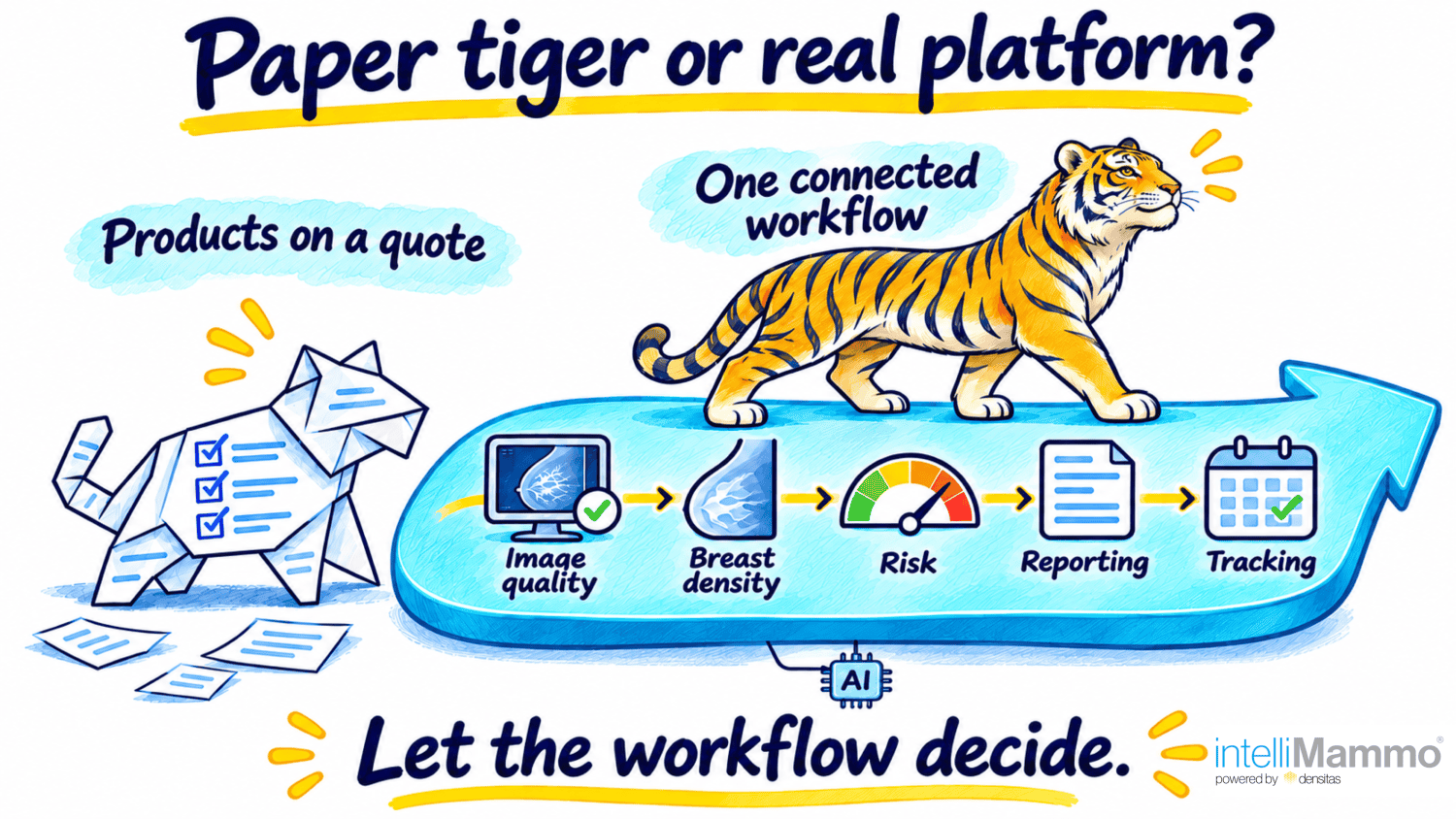
One quote can make a technology stack look complete. But “end-to-end” on paper says little about daily breast imaging work.
If staff must re-enter information, reconcile competing worklists, and chase results between applications, the customer becomes the integration layer.
That is the paper tiger: comprehensive in the proposal, fragmented in practice.
A purposefully architected platform starts with workflow. A unified codebase, shared data model, and consistent logic provide the foundation for information and responsibility to move together. Its value comes from dependable handoffs and less work connecting the pieces.
- In breast imaging, image quality informs interpretation, findings shape recommendations, and risk assessment informs care planning. Follow-up requires an owner and a way to confirm what happened.
Workflows rule. AI is a powerful supporting actor.
AI belongs where it helps the customer’s team…
- Assessing positioning during acquisition for synchronous learning.
- Providing actionable post-acquisition analytics for coaching, training, operational efficiency, and ACR and FDA MQSA EQUIP compliance.
- Supplying breast density results during interpretation and for ACR image selection.
- Supplying breast cancer risk results during interpretation to triage patients to high-risk clinics.
- Flagging reporting inconsistencies for review.
- Supporting patient follow-up and management.
Placement should follow workflow; clinical judgment remains with the care team.
The same applies to specialist and enterprise systems.
- Electronic health records, imaging archives, scheduling, and billing systems provide essential infrastructure.
A specialist breast imaging platform – boosted by an AI engine – should build on those investments, contribute deeper capabilities, and return useful information.
Enterprise systems should accommodate that expertise without recreating every specialty function…
- Avoid duplicate data entry, competing processes, and conflicting patient communications. Agree where tasks belong and how information moves.
- Demand unity within the specialist platform and cooperation across the enterprise.
- Test both across the complete patient journey: acquisition/quality, risk/density, reporting and tracking.
Ask your teams the following questions:
- Clinical teams: Can we move from finding to action without chasing information?
- IT teams: Can we maintain, update, and scale the platform without repeatedly repairing connections?
- Administrators: Can we see outstanding care, capacity, access, and accountability?
Include an amended report and an overdue follow-up. Watch the handoffs, not just the screens.
The Takeaway
The paper tiger may check the boxes. But the real tiger delivers when work gets complicated. Buy the workflow. Demand architecture that supports it. Let AI supercharge it.