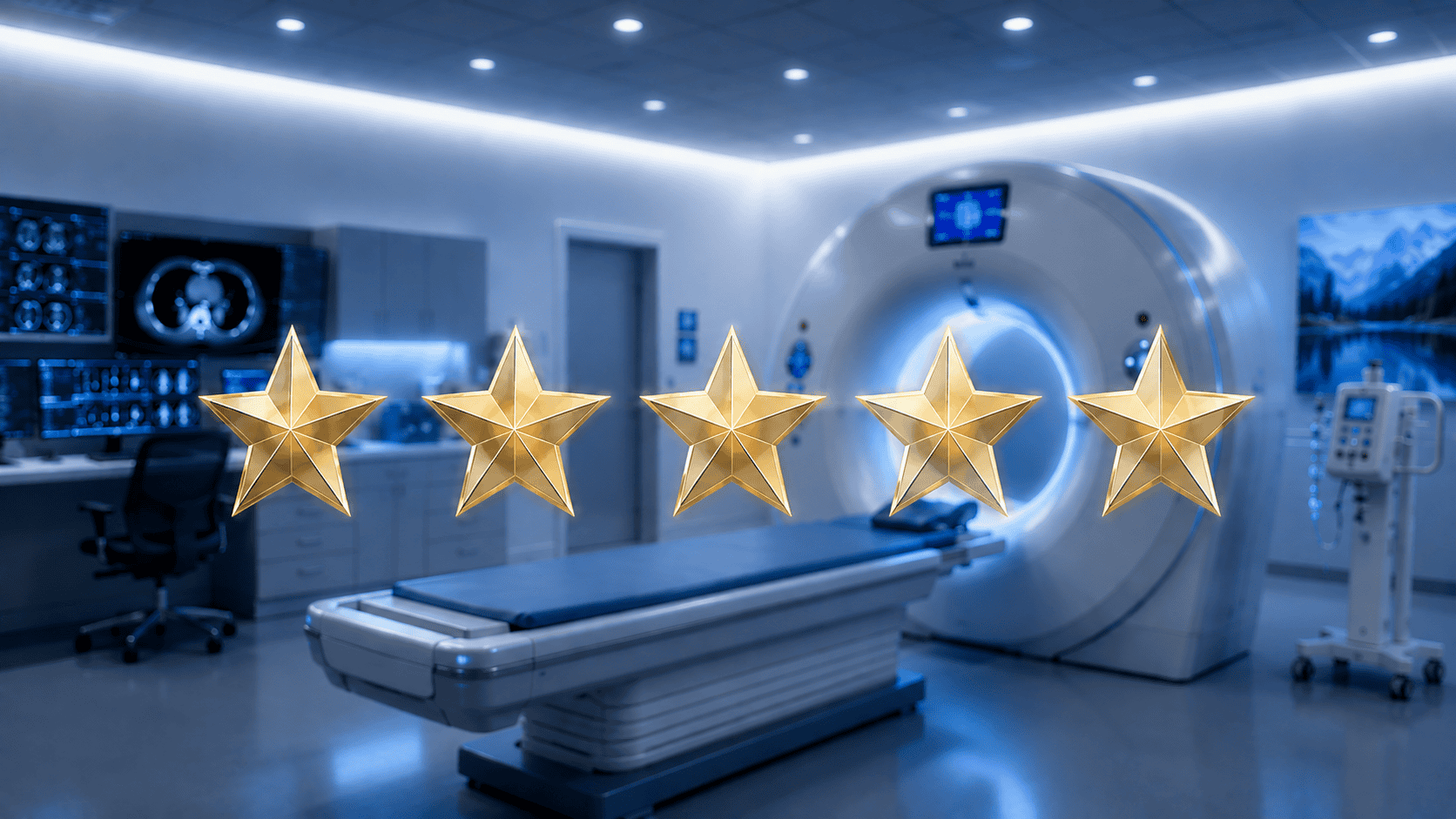
As radiology strives to reduce CT radiation dose, one of its challenges is maintaining image quality while keeping dose low. A new five-star system for rating images is described in a new paper in EJR and could offer a solution by establishing an easy-to-understand global metric.
The radiology community has been making progress in reducing CT radiation dose, but much work remains to be done.
- In particular, radiology professionals struggle between the desire for better-looking images – which usually result from higher radiation dose – with low-dose images that may be noisier but are good enough to make a diagnosis.
While there are lots of metrics for measuring radiation dose, image quality doesn’t have a widely recognized scale.
- So a team from the IAEA and MGH worked together to develop one, based on the widely recognized five-star paradigm for ranking consumer-facing businesses.
In an interesting wrinkle, the five-star system acknowledges the dose dilemma, essentially penalizing images in which too much radiation dose was used to produce an image that’s crisper than what’s needed for diagnosis.
- On the other hand, the system rewards images that might be noisy due to use of less radiation, but that are still diagnostic.
The system’s ratings are as follows…
- Five stars – Acceptable, despite high image noise associated with low-dose CT.
- Four stars – Acceptable for all parts within the region of interest.
- Three stars – Acceptable, despite unintended high noise and/or some artifacts.
- Two stars – Excellent quality with unjustifiably low image noise and no artifacts.
- One star – Non-diagnostic, due to excessive noise or artifacts, or poor contrast.
To test the rating scale, IAEA and MGH researchers performed a study at six hospitals across five European countries.
- CT scans of 2.7k adults were acquired, and three radiologists per hospital were trained in the five-star scale and scored the images to see how reader subjectivity affected the scoring.
The study found…
- Reader concordance was up to 93% at some sites, indicating little variability in scoring.
- Overall discordance was rare, at 1.6%.
- The two-star ratings (in which too much radiation was used) were associated with higher radiation dose in nearly all patient weight groups.
The Takeaway
The new study shows that a five-star system for rating CT image quality is feasible and can reveal cases of unnecessarily high radiation dose. The question is whether the system remains an interesting thought experiment, or if it becomes an integral part of radiology’s effort to better manage radiation.