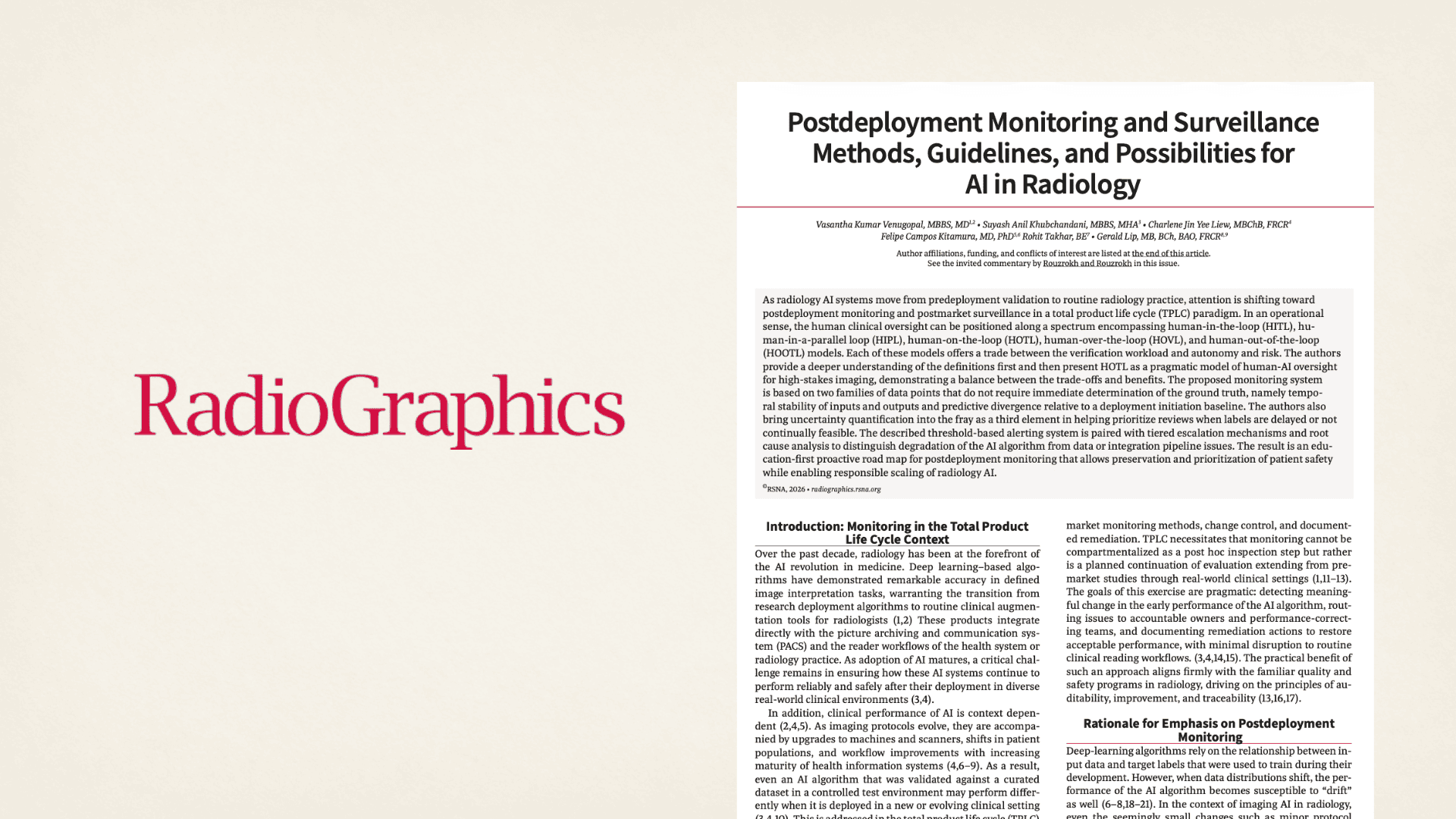
AI has its skeptics and superfans when it comes to interpreting medical images, inspiring a wide range of approaches to checking its work, but a new RadioGraphics paper argues the right level of oversight lies somewhere in the middle.
There’s a strong consensus on the importance of monitoring AI post-deployment, even as the right level of rigor remains an open question.
- The FDA and many of its global peers require institutions to track AI performance, implement human oversight, and have a corrective action plan.
- Past studies show oversight mechanisms are top of mind for many radiologists.
The international researchers behind the article say a human-on-the-loop (HOTL) model is the sweet spot for radiology departments as they balance safety and reliability with efficiency.
- Under this framework, radiologists don’t have to review every AI output.
- At the same time, the proposed model doesn’t take AI results at face value.
- HOTL threads the needle by alerting humans to drift and accuracy problems.
- If performance drops, the work of reading these scans reverts to radiologists.
The model acknowledges that even the most cleverly designed radiology algorithms can be sensitive to changing inputs.
- Scanner upgrades, workflow adjustments, and shifts in patient mix can leave AI that aced training tests out of step with clinical realities.
HOTL has its perks, but the authors note a few challenges.
- Excessive alerts risk desensitizing monitoring teams, so it’s important not to set the notification threshold too low or treat minor deviations as urgent.
- Declines in subgroup performance can go unnoticed if overall metrics stay stable.
The Takeaway
For radiology departments, the ideal AI oversight plan protects patients without making the technology more trouble than it’s worth. It seems the HOTL system outlined in RadioGraphics checks those boxes by focusing on trends over individual outputs. Even so, the debate over how to best supervise AI is sure to remain lively.