The growing importance of theranostics was on display at this year’s annual meeting of the Society of Nuclear Medicine and Molecular Imaging in Los Angeles. New data on theranostics agents in development dominated the scientific sessions, while on the diagnostics side a proliferation of new PET radiotracers promises to go beyond FDG.
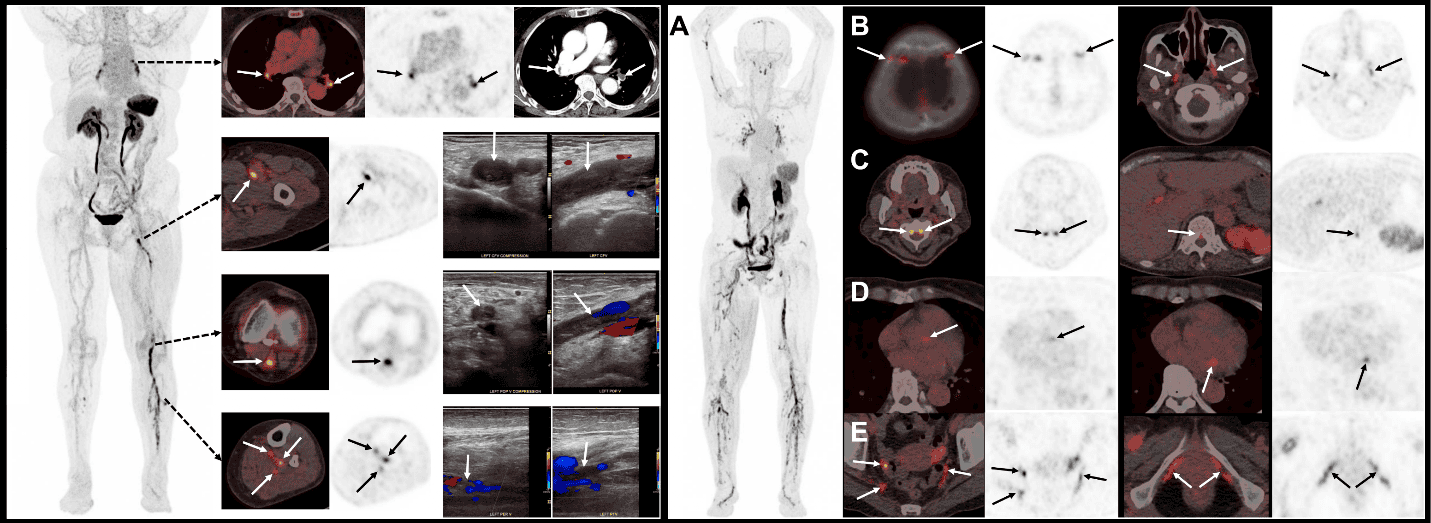
The selection of SNMMI’s Image of the Year went to South Korean researchers for their work on the radiotracer 18F-GP1 PET/CT to identify acute lower extremity deep vein thrombosis.
- In a study with 46 symptomatic patients, the tracer showed high diagnostic accuracy for detecting clots not only in the thigh but also in the calf, and had a high detection rate of pulmonary embolism occurring together with DVT.
Meanwhile, the Abstract of the Year award was given to a study using PET to link brain metabolism patterns to the effectiveness of treatments for Alzheimer’s disease.
- UCLA researchers performed FDG-PET brain scans on 124 patients being considered for anti-amyloid therapy. Those whose scans suggested Alzheimer’s disease and who got therapy had higher cognitive scores at one year compared to patients whose PET scans didn’t show evidence of Alzheimer’s.
Other SNMMI 2026 highlights included…
- FDG-PET/CT scans showed that patients who got bariatric surgery had metabolic changes across multiple organs that correlated with improved clinical markers.
- A new PET tracer, gallium-68 RCC78, was able to detect clear cell renal cell carcinoma and identified additional metastatic lesions missed by standard imaging.
- A first-in-human study with a novel PET radiotracer, carbon-11 nevanimibe, was presented for imaging patients with overactive adrenal glands.
- In patients with metastatic neuroendocrine tumors, a new type of peptide receptor radionuclide therapy with actinium-225 DOTA-LM3 showed promise.
- PSMA-PET scans showed that prostate cancer patients with just one to five bone metastases had much worse outcomes than patients with no metastases.
- A novel approach with two PET radiotracers during cancer treatment detected both tumor progression and cardiac inflammatory response.
- A novel PET tracer, fluorine-18 OXD-2314, showed promise for detecting chronic traumatic encephalopathy in living patients.
- An AI algorithm using data from pre-therapy PET/CT scans predicted radiation dose in lutetium-177 PSMA treatment for prostate cancer.
The Takeaway
This year’s SNMMI 2026 highlighted the exciting evolution of theranostics, from a niche treatment used mostly when other therapies failed to a major step on the road to personalized medicine – and better patient care.