|
Mardini’s New Startup, CT Radiation Dose, and AI for MRI and Echo
November 5, 2026
|
|
|

|
|
Together with
|

|
|
|
“I put a recently published research paper in a top subspecialty journal into ChatGPT for Clinicians and it found at least 6 significant errors … Authors and journals that don’t use AI to check for basic errors are going increasingly to find themselves with their pants down in post-publication review.”
|
|
Radiology educator Francis Deng, MD.
|
|
|
|
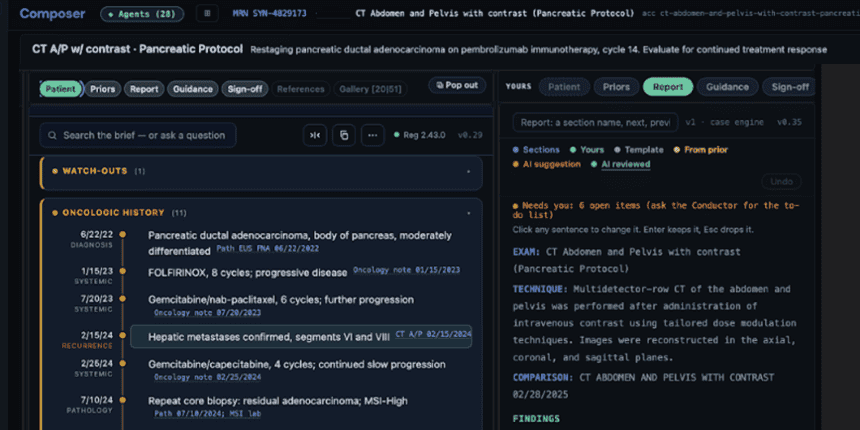
The imaging informatics entrepreneur who helped drive radiology’s transition to speech recognition is returning with a new start-up. Michael Mardini is bringing Vware.ai out of stealth to commercialize technology created at Mass General Brigham for developing and deploying agentic AI.
Mardini’s roots in radiology go back decades, and he’s been involved in at least three startups that had successful exits…
- Talk Technology, an early developer of speech recognition and workflow applications acquired by Agfa HealthCare in 2001.
- Commissure, a radiology reporting developer acquired by Nuance in 2007. Nuance used Commissure’s RadWhere as the foundation for PowerScribe 360, which came under Microsoft’s umbrella with its 2022 purchase of Nuance.
- National Decision Support Company (NDSC), a developer of clinical decision support software acquired by Change Healthcare in 2018.
All of Mardini’s ventures have focused on improving radiologist productivity, which remains an issue given rising imaging volume and a stagnant workforce.
- Speech recognition-based reporting created a leap in radiologist productivity, and Mardini sees a similar jump possible with agentic AI, especially as many healthcare providers are creating their own AI agents.
But developing and deploying AI agents often involves significant IT complexity. And that’s where Vware comes in.
- Vware has taken technology developed at Mass General Brigham’s MGB AI division under the purview of Keith Dreyer, DO, PhD, and is adapting it for the commercial market as Composer IQ. Mardini and Dreyer discussed the new venture in an interview with The Imaging Wire.
Dreyer likens the technology behind Composer IQ to an agentic AI builder and orchestration platform that not only hosts AI agents but also enables subject-matter experts – like radiologists – with no programming experience to develop agents for their own use.
- There are already hundreds of agents running within Composer IQ, including Case Engine, which loads relevant patient data radiologists need for interpreting images. Other agents are available for tasks like reading coronary artery calcium scans, billing optimization, and case reporting.
Vware plans to offer Composer IQ directly to radiology facilities as well as through partnerships with PACS and AI companies. The firm will be discussing the technology at the upcoming RSNA 2026 (although it won’t be exhibiting).
The Takeaway
Will lightning strike a fourth time for Michael Mardini and Vware? Only time will tell, but there’s no question that by focusing on agentic AI, he’s once again targeted one of the hottest areas of radiology for his latest entrepreneurial venture.
|
|
Experience the Platform for the Future at RSNA
Visage is not only leading imaging’s move to the cloud, they’ve defined it. Book a priority demo with them at RSNA 2026 or visit Booth #4329 to experience the platform for the future – powered by speed.
|
|
See What Matters Most
Visit GE HealthCare at RSNA 2026 to explore innovations across imaging, AI, software, services, and pharmaceutical diagnostics. Connect with experts, experience demonstrations, and discover new technologies by requesting a meeting today, or visit Booth #7330.
|
|
AI-Enabled Data Migration
Laitek’s Migratek platform is a trusted solution for DICOM data migration that’s been significantly enhanced through Enlitic’s advanced ENDEX data standardization technology. Learn more about the future of data migration on this page.
|
|
- Study Reveals Variation in CT Radiation Dose: We’ve long known that CT radiation dose can vary widely between facilities, but a new JACR study details just how much. Researchers tracked dose reported under the Medicare ExRad measure for excessive radiation dose across 254 sites and 783.6k scans. They found that 31% of scans exceeded the radiation thresholds for certain exams, and at some facilities 90% of scans exceeded acceptable ranges. Meanwhile, only 0.06% of scans fell short on image quality – meaning there’s plenty of room to cut dose.
- AI of Cardiac MRI Predicts Mortality: An AI algorithm that measured ejection fraction from cardiac MRI scans was more accurate than doctors in predicting all-cause mortality in a new study in The Lancet Digital Health. Researchers used the 1CMR algorithm from MyCardium AI to analyze scans from 27.4k patients in the U.S. and U.K., finding that AI produced “marginally superior” mortality prediction over more than five years than ejection fraction measurements from clinicians. AI also produced estimates much faster than clinicians (2-3 seconds vs. 13 minutes).
- Study Supports AI for Rural Echo Scans: An echocardiography AI algorithm helped non-expert healthcare practitioners perform scans in rural areas in research to be presented at AHA 2026. In the RURAL study of 4.6k adults, GE HealthCare’s Caption Guidance algorithm was used by 14 non-sonographers (nurses, nursing assistants, CT technologists) who got two-hour training sessions in a mobile health unit. In all, 98% of scans included all six standard echo views and 99% were rated as “adequate” by experts. Median scan time was 9.5 minutes – within targets.
- GE Debuts New Angio System: GE HealthCare debuted a new interventional angiography system at this week’s TCT 2026 conference. Allia Celeo is a ceiling-mounted angio system that features an extra-wide C-arm bore that enables the system to rotate freely around the patient and reach steep angulations. The system also sports an AI-powered imaging chain that includes automatic adjustment of acquisition parameters to deliver consistent image quality at low radiation dose. It also supports GE cardiac imaging protocols like StentViz, 3DStent, and Valve ASSIST 2.
- Angio FFR Measures Up for Revascularization: Angiography-derived fractional flow reserve worked as well as more invasive wire-based FFR for guiding coronary revascularization in the LIPSIA-STRATEGY study in JACC. German researchers tested Pie Medical Imaging’s CAAS vFFR angio FFR software, and among 1.1k people with intermediate coronary stenoses randomized to either technique, those getting angio FFR had slightly lower rates of MACE at one year (3% vs. 4.1%). MACE rates were lower than expected in those getting angio FFR.
- Elucid Touts FFR-CT Study at TCT 2026: An even less invasive way to generate fractional flow reserve measurements is with CT, and FFR-CT developer Elucid highlighted results from the ELUCIDATE study of its FFR-IQ software at TCT 2026. In 347 patients, FFR-IQ had 92% sensitivity and 93% specificity compared to pressure-wire FFR, with vessel-level diagnostic accuracy of 93%. Elucid in particular touted FFR-IQ’s accuracy in the “gray zone” of FFR values from 0.75 to 0.85, a physiological area of uncertainty in patients with moderate stenosis.
- Philips Releases Fixed-Room HyperVue System: Philips used this week’s TCT 2026 as a springboard to launch a fixed-room version of the HyperVue intravascular imaging technology it acquired with its purchase of SpectraWAVE in January 2026. HyperVue combines optical coherence tomography (OCT) with near-infrared spectroscopy (NIRS), and the new configuration will make OCT and NIRS available within a fixed interventional room that’s also capable of angiography-derived fractional flow reserve with SpectraWAVE’s X1-FFR technology. The combination should give clinicians more flexibility for coronary interventional procedures.
- Cleerly Updates Cardiac Analysis Software: Cleerly is announcing several software updates this week. The FDA cleared an updated version of its Cleerly LABS analysis software, and Cleerly also got the FDA’s nod for the latest generation of its PLAQUE AI algorithm. The new version of PLAQUE was trained on a more diverse dataset from the CONFIRM2 trial that added a cohort comprising 50% women as well as a cohort of 6.6k people from 46 countries. The updates will be available in November to Cleerly users.
- Lags in Malpractice Payment Payouts: A new JACR analysis tracking the lag between when a malpractice event allegedly occurred and when patients got paid found nearly half of claims took longer than five years. Across 2k reports with imaging-related malpractice allegations, the median time to payment was four years, and 47% took ≥ 5 years. The long delay means that malpractice payments are a poor yardstick for measuring a practice’s current quality, and instead established QA safety measures like ensuring timely patient follow-up should be used.
- FDA Clears United PET/MRI Scanner: The U.S. market for PET/MRI has a new entrant after United Imaging got clearance for uPMR Zenith, a hybrid scanner the company debuted at SNMMI 2026. Like other PET/MRI systems, the scanner enables users to perform both molecular and anatomic imaging, and United Imaging simplified scanning with one-button whole-body exams and grouped scan protocols. The system’s 3T MRI component can be used for attenuation correction for PET quantification and tissue segmentation. The company will highlight uPMR Zenith at RSNA 2026.
- HHS Launches Dense Breast Project: HHS’ Office on Women’s Health (OWH) is partnering with DenseBreast-info.org (DBI) on a project to improve detection of breast cancer in women with dense breast tissue. The two are collaborating on the OWH-AHRQ Breast Cancer Screening and Diagnostic Follow-Up Initiative to analyze national screening and follow-up patterns, with over 40 health systems participating. The partnership also includes development of new educational materials to help women understand their breast cancer risk.
- Sectra Lands First U.S. Reporting Contract: Sectra landed the first U.S. contract to install its new reporting solution. Mount Sinai Health System in New York City will add the Sectra Reporting native reporting module to its existing Sectra One Cloud network. The addition will enable Mount Sinai radiologists to go from worklist to signed report in one seamless experience, without having to switch between applications. The agreement is a seven-year contract with go-live planned for spring 2027.
- RapidAI Adds to Platform: RapidAI added solutions from several AI developers to its Rapid Enterprise Platform for AI orchestration. RapidAI users will gain access to Neurophet’s brain imaging analysis solutions, Neurophet AQUA AD Plus and Neurophet SCALE PET for Alzheimer’s disease, as well as Neurophet AQUA MS for detecting multiple sclerosis on MRI. In addition, AZmed’s AZtrauma for trauma musculoskeletal indications on X-ray and AZchest for thoracic radiography applications are now available through RapidAI.
- Penn Tests Percival CT VLM: Researchers from the University of Pennsylvania hope their new Percival open-source CT vision language model has potential for opportunistic screening. In a proof-of-concept study in npj Digital Medicine, they applied Percival to CT scans from 50k patients in the Penn Medicine BioBank database, finding that the VLM was able to detect traces of chronic conditions like atrial fibrillation and chronic kidney disease and was more reliable than the TotalSegmentator AI model for pancreatic cancer, cirrhosis, and bacterial pneumonia.
|
|
Bring Your Hardest Imaging Question to Chicago
Mach7 Technologies delivers your imaging data, working for patient care. Everywhere it’s needed, ready for AI, under your control. You’ll find eUnity and the Mach7 vendor-neutral archive running live at RSNA 2026 – book a meeting or stop by Booth #4116.
|
|
Centered on Innovation. Shaped by Experience
Visit Fujifilm at RSNA 2026 to see how their advanced solutions built on over 90 years of medical imaging experience can help meet your imaging needs. Book a meeting or stop by at Booth #4100.
|
|
Is Sticking With Your Reporting Platform Really Safer?
Familiar technology isn’t always the safest choice. As AI transforms radiology reporting, discover why evaluating the risks of staying put matters just as much as switching. Read the blog.
|
|
- The Right Data, Ready When You Are: Kailo Medical will be at RSNA 2026 at Booth #5141 in the South Hall with four demo stations and a private room for team sessions. Request a time now to confirm a slot that fits your week in Chicago.
- Stop Optimizing Imaging. Start Transforming Operations: If better imaging alone solved staffing shortages, burnout, and turnaround times, radiology would not be facing today’s operational challenges. Discover how leading groups are solving problems PACS was never designed to address.
- See Mosaic Reporting live at RSNA 2026: Mosaic Reporting uses ambient AI and large language models to help radiologists create structured reports faster, alongside your existing PACS. Visit Booth #5304 in the South Hall AI Showcase or book a private demo on the Mosaic RSNA Event Hub.
- Automated Prior Retrieval with Medicom Smart Search: Electronic image exchange has made outside priors accessible. The work that remains is manual. Learn how Medicom Smart Search makes automated prior retrieval possible in this webinar on Tuesday, November 17 at 12 pm EST. Sign up today.
- Your RSNA Starts Here: Whether you’re visiting RSNA 2026 to solve a specific challenge or to explore what’s possible, Sectra’s team will be there for you. Book a demo to discover how their enterprise imaging SaaS solutions – including radiology reporting – can meet your imaging needs.
- How AI is Unlocking Opportunistic Screening: Routine imaging already contains preventive health information patients often never receive, and AI is making it possible to surface that data. Learn how CARPL can help you implement opportunistic screening on this page.
- Transform Imaging Data into Actionable Predictions: When you choose Quibim, you get more than a partner for detecting and diagnosing prostate cancer on MRI scans. Learn how they can help you transform imaging data into actionable predictions by booking a demo today.
- At the Center of Care at RSNA 2026: Imaging is at the center of countless clinical decisions. At RSNA 2026, explore how Intelerad is helping healthcare organizations connect imaging across the enterprise to support more efficient workflows, greater capacity, and better clinical decision-making. Schedule a meeting today.
- Help Patients Get the Right Care Sooner: Rising demand, limited time, and disconnected systems can make it harder to get the right care to patients. Discover how Philips’ latest radiology solutions can help at RSNA 2026. Reserve time with our experts or stop by Booth #6730.
- Connectivity Solutions at RSNA 2026: Visit Altamont Software at RSNA 2026 to learn more about their full portfolio of connectivity solutions, from Passport SR for capturing DICOM Structured Report measurements to eForms for eliminating paper-based workflow. Book a meeting today or stop by at Booth #7808.
- A New Standard of AI-Powered Care: Unify for your imaging experience with AI-powered solutions from DeepHealth. Book a demo today to discover the latest in integrated, cloud-native imaging and operations, or visit them at Booth #1329.
- Learn a New Subspecialty in 5 Minutes a Day: Become a faster, more confident radiologist with expert-led online video courses from Medality. Gain simulated practice with the largest collection of curated, scrollable DICOM cases available anywhere. Browse their library of radiology courses today.
- Heading to RSNA 2026? See how Scanslated’s solution – powered by real clinical expertise, not AI – turns confusing radiology reports into patient-friendly explanations, cutting through the misinformation and anxiety patients face interpreting reports alone. Schedule a virtual demo or book a time to stop by Booth #2809.
- United Imaging at RSNA 2026: At RSNA 2026, United Imaging will be featuring new technology in all modalities. You’ll be able to see the latest and greatest, review images, and meet leadership. Visit them at Booth #1932 to learn how their Passion for Change makes a difference.
- See Clearly. Decide Confidently: Streamline reading time, improve accuracy, and quantify population health metrics in cardiothoracic imaging with powerful AI tools from Riverain Technologies. See how their ClearRead solution works by booking a demo at RSNA 2026 or stopping by Booth #4741.
- Implementation Speed and Radiologist Burnout: Join Merge Chief Medical Officer Raj Chopra, MD, for a webinar on November 17 addressing how the speed of implementing imaging workflow solutions is fueling radiologist burnout – and what to do about it. Reserve your seat today.
- AI Echo for Hypertrophic Cardiomyopathy: Hypertrophic cardiomyopathy is a leading cause of sudden cardiac death in the young. It is now treatable in the era of cardiac myosin inhibitors, yet remains substantially underdiagnosed. Learn how AI echo with Us2.ai can help.
- Experience Imaging as One: At RSNA 2026, experience one unified enterprise imaging platform from AGFA HealthCare, bringing together workflow orchestration, streaming, cloud, AI, and interoperability. Book a meeting or visit them at Booth #2119.
|
|
|
|
|


