|
VA Probes Radiologist ‘Mass Exodus,’ FDA and Gen AI, and FDA Petition
August 20, 2026
|
|
|

|
|
Together with
|

|
|
|
“[T]he return to in-person work requirement was the ‘tipping point’ and contributed to the loss of radiologists. Specifically, the initial message that mandated a return to in-person work, ‘spooked’ the radiologists.”
|
|
VA OIG report on radiologist turmoil at the Washington DC VA Medical Center.
|
|
|
It seems like nobody’s happy with how the FDA is regulating AI these days … possibly even folks at the agency itself. But FDA staffers should look on the bright side – at least they’re not working at the VA right now. – Brian Casey, Managing Editor
|
|
|
|
A new federal investigation confirms that a “mass exodus” of radiologists occurred at the VA hospital in Washington, DC, causing a backlog of imaging exams. The departures occurred in response to “return-to-office” requirements implemented in the early days of the second Trump administration.
Reports began surfacing in late July of turmoil among VA radiologists that centered on the Washington DC VA Medical Center.
- The departures were linked to changing federal policies on remote work, which has become commonplace in radiology.
The VA supported remote radiology work dating back to the COVID-19 pandemic under a policy that began as a temporary measure and subsequently “became standard practice” as radiologists were allowed to work from home several days a week.
- Indeed, teleradiology and remote radiology interpretations “have become factors in employment decisions for many radiologists, influencing recruitment and retention strategies across the industry,” noted a report issued in early August by the VA’s Office of Inspector General (OIG) investigating the turmoil.
But all that changed on January 20, 2025, when a presidential memo was issued ordering heads of all federal departments and agencies to “take all necessary steps to terminate remote work arrangements and require employees to return to work in-person at their respective duty stations on a full-time basis.”
- This sparked the departure of most of the Washington DC VA’s diagnostic radiologists, as four of the facility’s five full-time radiologists – including the chief of radiology – resigned over the next six months.
The OIG report confirms that the return-to-office memo was a “tipping point” that “spooked” radiologists into leaving the Washington DC VA.
- While the VA later issued an exemption allowing remote work for radiologists, it wasn’t clear whether the exemption would be extended beyond one year, creating uncertainty and undermining the VA’s ability to recruit new radiologists.
The turmoil has had several ramifications…
- Body MRI scans were shut down in July 2025.
- A backlog of CT exams developed in September 2025.
- Imaging exams were sent out to community imaging centers.
- The delays created the risk of patient harm, with the OIG report identifying six patient cases of particular concern.
The Takeaway
The new OIG report on radiologist departures from the VA provides a stunning look at the turmoil caused within one VA hospital by misguided government policies. The question is whether the facility’s challenges in retaining radiologists are just the tip of the iceberg, and whether similar problems extend throughout the VA health system.
|
|
Power at the Point of Care
The uDR 380i Pro from United Imaging is a high-performing and agile mobile X-ray system with an ultra-narrow body design, a high-voltage generator, and the uVision Remote Console that redefines the workflow for point-of-care imaging.
|
|
AI Echo Reduces Reporting Time
AI-assisted reporting of echocardiography exams reduced preliminary reporting time by nearly 7 minutes per case. Read the study to find out how Us2.ai can help you speed up reporting turnaround times.
|
|
Why HealthPartners Has Relied On Merge for 20 Years
Over two decades, Health Partners has never wavered from Merge as their imaging solutions provider. Read this article to learn how their relationship transcends the typical vendor-client dynamic.
|
|
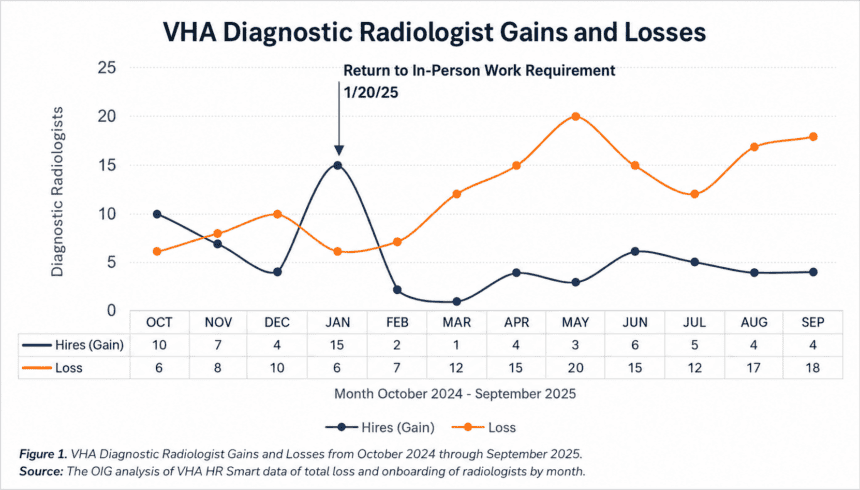
- The VA’s Growing Radiologist Gap: Just how many radiologists have left the Veterans Health Administration in the wake of the “return-to-office” debacle? A chart released by the VA’s Office of Inspector General (see above) provides some insight, showing a widening gap between monthly radiologist gains and losses since the January 2025 policy was announced. From January through September 2025, the VA system saw a net loss of 87 radiologists, representing 6% to 7% of the health system’s total workforce (estimated at 1.2k-1.5k radiologists).
- VA Hospital Hiring for Chief of Radiology: Meanwhile, the Washington DC VA Medical Center posted a job ad for a new chief of radiology to replace the previous chief, who left after the Trump administration banned remote work in federal offices. The requirements for the new position indicate that it is “telework eligible” on an ad hoc basis “as determined by the agency policy.”
- FDA Moves Toward Clarity on Gen AI: The FDA may be moving toward a clearer approach to how it regulates medical devices using generative AI. The agency this week published a discussion paper that outlines the considerations involved in a future regulatory approach, including risk assessment, AI evaluation, and lifecycle oversight, as well as foundation models and agentic AI. The agency has yet to clear any generative AI algorithms for radiology, although one company outside the specialty (UpDoc) claimed it was the first to get clearance, for its patient-facing generative AI algorithm.
- Mosaic’s FDA Petition on VLMs: Imaging vendors may be getting impatient waiting for the FDA to clarify its position on new AI technologies like generative AI and vision language models (VLMs). Mosaic Clinical Technologies this week filed a petition with the FDA asking the agency to “take action to clarify the regulatory status” of commercially available VLMs for medical image analysis. The FDA held meetings on generative AI regulation in November 2024, but no new rules have been forthcoming.
- Study Questions FDA AI Clearances: While we’re on the subject of AI regulation, a new paper in PLOS Digital Health questions the methodology the FDA uses to clear AI-enabled medical products. Researchers analyzed 1.4k authorizations for AI-based devices, finding that only 34 had been included in registered clinical trials, only 12 had results posted, and just three were tested on patient outcomes. “Clearance tells you a device resembles something already on the market. It does not tell you it helps anyone,” the authors concluded.
- Trump Aide Tapped to Lead FDA: President Donald Trump is expected to nominate Heidi Overton, MD, to lead the FDA, replacing the agency’s last permanent director, Marty Makary, MD, who resigned earlier this year after refusing to grant FDA authorization for vaping products. Overton is a physician specializing in public health and preventive medicine, and has served as a domestic policy aide to Trump since 2025. Overton will inherit an agency that’s seen significant turmoil over the past two years, including the loss of nearly 3k staffers.
- A Call to Action on AI in Radiology: A group of radiology key opinion leaders issued a call to action in Radiology for applying AI to address radiology’s challenges like workforce shortages and rising imaging volumes. In an expansive paper, the authors cover multiple aspects of AI deployment, such as the need for AI to improve radiologist productivity, grow diagnostic capacity, and create patient-friendly radiology content, while transforming radiology in the future by enabling opportunistic screening and multimodality data integration. It’s definitely worth a read.
- Fracture AI Boosts Sensitivity: Radiologists using Radiobotics’ RBfracture AI algorithm for fracture detection on X-rays saw an 11-percentage-point gain in sensitivity in a new study in Radiology. In a trial of 1.5k patients at three European hospitals, radiologists using RBfracture had higher sensitivity than those who didn’t (75% vs. 64%), with no statistically significant change in specificity. There was some variability between hospitals, however, in the algorithm’s ability to improve radiologist performance for wrist/hand and finger exams.
- Occupational Radiation Risks: As the U.S. government debates whether to relax rules on occupational radiation exposure, a new JAMA Internal Medicine study reiterates the risks of radiation. Flight attendants and pilots had the highest risk-adjusted percentage of deaths from radiation-related cancers (6.9% and 6.7%, respectively), just as they had the highest occupational exposure to ionizing radiation due to cosmic radiation from high-altitude flights. For reference, nuclear medicine technologists had the 12th highest mortality percentage of the 503 professions in the study.
- FDA Clears New CureMetrix Version: CureMetrix received FDA clearance for a new version of its cmAngio software that adds quantification to its core feature of breast arterial calcification (BAC) detection. cmAngio 2.0 provides quantified BAC scores based on analysis of screening mammograms, enabling clinicians to identify a woman’s cardiovascular risk opportunistically. The new version also places a woman’s BAC score in a clinical context through an age-based BAC percentile.
- 4DMedical Announces Azra Alliance: Lung imaging company 4DMedical inked yet another partnership, this time with Azra AI. Under the agreement, 4DMedical will resell Azra’s patient-identification and risk-management solutions to its nearly 400 global customers. 4DMedical’s imaging technology is now coordinated into a streamlined workflow that prevents at-risk patients from falling through the cracks. This collaboration is the newest in a string of big moves by 4DMedical, which recently partnered with RevealDx.
- FDA Approves Lantheus Alzheimer’s PET Agent: Lantheus received FDA approval for Tauklarify (florquinitau fluorine-18), a PET radiopharmaceutical for detecting tau neurofibrillary tangle accumulation related to Alzheimer’s disease in adults with cognitive impairment. Lantheus gained rights to the agent through its 2023 acquisition of Cerveau Technologies, which was developing it as MK-6240. The approval expands Lantheus’ portfolio of commercialized PET agents as it prepares to be acquired by Curium for up to $8B.
- Cortechs PET AI Gets Clearance: Clinicians are getting a new AI solution for analyzing PET exams following FDA clearance of NeuroQuant PET from Cortechs.ai. The algorithm provides automated quantification and regional analysis of PET data from amyloid tracers for assessing cognitive impairment and other neurological conditions, while also supporting structured reporting. NeuroQuant PET joins other applications in Cortechs’ portfolio like NeuroQuant for MRI.
|
|
Shifting the Stage in Lung Cancer Screening
Watch this video from Riverain Technologies to learn how their ClearRead CT solution for lung cancer screening can drive enrollment, earlier detection, and seamless management of incidental findings.
|
|
AI-Powered Referral Automation
Radiology teams are drowning in referrals, and a huge chunk of that burden is purely administrative. Kailo Medical built a solution to fix that: An AI-powered referral automation workflow that handles the full intake process. Find out how it works today.
|
|
More than an Image. The Big Picture
AGFA HealthCare understands that striking the critical balance between clinical efficiency and quality delivery of patient care starts with the clinician experience. Learn how their Enterprise Imaging platform makes the complex simple.
|
|
- A Next-Generation Oncology Ecosystem: Quibim has launched their next-generation oncology ecosystem platform. Find out how QP-Prostate provides a comprehensive, end-to-end management workflow for prostate cancer care, supporting clinicians from the earliest stages of image acquisition through diagnosis, patient management, and follow-up.
- Making a Difference For Pediatric Patients and Families: A new study published by Stanford Children’s and Duke examined over a year and a half of patient feedback following the implementation of patient-friendly radiology reports from Scanslated. Learn about the positive impact Scanslated can create for your patients today.
- Advancing Enterprise Imaging With IntelePACS: Watch this on-demand webinar to learn how IntelePACS from Intelerad helps radiology groups, hospitals, and health systems simplify imaging workflows through a scalable, enterprise-ready platform.
- Increase Radiologist Productivity in DEXA Reporting: Manually dictating DEXA measurements into structured reports is time-consuming and creates unnecessary workload for radiologists. In this case study, discover how Tower Saint John’s Imaging used Altamont Software’s Passport SR to eliminate manual dictation of DEXA measurements.
- A New Resource for Radiology Jobs: Check out the new Job Boards from Medality to gain access to newly posted positions for radiologists, residents, and fellows. If you’re an employer, post your first job for free to reach Medality’s network of over 40,000 monthly users.
- Reporting Is Radiology’s Next Transformation: While AI’s role in diagnostic imaging is well-established, one part of the workflow has remained largely unchanged despite its central role: the report. Read this article from DeepHealth to learn more about radiology’s next transformation.
- Cut Repetitive Manual Tasks: Discover how Rad AI’s radiology reporting software helps you speak less and say more by reducing dictation times up to 50% and words dictated up to 90%. Join 9 of the top 10 radiology practices using Rad AI to improve efficiency.
- Still Managing Multiple Imaging Silos? Consolidate imaging access and simplify clinical workflows with Mach7 enterprise imaging solutions. Modernize your imaging with Mach7 Technologies.
- MRI Solutions for Claustrophobic Patients: Neurological Associates of Long Island had an Alzheimer’s patient who was unable to tolerate MRI due to severe claustrophobia. Read how she completed the scan calmly and without movement thanks to Fujifilm’s Echelon Synergy 1.5T MRI system.
- How AI Is Redefining Data Migration: Enlitic’s Migratek data migration services – combined with AI-enabled ENDEX data standardization – is changing the game for data migration projects. Discover how it can benefit you in this article.
- 3T Wide-Bore MRI Delivers Power with Purpose: Translate groundbreaking discoveries into patient care with SIGNA Bolt, GE HealthCare’s visionary 3T MRI scanner that empowers leading-edge research for real patient care.
- The World’s Happiest Customers – 13 Straight Years: Sectra continues to top the charts when it comes to customer satisfaction. The company recently won seven Best in KLAS awards, including the 13th straight for its Sectra PACS enterprise imaging solution. Find out why on this page.
- Preserve Your Radiography Investment: FutureProof 20 is Philips’ commitment to support their Radiography 7300 C for 20 years, helping you keep the system performing for decades, reducing total cost of ownership over the long run and letting you focus on the patient.
- From Image Exchange to Enterprise Interoperability: Easily share, access, and exchange any medical image with solutions from Medicom. Deliver critical studies directly into the EHR to ease clinician burden, simplify your tech stack, and unlock the research potential hidden in clinical imaging data.
- AI-Assisted Radiology Reporting: Move beyond legacy radiology reporting with AI-assisted reporting from Mosaic Technologies. See how Mosaic Reporting can help your organization move faster today while building for tomorrow.
- Lower Doses, Higher Quality: What if you could reduce radiation exposure without compromising accuracy in MSK imaging? Discover a system from Siemens Healthineers that supports dose-saving strategies while delivering high-quality images for confident diagnoses and maintaining clinical accuracy.
- Stop Optimizing Imaging. Start Transforming Operations: If better imaging alone solved staffing shortages, burnout, and turnaround times, radiology wouldn’t be facing today’s operational challenges. See how leading groups are solving the problems PACS was never designed to address.
- Rapid AI Deployment in Emergency Care: University Hospitals used CARPL to deploy AZmed’s fracture detection tool directly in the emergency department, reducing interpretation time by 30% without disrupting workflows. Learn how UH accelerated AI deployment.
- Radiology Without Limits: Watch this video from Visage Imaging to learn how their Visage 7 solution enables you to achieve radiology without limits – performance, reliability, and innovation.
|
|
|
|
|


