|
Residency Push Skips Radiology, Rad Shortage, and KLAS Awards
February 5, 2026
|
|
|

|
|
Together with
|

|
|
|
“It is an offense against reason, justice, and equity that we currently exclude millions of Americans from insurance coverage for CT lung cancer screening, including those over age 80, those who quit smoking more than 15 years ago, and those who showed the good sense and social responsibility to either never start to smoke or to quit as soon as possible.”
|
|
Frederic Grannis, MD, on a recent study proposing CT lung screening for non-smokers.
|
|
|
From standalone imaging centers to major hospital networks, radiology providers face mounting financial pressure. While MRI technology has advanced, many providers remain constrained by long scan times and inefficient workflows. Check out this eBook from AIRS Medical to discover how you can find lost revenue in your MRI service that’s hiding in plain sight.
|
|

|
|
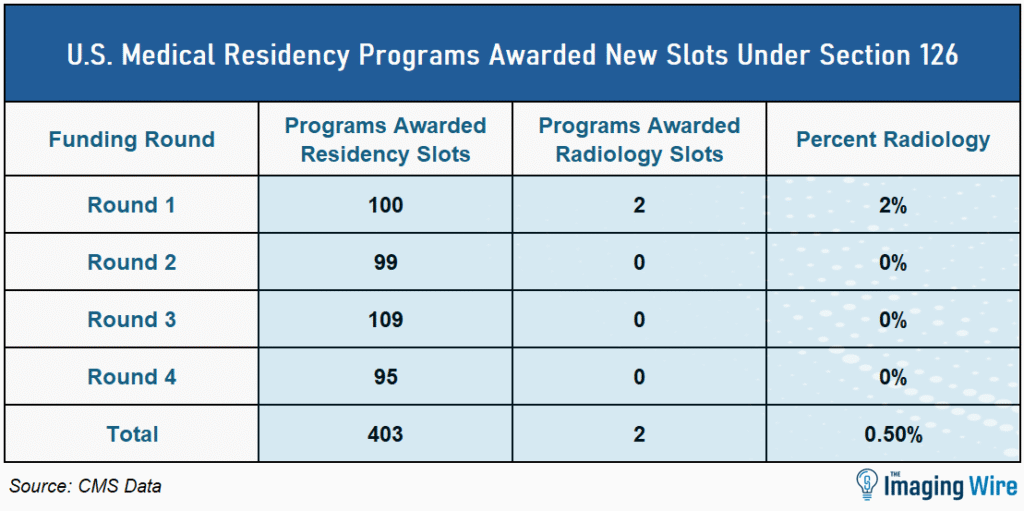
A federal push to alleviate the U.S. physician shortage by adding more resident training slots appears to have skipped radiology. Of the more than 400 residency programs awarded funding so far, only two diagnostic radiology programs got funds.
The ongoing doctor shortage has become a major issue in U.S. healthcare, as physicians face rising patient volume from an aging population with a workforce that’s largely stagnant.
- Physicians are already experiencing high burnout rates, and the Association of American Medical Colleges predicts there will be a shortage of as many as 86k doctors by 2036.
Part of the problem is that physician training is tightly controlled in the U.S. Residency programs get most of their funding from Medicare, and there’s been a cap on the number of slots Medicare can fund since 1997.
- So it takes an act of Congress – literally – to get more money to add residency slots.
That’s actually happened in recent years, with federal budget bills in 2021 and 2023 specifically allocating more money for Direct Graduate Medical Education to help train more residents through what’s commonly known as Section 126.
- In all, the legislation is funding 1.2k new residency slots, with the positions released through five rounds of funding.
But the fourth round of new resident positions under Section 126, announced in December, skipped diagnostic radiology entirely.
- A list of the new positions by Becker’s Hospital Review found no diagnostic radiology slots added to U.S. resident training programs, while 20 interventional radiology positions were added.
And over the course of the Section 126 program, only 0.5% of residency programs getting funding were diagnostic radiology.
It’s unclear how the omission occurred. Hospitals with resident training programs have to apply for the additional funding, and it’s possible that diagnostic radiology’s low (or nonexistent) numbers simply reflect fewer DR applications.
- But it’s widely known that the federal government has prioritized training primary care physicians, as well as hospitals in rural areas. Indeed, being in a rural area or health professional shortage area are two of four ways for residency programs to qualify for Section 126 funding.
Legislation currently languishing in Congress – the Resident Physician Shortage Reduction Act of 2025 – would add 14k residency positions over the next seven years.
- But even such a large expansion in residency training won’t help medical imaging much if diagnostic radiology continues to get passed over when allocating new positions (the application period for the fifth and final round just opened).
The Takeaway
The fact that diagnostic radiology is getting skipped over in Section 126 residency funding shows that there’s no cavalry coming over the hill to help the specialty deal with its workforce shortage. Help will have to come from somewhere else, be it AI, teleradiology, or some other kind of technology.
|
|
Merge Partners with Us2.ai
A new partnership integrates Us2.ai’s cutting-edge, FDA-cleared algorithms with Merge Cardio’s advanced imaging systems to deliver AI-generated analysis and reporting of echocardiograms. Find out what it means for you today.
|
|
One Imaging Platform for Your Enterprise
Bring radiology and all departments across the enterprise on the same page: one platform, one user experience, with no extra tools or training required. Find out what Merge has to offer on this page.
|
|
- Radiology Programs Could Add Residents: Meanwhile, a new survey of U.S. radiology training programs found that most are willing to add resident slots. Researchers in a new study in JACR received responses from directors of 47 of the 197 eligible programs, finding that 85% said they could add more radiology residents, with a mean capacity for expansion of 2.8 residents per program. In all, 28% had recently requested a capacity increase, and 85% were approved. Private funding – beyond what Medicare provides – could help programs expand.
- Radiology Expo Day Piques Interest: But what’s the best way to get medical students – particularly women and underrepresented minorities – to pick radiology as their specialty? A new paper in Academic Radiology describes how UC San Diego’s radiology program hosted a Radiology Exposition Day for medical students to spur interest in the field. The day included presentations by the department’s chair and faculty, followed by interactive activities such as case review and simulated interventional procedures. Post-event surveys showed an increase in attendees’ familiarity with radiology.
- Rad Shortage Drives Reporting Delays: The radiologist shortage is starting to drive delays in reporting imaging results to patients. An article this week in PennLive focuses on delays being experienced at University of Pittsburgh Medical Center, where some patients say they’ve waited 4-8 weeks for MRI and CT results. The article lists well-known factors behind the shortage like an aging population and radiologist retirements, but also says that the Trump Administration’s restrictions on H-1B visas have limited hospital recruitment of international physicians.
- Sectra Scores in KLAS Awards: Sectra continued its impressive streak in this week’s annual KLAS Research awards for customer satisfaction. The company received seven Best in KLAS awards for its Sectra PACS enterprise imaging software, holding on to the top spot in the U.S. for 13 straight years and in Canada for seven. Sectra also won in multiple international categories, including Northern Europe, Southern Europe, the DACH region of German-speaking countries, the Middle East/Africa, and Oceania.
- AGFA Nabs Three KLAS Awards: AGFA HealthCare landed Best in KLAS awards in three categories. Its Enterprise Imaging for Radiology solution won in the category for small PACS (under 300k studies), its Xero Viewer won in universal viewer for imaging, and its Enterprise Imaging VNA nabbed the top spot in the vendor-neutral archive category. AGFA won the viewer award for the third straight year and the VNA award for the second consecutive year.
- Intelerad Garners KLAS Nods in U.K., Ireland: Intelerad’s InSight PACS solution received the Best in KLAS award for the U.K. and Ireland, marking the company’s third straight year receiving the accolade. InSight PACS was tailor-made to support the image management needs of the U.K.’s National Health Service as well as private practices, and is in use at over 250 healthcare organizations in the country.
- Other KLAS Imaging Awardees: Several other imaging software companies received Best in KLAS awards, including Merge by Merative for its Merge Hemo software in the cardiology hemodynamics category, while Microsoft landed atop the image exchange category for its PowerShare solution and Infinitt won for its Cardiology Suite. A relatively new entrant – Jacobian – won the category for speech recognition with its Fluency for Imaging software — the solution’s fifth KLAS award. Jacobian was formed in 2025 through the merger of Smart Reporting and Fluency for Imaging.
- HHS Asks for Image Exchange Comments: Healthcare’s ongoing challenge with medical image exchange may be moving toward a resolution. The U.S. Department of Health and Human Services is requesting feedback on a proposal to adopt new technical standards for improved medical image exchange for healthcare providers and patients. While the DICOM standard makes it easy to exchange images within a health system, external image exchange is hindered by proprietary file formats and other barriers. The agency is accepting comments through March 16.
- Imagion Files IND for MRI Contrast Agent: Imagion Biosystems filed an IND with the FDA for its MagSense HER2 MRI contrast agent, marking a milestone in the company’s effort to commercialize the agent. On approval of the IND, Imagion will start a Phase 2 clinical trial with its U.S. clinical partners as early as the current calendar quarter. The trial will collect safety and dosing data on using MagSense to identify HER2+ breast cancer with breast MRI.
- MGB AI Predicts Brain Age from MRI: Mass General Brigham researchers have developed a foundation model AI algorithm to analyze brain MRI scans to perform tasks like identifying brain age and predicting dementia. MGB’s BrainIAC algorithm was described in a paper in Nature Neuroscience, where researchers validated its performance on 49k brain MRI images. They found BrainIAC performed well for both easy tasks like classifying types of MRI scans to more challenging applications like detecting brain tumor mutation types.
- Brainomix Updates AI Platform: Brainomix launched the next generation of its AI-based stroke analysis solution at this week’s International Stroke Conference. Brainomix 360 Stroke Next Generation is designed to streamline workflow around stroke evaluation, and the new update includes a net water uptake feature that provides deeper insights into stroke injury based on non-contrast CT scans.
- GE Gets Angio Authorizations: GE HealthCare received FDA and CE Mark regulatory authorizations for Allia Moveo, a floor-mounted angiography system for interventional radiology use. The system debuted at RSNA 2025 and features a compact design and is mounted on motorized wheels for maneuverability and easier siting. Allia Moveo supports cone-beam CT scanning with GE’s ClearRecon DL protocol for improved image quality, and includes algorithms for reduction of motion and metal artifacts, as well as procedure guidance.
- Photon-Counting CT Reduces Radiation: Photon-counting CT could be an optimal tool for monitoring patients being treated for lung cancer thanks to a protocol that reduced both radiation and contrast dose. In a study in Radiology of 200 patients with lung cancer, researchers found that Siemens Healthineers’ Naeotom Alpha photon-counting CT scanner with 0.4mm section thickness reconstruction had lower radiation dose than conventional CT (1.36 vs. 4.04 mSv) as well as lower contrast iodine exposure (iodine load of 21 vs. 28 mg), with better image quality ratings.
- RevealDx Lands Lung Nodule Clearance: RevealDx received FDA clearance for RevealAI-Lung, an AI algorithm for characterizing lung nodules found on chest CT exams. RevealAI-Lung produces a malignancy similarity index that indicates a nodule’s likelihood of being malignant, and was tested on real-world NLST data. The algorithm is available through relationships RevealDx has with Sirona Medical and Riverain Technologies, as well as through Fujifilm Medical Systems’ PACS software.
- HeartLung Added to Microsoft’s PIN: AI solutions from HeartLung.AI will be added to Microsoft’s Precision Imaging Network AI orchestration platform under a new agreement between the companies. HeartLung’s AutoChamber algorithm for analyzing cardiac chamber structure and AutoBMD for calculating bone density will be made available to PIN users. Both solutions analyze CT images acquired for other indications to enable clinicians to opportunistically screen for pathology.
- RadNet Enters Midwest with Indiana Acquisition: RadNet is expanding into the Midwest with the acquisition of the outpatient imaging assets of Northwest Radiology, an Indiana-based provider with six imaging centers in the Indianapolis area. Northwest’s 18 radiologists will continue to provide interpretation services to the centers under contract. The acquisition will add about $18M in annual revenue to RadNet.
- United Taps Customer Success VP: United Imaging named medical imaging veteran John Campbell as vice president of customer success. Campbell brings 25 years of healthcare and medical imaging experience to United, starting as a biomedical equipment specialist in the U.S. Army. Following that, he spent 20 years at Siemens Healthineers in a variety of roles.
- Solis Names New CEO: Breast imaging center operator Solis Mammography appointed Lisa Ashby as CEO, succeeding Grant Davies, who is retiring. Ashby most recently was CEO of Carestream Dental, and prior to that spent 25 years at Cardinal Health in several leadership roles, including president of Cardinal’s medical devices and diagnostics division. Solis has acquired several new centers in recent months and now operates over 160 facilities in 25 major metropolitan markets.
|
|
AI-Centric Radiology Reporting
KailoAir is a new AI-centric radiology reporting solution from Kailo Medical that combines real-time voice dictation, AI-powered prior study analysis, and structured reporting in a seamless browser-based workspace. No installation and no compromise.
|
|
Experience the Next Evolution
From Day 1, AGFA HealthCare has understood that striking the critical balance between clinical efficiency and quality patient care starts with the physician experience. Learn about their history of firsts on this page.
|
|
A Passion for Change
United Imaging’s passion for change was on display at RSNA 2025 with the launch of new products across multiple modalities, including the new uSonique ultrasound family shown as works-in-progress. Find out what drives the company on this page.
|
|
- Leadership in Life Sciences: Quibim is committed to accelerating its development within the life sciences sector and strengthening collaborations with leading pharmaceutical companies. Learn about recent leadership developments that are moving the company forward.
- Empowering Radiologists at the Point of Interpretation: Reserve your seat at this February 12 webinar to learn how Rad AI and RSNA Ventures have partnered to deliver trusted, peer-reviewed RSNA insights directly into the radiologist’s workflow — at the exact point of interpretation.
- The Workstation of the Future: A dedicated team of radiologists shapes every aspect of the functionality and design of MosaicOS from Mosaic Clinical Technologies. Learn how every feature was built to eliminate distractions, amplify focus, and enhance the radiologist experience.
- The Power of a Smooth Go-Live: Don’t gamble on your healthcare institution’s go-live: take control of your PACS migration with ENDEX from Enlitic. Discover how ENDEX uses AI to standardize, normalize, and cleanse your imaging metadata before migration.
- Taking Flight at RSNA 2025: What were RSNA 2025 highlights at Mach7 Technologies? Watch this video to learn how the company debuted new customer engagement initiatives like the Flight Crew, as well their new Flamingo Architecture, to help customers achieve success.
- Making AI a Trusted Part of Imaging Workflow: Join Philips experts for this February 10 webinar as they share insights from the 2025 AHRA-Philips Survey, capturing perspectives from imaging leaders as we explore key findings and discuss how organizations can make AI a practical, trusted part of imaging workflow.
- It’s Time to Make AI Adoption Simple: Gleamer unifies a fragmented AI landscape into a single, simple, powerful platform with GleamerOS. Discover an AI ecosystem where everything is designed to be intuitive, consistent, and scalable, making AI adoption simpler than ever.
- Interpretation Efficiency in Radiology – A Critical Strategy: Healthcare institutions are at a critical stage, where an emphasis on interpretation efficiency needs to be a priority. Check out this white paper from Visage Imaging and Signify Research on strategies to optimize your interpretation efficiency.
- Every Image Tells a Story: Intelerad’s enterprise image management solutions are empowering radiologists and patients while transforming radiology workflows. Learn about the technologies they highlighted at RSNA 2025 for empowering imaging professionals.
- Will Radiologists Lead or Be Led? Radiology is facing a defining moment. In this episode of The Radiology Report, host Daniel Arnold of Medality sat down with Frank Lexa, MD, to talk candidly about what comes next for the specialty.
- Rapid AI Deployment in Emergency Care: University Hospitals used CARPL to deploy AZmed’s fracture detection tool directly in the emergency department, reducing interpretation time by 30% without disrupting workflows. Learn how UH accelerated AI deployment.
- Could AI Help People Live Longer? The most powerful transformation in healthcare may come not after illness appears, but through what we do before disease ever takes hold. Read this article from DeepHealth on how AI can fundamentally change the way we approach health.
- The Next Generation of Universal Remote Imaging: Step into the next generation of universal remote imaging with LUMINOS Q.namix R from Siemens Healthineers. Designed for intuitive operation and patient comfort, this award-winning system sets a new standard in fluoroscopy. Explore its precision and efficiency.
- Five Years Into the Cloud – And Just Getting Started: John Muir Health in California needed help dealing with its data deluge, which became acute with the adoption of 3D breast tomosynthesis. Find out how they turned to Sectra and its cloud-based enterprise imaging management for a solution.
- Driving Efficiency in Radiology: Radiology’s workforce is under pressure. Discover evidence-based strategies for driving efficiency without burning out your staff in this e-book from Riverain Technologies.
|
|
|
|
|