|
Expanding CT Lung Screening, Saphier Testimony, and Brain Health MRI
September 17, 2026
|
|
|

|
|
Together with
|

|
|
|
“Stigma of lung cancer is … an important factor in political decision making – we saw (and see) it in the reluctance to start screening programs, when comparing this to other cancer types. A central factor for stigma is the narrative that ‘smoking is a choice.’ This was established by the nicotine industry.”
|
|
Sebastian Schmidt of Siemens Healthineers.
|
|
|
Quantification of brain MRI scans can be a powerful tool for diagnosing pathology and tracking patient response to treatment, but it can be tricky to do right. That’s why you should attend today’s webinar on MRI quantification at 12 pm ET/9 am PT, in partnership with AIRS Medical. See you there. – Brian Casey, Managing Editor
|
|
|
|
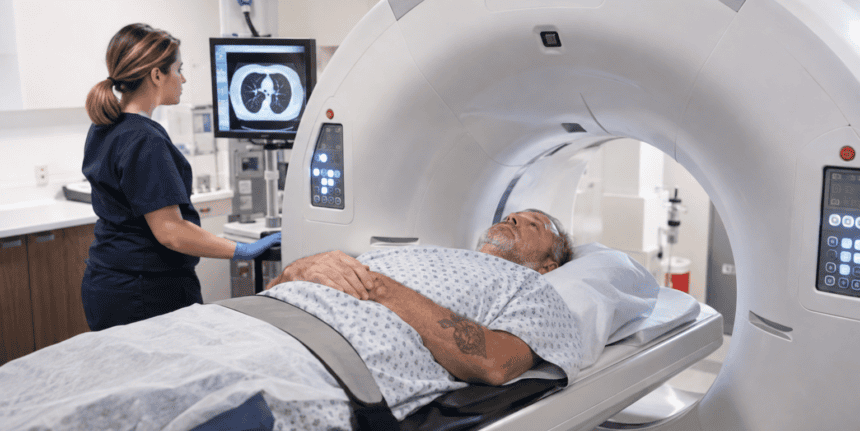
Low-dose CT lung cancer screening appears set to be the next major population-based cancer screening exam. But much work remains to make LDCT screening available to as many eligible people as possible while optimizing scanning protocols.
That’s according to sessions at IASLC’s World Conference on Lung Cancer (WCLC 2026), which just wrapped up in Seoul, South Korea.
- WCLC 2026 sessions ranged from expanding scanning to people at high risk but without smoking histories to using AI to not only detect and characterize lung nodules but to predict future cancer risk.
Some of the key findings from WCLC 2026 included…
- Australia started its national LDCT screening program in 2025, and researchers expect a national-level stage shift to earlier diagnosis. At a 50% participation rate, stage I diagnoses should grow from 32% currently to 42% for women and 43% for men.
- The Ready to Screen (R2S) trial in Australia found that of 1.7k eligible screening candidates surveyed, 85% “definitely” intended to get screened and 26% said they had already received an LDCT scan.
- Taiwan’s national screening program showed that – at least in East Asia – people with a family history of lung cancer should be screened. Of 2.8k cancers detected, there was a 74% higher detection rate in those with family histories versus smoking histories (18 vs. 10 cancers per 1k screened), with more early-stage cancers detected (92% vs. 83%).
- An LDCT screening program in China screened 6.7k people – including those with risk factors besides smoking – finding a 56% lung cancer mortality reduction.
- French clinicians successfully added smoking cessation therapy to their LDCT program, with 88% screening attendance and participants 44% less likely to smoke.
- MIT’s Sybil AI algorithm was more accurate than Lung-RADS in predicting one-year cancer risk from suspicious nodules, with higher AUC when applied to two large lung screening trials (NLST and P-IELCAP).
- Researchers found that applying Sybil to coronary artery calcium scans could also predict lung cancer risk for both smokers and non-smokers over a 15-year follow-up period.
- Researchers used Softek Illuminate’s Illuminate AI software for identifying incidental pulmonary nodules as a complement to an LDCT screening program, finding that the algorithm discovered more lung cancer cases than conventional screening.
The Takeaway
This week’s WCLC 2026 sessions point out the rapid progress being made around the world in expanding access to LDCT lung cancer screening – as well as the role that AI-based software tools can play in making screening more effective and more widely accessible.
|
|
How to Choose Between Tableside and Remote Fluoroscopy
Need help deciding whether tableside or universal remote fluoroscopy is right for you? This whitepaper from Siemens Healthineers may be able to put things in perspective.
|
|
Why Cloud? Why Now?
Attend this webinar at 2 pm ET on Wednesday, September 23 to learn how St. Luke’s University Health Network outgrew its legacy PACS and turned to Sectra’s cloud-based SaaS enterprise imaging platform.
|
|
- Mobile CT Lung Screening in Brazil: In another talk from WCLC 2026, researchers from Brazil shared how mobile CT lung cancer screening can improve access for high-risk people. The BRELT3 trial provided mobile low-dose CT screening across four cities from 2023 to 2025. In all, 2k people met eligibility criteria and were screened, with Lung-RADS 3 or 4 findings in 14%. Biopsy was indicated for 2.3%, and 19 lung cancers (0.94%) were diagnosed. Community health workers played an important role in finding screening participants.
- Smoking Cessation and Lung Screening: Smoking cessation should be an integral part of any low-dose CT lung cancer screening program, and a new study in JAMA Network Open shows how cost-effective it is. Among 2.5k people in four SCALE trials who got various types of cessation counseling with LDCT screening, quit rates were 10%-27%. Smoking cessation interventions saved money in the long run over LDCT screening alone, and high-intensity pharmacotherapy with low-intensity counseling had the lowest lifetime cost ($1.5B per 100k screened) while meeting cost-effectiveness thresholds.
- Germany Builds Lung Screening IT Backbone: Germany recently launched a national low-dose CT lung cancer screening program, and several companies are collaborating on the IT backbone needed to run it. Curagita and Mint Medical are working together on the project, with Curagita organizing a network of participating radiology practices using its CuraHub AI platform, while Mint Medical provides its mint Lesion software for structured reporting and data management while 4DMedical’s contextflow supplies its ADVANCE Chest CT lung nodule analysis application. Some 25 screening sites are participating in the network.
- Surgeon General Pick Saphier Faces Senate: The radiologist nominated by the Trump administration to be the next U.S. surgeon general – Nicole Saphier, MD – testified in the Senate yesterday as part of her nomination process. While Saphier is not as controversial as some of the administration’s other HHS and FDA appointments, she drew scrutiny for her positions on childhood vaccines (generally supportive, but with some caveats), as well as for her ownership of a supplement company and other investments – which she is divesting.
- Merge Launches AI Foundation: Aiming to make clinical AI deployment easier, Merge this week debuted MergeIQ, a scalable foundation for implementing AI algorithms across Merge’s enterprise imaging platform. MergeIQ gives users a governed, scalable approach to AI adoption within the Merge environment without having to add another standalone AI platform. The first AI applications that can be deployed within MergeIQ are RelevancyIQ and NavilQ, which were designed to locate prior information and deliver it within existing diagnostic reading workflow. MergeIQ launches within the company’s Merge Workflow Orchestrator application.
- AI Boosts Brain Aneurysm Detection: Radiologists using Aidoc’s AI algorithm for detecting intracranial aneurysms on CT angiography scans detected 39% more aneurysms. In a study by Neiman HPI researchers published in JACR, clinicians evaluated Aidoc’s AI on 3.9k CTA scans at Northwell Health in New York, finding 55 true-positive aneurysm cases that radiologists had not reported, while AI missed 30 detected by radiologists. The findings show AI can deliver clinical value in real-world settings.
- Environmental Effects on Brain Health: Dementia, cardiovascular disease, and mortality have all been linked to accelerated brain aging, and now researchers writing in Radiology are trying to figure out who’s most at risk. Among 2.8k patients who underwent brain MRI, those living in socioeconomically disadvantaged areas had faster brain aging, lower total brain volume, and more areas of damaged white matter than those in non-disadvantaged regions. The authors noted that these results are consistent with widespread rather than isolated changes, reflecting the effects of chronic stress exposure and inflammation.
- Less Brain Imaging for Medicaid-Eligible Patients: Structural brain imaging is underused in patients eligible for Medicaid – an indication of economic disparities. In a new analysis in JACR, researchers reviewed use of brain CT and MRI for 1.1M patients eligible for Medicare with newly diagnosed mild cognitive impairment in 2021. Imaging use rates were lower for those eligible for both Medicaid and Medicare (known as “duals”) versus Medicare-only patients (58% vs 61%). The dual disparity could be because many practices won’t accept Medicaid patients.
- DeepHealth’s Nod for Foundation Model: A new radiology AI algorithm built on foundation models has been cleared by the FDA. DeepHealth’s Chest XRay was broadly trained on large volumes of chest radiographs and can be used to detect lung nodules, consolidation, mediastinal and hilar abnormalities, and pleural space abnormalities. The solution is the latest evolution of technology DeepHealth acquired with its purchase of Gleamer, which marketed it as ChestView.
- Mosaic’s Cognita Lands LLM Grant: The Cognita Imaging Solutions unit of RP’s Mosaic Clinical Technologies received a $1.3M grant from the FDA to investigate how large language models (LLMs) can help evaluate AI-generated radiology reports. Cognita is developing vision language models (VLMs) that can generate and synthesize clinical information, and company researchers will use the FDA award to see if VLMs can help researchers assess clinical text at scale and aid in regulating AI-enabled medical devices.
- GE Eyes PET Tracer Company: GE HealthCare could be looking to build on its longtime partnership with Sofie Biosciences by acquiring the radiopharmaceutical company outright. Reports in the business press this week suggested that GE would pay $1B for Sofie and fold it into its existing molecular imaging tracer business. The companies in 2023 signed a pact to collaborate on developing gallium-68 and FAPI fluorine-18 tracers for diagnosing cancers.
- Median Lands Big Research Contract: French software company Median Technologies landed what it’s calling one of the largest contracts in the company’s history for its iCRO clinical trials business unit. iCRO will supply central imaging services and image analysis to a “leading European pharmaceutical company” for a phase III clinical trial evaluating an investigational treatment for a rare form of brain cancer. Median estimates the contract’s value at €8.4M ($9.5M).
- Disabilities Linked to Lower Screening: New American Cancer Society data show health systems may not be doing enough to meet the screening needs of the one in seven U.S. adults with disabilities. Compared to those with no disabilities, breast and cervical cancer screening rates were between 31% and 37% lower for individuals whose disability made it hard to perform daily self-care tasks. The authors emphasized the success of at-home tests for colorectal cancer in increasing participation.
|
|
A Next-Generation Oncology Ecosystem
Quibim launched their next-generation oncology ecosystem platform at RSNA 2025. Find out how QP-Prostate provides a comprehensive, end-to-end management workflow for prostate cancer care, supporting clinicians from the earliest stages of image acquisition through diagnosis, patient management, and follow-up.
|
|
The Future of Radiology Is Operational Transformation
In this webinar at 12 pm ET on Tuesday, September 29, discover how leading radiology groups are increasing throughput, reducing report turnaround times, improving workload equity, and helping attract and retain radiologists through a new approach to enterprise radiology operations.
|
|
AI-Assisted Radiology Reporting
Move beyond legacy radiology reporting with AI-assisted reporting from Mosaic Technologies. See how Mosaic Reporting can help your organization move faster today while building for tomorrow.
|
|
The Modern Way to Send and Receive Medical Images
Medicom Connect enables you to automate clinical image exchange across your healthcare ecosystem with workflows that automatically find, retrieve, and deliver images directly to the point of care, improving access and care coordination. Learn more about Medicom’s solutions today.
|
|
- New Tools for Detecting Cardiovascular Plaque: New imaging tools are advancing the detection of cardiovascular plaque – a key risk factor for heart attack. In this video, ClearCardio’s John Osborne, MD, PhD, discusses these innovations, including United Imaging’s uCT ATLAS CT scanner and their Software Upgrades for Life program.
- Next-Generation 1.5T MRI: Echelon Synergy from Fujifilm Healthcare Americas is a powerful and affordable next-generation 1.5T MRI system featuring Synergy DLR deep-learning reconstruction, fast exam times, and patient-friendly design. Discover how it can help you achieve faster workflow and improved image quality.
- 20% Faster Reporting at Scale: Learn how ARA Health reduced median reporting time with Rad AI Reporting while lowering workflow friction and cognitive load. See the case study.
- One Viewer for All: Achieve ultrafast image interpretation with greater efficiency and precision with Visage 7 from Visage Imaging. Visage’s one-viewer philosophy enables all end users – from radiologists to clinicians – to access powerful tools based on clinical need.
- Unlock Next-Level Diagnostic Possibilities: Photonova Spectra from GE HealthCare is designed to realize the full potential of photon-counting CT in oncology, cardiology, neurology, and more. Learn more about the difference its Deep Silicon technology makes on this page.
- Data that’s Correct, Complete, and Consistent: ENDEX from Enlitic standardizes your DICOM imaging data with AI precision, so every study is labeled right and ready to use. Learn how it can benefit your radiology practice today.
- The Most Exposed System You Own: Digitization plateaued. Much of the infrastructure underneath enterprise imaging is now both costly to maintain and attractive to attackers. This framework reframes modernization as phased evolution rather than a rip-and-replace event, and shows leaders how to fund it. Get the framework.
- The Radiology Layer Nobody Talks About: Detection algorithms, generative reporting tools, and worklist triage engines are only as good as the data that reaches them. Kailo Medical’s KailoHub is the connective tissue that sits between everything. Learn how it can benefit you on this page.
- How DRH Health Streamlined Enterprise Imaging Workflows: DRH Health in Oklahoma needed a connected, reliable, efficient enterprise imaging ecosystem to support their mission of providing quality healthcare to patients. Learn how they found it by turning to Merge.
- AI Echo Reduces Reporting Time by 35%: AI-assisted reporting of echocardiography exams reduced preliminary reporting time by nearly 7 minutes per case, or 35%. Read the study to find out how Us2.ai can help you speed up reporting turnaround times.
- AI Tools for Lung Cancer Screening: CT lung cancer screening is gaining momentum around the world. Learn about AI-based nodule detection tools that can improve the accuracy of low-dose CT scans in this video from Riverain Technologies.
- Connected Imaging. Empowered Flow: Know those rare and indescribable moments at work when distractions melt away? AGFA HealthCare’s Enterprise Imaging Platform is designed to keep you in that hyper-focused state of mind all day long. Learn more about their solutions today.
- A New Resource for Radiology Jobs: Check out the new Job Boards from Medality to gain access to newly posted positions for radiologists, residents, and fellows. If you’re an employer, post your first job for free to reach Medality’s network of over 40,000 monthly users.
- Advancing Enterprise Imaging With IntelePACS: Watch this on-demand webinar to learn how IntelePACS from Intelerad helps radiology groups, hospitals, and health systems simplify imaging workflows through a scalable, enterprise-ready platform.
- A New Fleet. A New Era for CT: Imaging teams are being asked to do more across clinical settings, with speed, clarity, and consistency. Introducing Rembra, Rembra RT, Areta RT, and Verida, a CT portfolio from Philips designed to support high-demand imaging environments. Learn more.
- Why Are Radiologists Still Dictating Measurements? Twenty years since voice dictation systems supporting DICOM Structured Reporting replaced manual radiology report transcription, why are radiologists still dictating measurements? Check out this white paper to find out how Altamont Software’s Passport SR can help you automate reporting.
- How AI Powers Lung Cancer Screening: Discover how DeepHealth’s AI and workflow applications are helping radiologists report findings efficiently and with consistency in the U.K. national lung cancer screening program, finding cancers earlier at more treatable stages.
- Don’t Leave Your Patients in the Dark: Top institutions like Duke and Northwell Health are using patient-friendly radiology reports from Scanslated to boost patient engagement and satisfaction. Discover how Scanslated can work for you today.
|
|
|
|
|




