|
Top 10 AI Vendors Updated, Overdiagnosis Overrated, and AI Time Savings
September 14, 2026
|
|
|

|
|
Together with
|

|
|
|
“Exaggerated harm estimates [from overdiagnosis] may lead policymakers to recommend less intensive screening than optimal and deter the target population from participating in this potentially life-saving intervention.”
|
|
Helle Njor S. et al, in a new paper on overdiagnosis rates in screening mammography.
|
|
|
This week we’re offering an update on the FDA’s list of authorized AI-enabled medical devices. Not much has changed since the agency’s last update in June in terms of radiology’s dominance of the list, but this has been one of our most consistently popular stories in recent years, so as long as you keep clicking on it we’ll keep publishing it. – Brian Casey, Managing Editor
|
|
|
|
The FDA updated its list of regulatory authorizations for AI-enabled medical devices, covering approvals granted through the end of June 2026. The new numbers show radiology maintaining its strong lead over other medical specialties.
The FDA issues quarterly updates on marketing authorizations for AI-enabled products, a category that includes dedicated software applications as well as AI-enhanced hardware, like scanners with onboard AI functionality.
- The list is closely watched by healthcare industry observers, and radiology has typically secured more than three-quarters of the authorizations – not surprising given the specialty’s image-intensive nature.
The most recent list tracks FDA actions through the end of June 2026, indicating that the FDA has…
- Authorized 1,614 AI-enabled medical devices since it started keeping track, up 5.9% from Q1 2026.
- Authorized 1,230 radiology devices, or 76% of all AI-enabled medical authorizations.
- In the second quarter of 2026, the FDA authorized 89 AI-enabled medical devices, slightly fewer than the 92 devices it authorized in the first quarter of 2026.
- For the quarter, 66 authorizations (74%) were for radiology devices, similar to the Q1 ratio (75%).
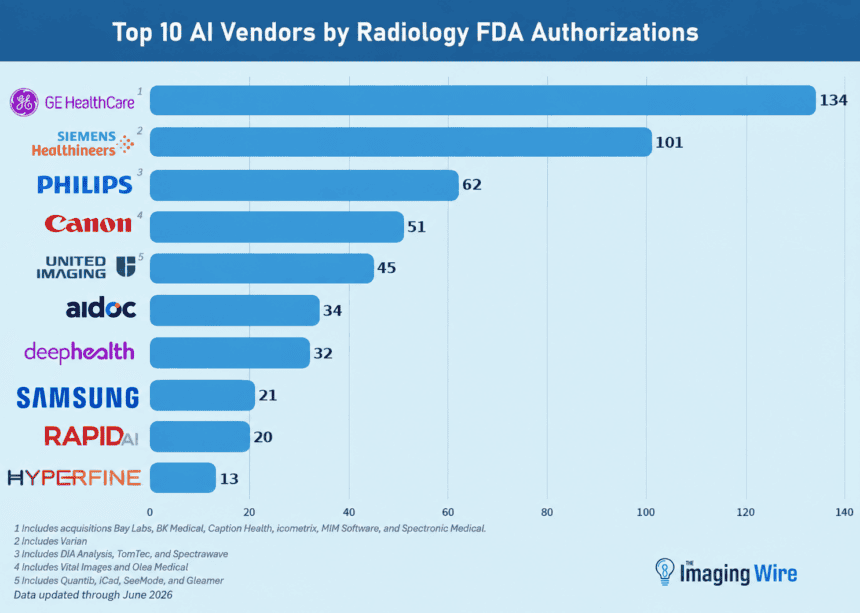
- GE HealthCare maintained its AI authorizations lead with 134, thanks in part to approvals secured by companies it has acquired over the years.
- Next are Siemens Healthineers at 101, then Philips at 62, Canon at 51, United Imaging at 45, Aidoc at 34, and DeepHealth at 32, with all numbers including acquisitions.
- Rounding out the top 10 are Samsung (21), RapidAI (20), and Hyperfine (13).
The Takeaway
The new numbers track pretty closely with data on AI-enabled regulatory authorizations the FDA released for the first quarter. It will be interesting to see whether the agency’s pace changes as it comes to a final decision on regulating generative AI algorithms used for direct clinical care – a task for which it is currently soliciting feedback.
|
|
Reporting Is Radiology’s Next Transformation
While AI’s role in diagnostic imaging is well-established, one part of the workflow has remained largely unchanged despite its central role: the report. Read this article from DeepHealth to learn more about radiology’s next transformation.
|
|
How QITA Improved Radiologist Productivity
Quantum Imaging & Therapeutic Associates (QITA) faced inefficiencies in their reporting processes, manually transposing ultrasound and DEXA measurements into reports. Find out how they turned to Altamont Software’s DICOM Structured Report integration to improve radiologist productivity.
|
|
A Paradigm Shift in Imaging Information
Have you ever wanted instant access in the palm of your hand to real clinical cases, innovative MR technologies, and quality customer support to guide you in finding the right MR solution? Check out the Philips MR Imaging App today.
|
|
- Is Overdiagnosis Overrated? Rates of breast screening overdiagnosis are probably far lower than previously estimated. A new study in JNCI compared data from the major randomized mammography screening trials to data from Denmark’s national screening program, finding an overdiagnosis rate of around 5% – far lower than the 30% to 50% rate claimed by many mammography skeptics. The findings undercut one of the main arguments against breast screening – that women would be treated for findings that might never pose a health risk.
- Calculating AI’s Time Savings: Studies have shown that AI can reduce the number of screening mammograms radiologists have to read. But how much time does that save? Researchers propose a new metric in Academic Radiology based on person-minutes per 1k women screened that also accounts for time spent on tasks like case arbitration and reading different modalities like DBT. They propose testing the methodology in a new trial that would provide data that can be used for staffing, capacity planning, and cost analysis.
- Breast Screening = Better Outcomes: Women with breast cancer diagnosed on screening have better clinical outcomes. A new JACR paper proves the point, tracking 1k women diagnosed from 2019 to 2021. In all, 69% of cancers were diagnosed on screening, and these women had earlier T stage (T0 = 26% vs. 5.4%) and higher rates of negative lymph nodes (86% vs. 59%) and absence of metastases (99% vs. 82%). Cancers detected outside of screening were more common among unemployed women (21% vs. 14%) and the uninsured (3.8% vs. 1.7%).
- Does DBT Reduce Interval Cancers? The U.S. mammography market’s massive shift to DBT may not have impacted detection rates for interval cancers (cancers found between screening rounds). A new meta-analysis in Academic Radiology covering 13 studies and 1.4M exams found that DBT produced no significant reduction in invasive interval cancers compared to 2D digital mammography (a difference of less than 1 cancer per 10k women). The findings question whether DBT meaningfully affects the ability to detect aggressive cancers.
- FDA Approves Telix’s Pixclara PET Tracer: A new PET radiopharmaceutical for imaging brain gliomas will now be available in the U.S. after the FDA approved Telix Pharmaceuticals’ Pixclara tracer. Pixclara is based on fluorine-18 floretyrosine (FET) amino acid, and the company claims it is the first FDA-approved PET tracer for glioma imaging. The FDA gave Pixclara orphan drug and fast track designations due to lack of commercial options for amino acid tracers, but Telix had to give the agency additional data before it signed off on the agent.
- Rural MRI Access Is Limited: A new study confirms that MRI access is limited in rural areas. Researchers found that 16% of counties in Michigan had no MRI access, and all were rural. Rural counties also had a longer mean straight-line distance to a fixed MRI site compared to urban ones (19 vs. 7 miles). Counties that were farther away from fixed MRI were 46% more likely to have access to mobile MRI, but 13 counties still lacked access to either mobile or fixed MRI.
- Epsilon Health Hauls in $27.6M: Epsilon Health emerged from stealth with $27.6M in funding to grow its operations. The San Francisco company is calling itself an “AI-native radiology practice” and has 50 radiologists working for it remotely as independent contractors. Epsilon’s clients send images that are reviewed by radiologists using AI algorithms the company developed and that run on Sirona’s SironaOS operating system. Epsilon’s model exemplifies an emerging trend of imaging services providers offering their own internally developed AI algorithms.
- Radiologist Job Ads Fall: The number of ads for radiologist jobs has fallen by nearly half in the last six months. But it’s not a sign of a cooling job market – instead, employers seem to be pulling ads that aren’t performing. That’s according to the latest update from RadBoard.io, which documented 4,523 open job ads as of September 10, down 48% compared to 8,725 ads in March 2026. In all, 34% of jobs have been advertised 90 days or longer, compared to 52% in RadBoard’s last update.
- PET/MRI for Pediatric Epilepsy: PET/MRI may be diagnostic radiology’s most expensive modality, but a new JNM study found it adds value over MRI alone in diagnosing pediatric epilepsy by pinpointing brain lesions that cause epileptic seizures. In 79 children who got both modalities, PET/MRI with EEG data detected 28% more positive lesions than MRI alone (46 vs. 36). Based on the data, 24 children underwent surgery, and 76% were free of seizures after two years of follow-up.
- Disinfecting Lead Aprons with UV Light: You probably don’t want to know how much bacteria is on those lead aprons your radiology staff wear. Fortunately, researchers from China developed an effective way to disinfect them using automated ultraviolet-C light. They found that applying UV-C light to various sampling locations on lead aprons reduced median bacterial colony counts to 0 colony-forming units (CFUs). Apron parts with the highest contamination levels included thyroid shields, lead protective caps, and lead aprons (12, 9.5, and 6.5 CFUs, respectively).
- RapidAI Organizes Orchestration: Prioritizing and routing relevant images to the right software can be cumbersome, but RapidAI’s new EdgeIQ orchestration engine aims to streamline the process. The platform relies on DICOM metadata and image pixels to sort through and select key image series, then send them to the right algorithms for processing while syncing results across systems. EdgeIQ is also built on the company’s RapidEdge cloud-based imaging infrastructure, enabling it to work in tandem with a wide mix of AI-enabled solutions with minimal configuration.
- AI for MSK Ultrasound Cleared: New tools for automatically performing and analyzing musculoskeletal ultrasound will soon become available to U.S. physicians. Danish software developer ROPCA received FDA 510(k) clearance for ARTHUR and DIANA, two complementary tools for MSK ultrasound. ARTHUR is a robotic ultrasound scanner that performs standardized scans of the finger, hand, and wrist joints to detect arthritis, while DIANA uses AI to analyze images and produce reports. The company plans to focus its U.S. launch on rheumatology practices.
- No Verdict on No Surprises: Billing intermediary HaloMD put out a new report suggesting that the No Surprises Act has successfully decreased emergency out-of-network health spending by up to 52% since kicking off in 2022 – with potential savings to the tune of $4B. The think tanks and policy experts were quick to disagree, asserting that the infamous independent dispute resolution (IDR) system boosts spending and benefits non-network providers. As for the data disparities, critics note that Halo’s analysis focused exclusively on emergency medicine, which could easily be too narrow a snapshot.
- Updated CCTA Guidelines: Since 2014, coronary CT angiography has moved from a helpful diagnostic test to the gold standard for noninvasive CAD detection. Now the SCCT’s updated guidelines reflect that shift, plus the growth of new CCTA technologies that move beyond stenosis into factors like plaque burden and non-atherosclerotic abnormalities. Reporting those factors became easier when CAD-RADS 2.0 was released in 2022, and now the standardized framework is also incorporated into SCCT’s updated guidelines. The update also touches on topics from imaging artifacts to artificial intelligence.
|
|
Making a Difference For Pediatric Patients and Families
A new study published by Stanford Children’s and Duke examined over a year and a half of patient feedback following the implementation of patient-friendly radiology reports from Scanslated. Learn about the positive impact Scanslated can create for your patients today.
|
|
The Business Case for Modernizing Medical Imaging
Explore the business case for modernizing medical imaging with Intelerad’s IntelePACS and InteleOrchestrator. Read the white paper to learn how healthcare organizations can improve operational efficiency, diagnostic quality, and cost management while delivering measurable business value.
|
|
A New Resource for Radiology Jobs
Check out the new Job Boards from Medality to gain access to newly posted positions for radiologists, residents, and fellows. If you’re an employer, post your first job for free to reach Medality’s network of over 40,000 monthly users.
|
|
- A New Solution for Radiology Reporting: Sectra Reporting delivers a fully built-in, AI-enhanced reporting experience that seamlessly connects PACS imaging data and measurements through intuitive templates. Discover how it can meet your needs today.
- More than an Image. The Big Picture: AGFA HealthCare understands that striking the critical balance between clinical efficiency and quality delivery of patient care starts with the clinician experience. Learn how their Enterprise Imaging platform makes the complex simple.
- Cutting-Edge PET/CT to Support Theranostics: Theranostics is an exciting new field that combines diagnostics and therapy. Discover how Florida Theranostics is using United Imaging’s uMI Panorama PET/CT scanner to establish a high-quality level of patient care.
- CAC Reimbursement for Routine Chest CT: The new Medicare code G0680 brings reimbursement for coronary artery calcium (CAC), enabling health systems to transform routine imaging into a proactive cardiovascular screening tool. Use Riverain’s customizable ROI calculator to demonstrate its potential financial impact on your operations.
- AI Echo for Hypertrophic Cardiomyopathy: Hypertrophic cardiomyopathy is a leading cause of sudden cardiac death in the young. It is now treatable in the era of cardiac myosin inhibitors, yet remains substantially underdiagnosed. Learn how AI echo with Us2.ai can help.
- The Heart of a 30-Year Relationship: Regional Medical Imaging (RMI) has relied on Merge for its enterprise imaging needs for over 30 years. Learn how Merge gives RMI the scalability and flexibility to keep up with growth, while Merge’s cloud solution helps offload strain on the network.
- KailoFlow Replaces the Patchwork: KailoFlow from Kailo Medical gives you one platform from digital patient intake to final structured report, with automated measurement transfer, built-in TI-RADS and BI-RADS calculations, and pre-drafted reporting across any device, any site.
- Imaging Tools for Heroes: Radiology departments are currently pushed to their limits by interconnected challenges. Staff shortages and heavy workloads form a vicious circle. Different measures are needed to address these challenges. Intelligent imaging from Siemens Healthineers can be one of them.
- From Image Exchange to Enterprise Interoperability: Easily share, access, and exchange any medical image with solutions from Medicom. Deliver critical studies directly into the EHR to ease clinician burden, simplify your tech stack, and unlock the research potential hidden in clinical imaging data.
- Purpose-Built for Modern Radiology: MosaicOS from Mosaic Clinical Technologies unites clinical expertise, AI, and advanced workflow tools in one intuitive platform. Find out how it can expand your clinical capacity and speed up turnaround times today.
- End-to-End Prostate Workflow Management: Find out how Quibim’s QP-Prostate provides a comprehensive, end-to-end management workflow for prostate cancer care, supporting clinicians from the earliest stages of image acquisition through diagnosis, patient management, and follow-up.
- Radiology Automation Simplified: CARPL is an enterprise-grade radiology AI validation and deployment platform with 250+ AI applications across 85+ AI vendors that empowers healthcare providers to access, assess, and securely integrate imaging AI in their practice. Book a demo today.
- Many VNAs Are Just Bigger PACS Archives: Vendor neutral is a claim, not a checkbox. This guide separates true neutrality from an expanded PACS archive, shows where enterprise imaging savings actually come from, and names five strategic moves the approach unlocks. Read the enterprise imaging guide.
- Data that’s Correct, Complete, and Consistent: ENDEX from Enlitic standardizes your DICOM imaging data with AI precision, so every study is labeled right and ready to use. Learn how it can benefit your radiology practice today.
- Therapy + Diagnostics = Renewed Hope: Theranostics is experiencing an exponential and global expansion as radioligand therapies give hope when other strategies have failed. Learn more about theranostics on this page from GE HealthCare.
- Interpretation Efficiency in Radiology – A Critical Strategy: Healthcare institutions are at a critical stage, where an emphasis on interpretation efficiency needs to be a priority. Check out this white paper from Visage Imaging and Signify Research on strategies to optimize your interpretation efficiency.
- Technology Your Radiologists Actually Want: AI only creates value when people use it. See how a responsive, personalized experience can help drive radiologist adoption. Ready to see Rad AI in action? Book a demo.
- Built for Today’s Demanding ORs: The Persona C HR mobile C-arm from Fujifilm Healthcare Americas combines high-power performance, ultra-low-dose imaging, and surgeon-friendly control – all in a lightweight, spacious design. Discover its advantages today.
- The Future of Radiology Is Operational Transformation: In this webinar at 12 pm ET on Tuesday, September 29, discover how leading radiology groups are increasing throughput, reducing report turnaround times, improving workload equity, and helping attract and retain radiologists through a new approach to enterprise radiology operations.
|
|
|
|
|




