|
AI Oversight Methods, Contaminated ORs, and Greener MRIs
By Jack Troy, Virginia Hunt
July 13, 2026
|
|
|

|
|
Together with
|

|
|
|
“Unless payment models evolve alongside technology, the greatest obstacle to clinical AI may not be regulatory approval or technical validation — it may simply be that there is no sustainable way to pay for it.”
|
|
Joe Lennerz, MD, PhD, Medical Director of Pathology Innovation at Natera, after CMS floated payment reforms for algorithmic software.
|
|
|
Hello! Jack Troy here. Were you expecting someone else?
The inimitable Brian Casey is on vacation, and to borrow his words from last week, I’d like to imagine he’s enjoying a frosty beverage on a remote desert island. I’m at the helm for just a single issue of The Imaging Wire, but it’s a good one, looking at how clinicians can keep an eye on imaging algorithms without driving themselves nuts.
If life sciences excite you, I’d love to have you over at The Bio Wire, which is set to launch soon. No hard feelings if you want to stick to radiology news.
– Jack
|
|
|
|
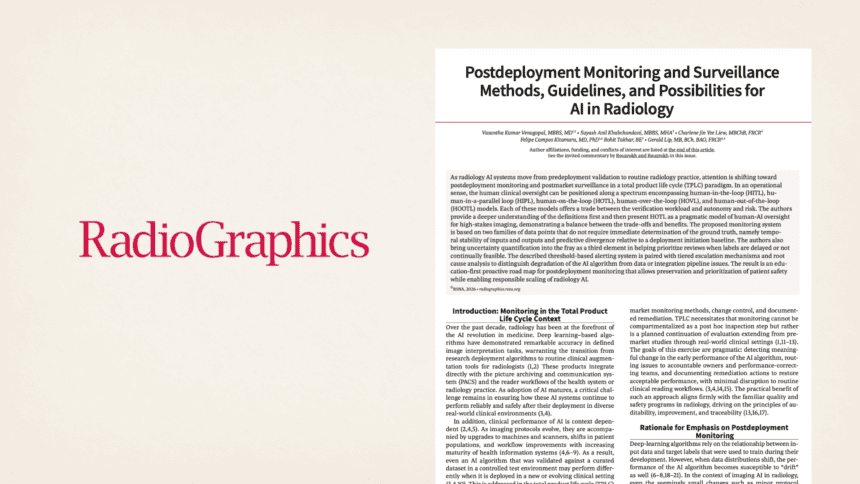
AI has its skeptics and superfans when it comes to interpreting medical images, inspiring a wide range of approaches to checking its work, but a new RadioGraphics paper argues the right level of oversight lies somewhere in the middle.
There’s a strong consensus on the importance of monitoring AI post-deployment, even as the right level of rigor remains an open question.
- The FDA and many of its global peers require institutions to track AI performance, implement human oversight, and have a corrective action plan.
- Past studies show oversight mechanisms are top of mind for many radiologists.
The international researchers behind the article say a human-on-the-loop (HOTL) model is the sweet spot for radiology departments as they balance safety and reliability with efficiency.
- Under this framework, radiologists don’t have to review every AI output.
- At the same time, the proposed model doesn’t take AI results at face value.
- HOTL threads the needle by alerting humans to drift and accuracy problems.
- If performance drops, the work of reading these scans reverts to radiologists.
The model acknowledges that even the most cleverly designed radiology algorithms can be sensitive to changing inputs.
- Scanner upgrades, workflow adjustments, and shifts in patient mix can leave AI that aced training tests out of step with clinical realities.
HOTL has its perks, but the authors note a few challenges.
- Excessive alerts risk desensitizing monitoring teams, so it’s important not to set the notification threshold too low or treat minor deviations as urgent.
- Declines in subgroup performance can go unnoticed if overall metrics stay stable.
The Takeaway
For radiology departments, the ideal AI oversight plan protects patients without making the technology more trouble than it’s worth. It seems the HOTL system outlined in RadioGraphics checks those boxes by focusing on trends over individual outputs. Even so, the debate over how to best supervise AI is sure to remain lively.
|
|
5 Data Migration Myths You May Still Believe
Many healthcare organizations fall victim to data migration myths that derail their efforts, waste valuable resources, and put their business at risk. Learn about five common myths and how they cost you in this article from Laitek, an Enlitic portfolio company.
|
|
Reimagine Enterprise Imaging
Mach7 helps healthcare organizations simplify access to imaging, improve interoperability, and modernize enterprise imaging workflows. Learn more.
|
|
AI-Powered MRI for Better Efficiency
Neurological Associates of Long Island runs its MRI service six days a week, conducting 850 scans each month. Learn how they met their efficiency needs by upgrading to Fujifilm’s AI-powered ECHELON Synergy 1.5T MRI and OASIS Velocity high-field open MRI systems.
|
|
- Putting a Price Tag on AI: CMS proposed stopgap changes to Medicare payments for AI-powered software. The agency has long weighed how to reimburse services whose value comes not from tangible inputs, like labor and supplies, but an algorithm that produces a diagnosis or treatment recommendation. The plan is characteristically modest: Rename the SaaS category to “Software as Medical Service,” move 36 codes there, and assign temporary rates to 21 of them. It nonetheless signals a shift in how CMS views some of the hottest technologies in healthcare.
- Unraveling MS Mysteries: Gray matter lesions, a key marker of multiple sclerosis, have been nearly impossible to detect on standard MRI scans. Researchers say they’ve broken that barrier by combining advanced post-processing techniques, like synthetic contrast, to retrospectively spot more than 10k lesions across 732 MS patients in a new Communications Medicine study. With troves of trial data ripe for reanalysis, the approach could spark deeper insights into the debilitating condition. In clinical settings, the results raise the possibility of lesion detection without top-notch scanners.
- $7M Payout for Misdiagnosed Lump: A Florida health system and radiology group settled for $7M with a woman who says her breast lump was ruled benign just months before her terminal cancer diagnosis. Court filings claim a radiologist at Acumen Medical Imaging and Interventional incorrectly gave the all-clear after a diagnostic mammogram and ultrasound, and Baptist Health System relayed the results. As part of the agreement, Baptist must add a disclaimer to normal mammogram findings and offer certain patients greater access to the interpreting radiologist.
- Elaitra Launches ViewFinder DBT AI: U.K. AI developer Elaitra launched its ViewFinder AI algorithm for supporting DBT exams. ViewFinder has 510(k) clearance for tissue matching on 3D mammograms, enabling breast radiologists to correlate findings between CC and MLO views. The company is supplying ViewFinder to U.S. sites on a patient self-pay basis, and recently signed an agreement to provide the solution to NewYork-Presbyterian/Columbia for use in clinical trials. Elaitra was founded by researchers from King’s College London.
- Contamination Concerns in Interventional Radiology: A new American Journal of Infection Control study revealed that blood contamination may pose a bigger risk than previously thought for interventional radiology procedures. Samples from 142 sites revealed that the top 10% of contamination hotspots, such as operating tables and C-arms, contributed 64% of the total load. The less obvious spaces on these hotspots, like table handles and the sides of C-arms, carried the most extreme contamination.
- Vacuum Excision Isn’t Airtight: A new study in The Breast revealed that disease lingers in two-thirds of patients after vacuum-assisted breast excision (VABE), even when the procedure looked to be radiologically complete. A meta-analysis of data from 5k individuals who underwent VABE to treat ductal carcinoma in situ showed that 16.4% of patients’ residual cancer was reclassified to a more serious stage. Though VABE is viewed as a less invasive alternative to traditional procedures, researchers note that the data supports surgery as the standard of care for removing remaining disease.
- Leo’s Big Haul: Leo Cancer Care raised $65M in Series D funding to scale manufacturing and continue development of its upright proton therapy and imaging system. The University of Sydney spinout cites research showing that patients have more reliable organ positioning when sitting or leaning versus lying down. Leo products make adjustments by rotating the patient, not the gantry, creating a compact setup. The raise comes about a year after Leo scored FDA clearance for its upright CT scanner.
- Next-Gen Ultrasound from Philips: Philips’ latest ultrasound system arrived in the U.S. and Europe, boasting a 24-inch monitor, tight footprint, and AI capabilities. Dubbed Alturion, the machine has the same user interface as other Philips ultrasound products and comes with backward compatible transducers for EPIQ Elite and Affiniti models. The company says the system is designed to speed up scans and ease cognitive load, helping clinicians keep up with high patient volumes.
- Greener MRI Sequencing: Imaging teams may have a small part to play in cutting greenhouse gas emissions. While MRIs are fundamentally energy intensive, a new study in Academic Radiology found that using clinically similar, but less power-needy sequences can reduce electricity consumption by 20% to 49%. The results came from monitoring one machine’s energy expenditure for a month. Still, researchers say the greatest power savings could lie in avoiding wasteful imaging and optimizing energy use during idle periods.
- They’re Paying How Much? Less than half of radiology job listings in the U.S. include a salary estimate. That’s according to a recent analysis from teleradiology service xAID, which found 47.6% of 5,000-plus postings are missing what’s arguably the most important part. The company sees it as evidence of a tight labor market in medical imaging, one where prospective hires are free to negotiate compensation. It’s quite possible, though, that missing pay ranges represent a headache for job seekers.
- AI’s Rise in Pediatric Imaging: Despite ample research on AI use in radiology, scant data has emerged on how the technology impacts pediatric imaging. New survey results in European Radiology help change that. Of 18 pediatric radiology centers, 88.9% reported using AI, with bone age testing (44.4%) and image segmentation and quantification (22.2%) most prevalent. Only 16.7% called AI “transformational.” Hang-ups included a lack of pediatric datasets (83.3%), integration issues (66.7%), and cost concerns (50%).
- Canon Connects With Us2.ai: Canon Medical Systems USA is reselling Us2.ai’s echocardiogram software, offering a convenient add-on for labs already using the Canon Aplio i-series ultrasound system. The Us2.ai algorithm automates echocardiographic measuring and reporting for an up to 70% time savings, and researchers also recently announced the software predicted which cardiac amyloidosis patients had better survival odds, showcasing its ability to provide prognostic information on top of diagnostic data.
|
|
Keeping Pace Means More Than Replacing Technology
A successful reporting transition takes more than a new platform — it takes the right partner. Learn more about Yale, Emory, and RAF’s disruption-free change management blueprint with Rad AI on July 21. Rethink Reporting. Sign up now.
|
|
Interpretation Efficiency in Radiology – A Critical Strategy
Healthcare institutions are at a critical stage, where an emphasis on interpretation efficiency needs to be a priority. Check out this white paper from Visage Imaging and Signify Research on strategies to optimize your interpretation efficiency.
|
|
3T Wide-Bore MRI Delivers Power with Purpose
Translate groundbreaking discoveries into patient care with SIGNA Bolt, GE HealthCare’s visionary 3T MRI scanner that empowers leading-edge research for real patient care.
|
|
- Experience Dynamic Simplicity in Fluoroscopy: Introducing LUMINOS Q.namix R and LUMINOS Q.namix T from Siemens Healthineers – truly multifunctional imaging systems designed to simplify your daily work routines and amplify your capabilities. Learn from your peers what makes LUMINOS Q.namix systems so special.
- Leveraging AI-Powered Discovery for Image Exchange: Southwest Medical Imaging, a premier physician-owned radiology practice in the southwestern U.S., partnered with Medicom to streamline their workflow. Discover how they utilize Medicom’s AI-powered Smart Search, which leverages an LLM to automatically detect and surface imaging data, to eliminate manual searching and accelerate patient care.
- The Workstation of the Future: A dedicated team of radiologists shapes every aspect of the functionality and design of MosaicOS from Mosaic Clinical Technologies. Learn how every feature was built to eliminate distractions, amplify focus, and enhance the radiologist experience.
- A Next-Generation Oncology Ecosystem: Quibim has launched their next-generation oncology ecosystem platform. Find out how QP-Prostate provides a comprehensive, end-to-end management workflow for prostate cancer care, supporting clinicians from the earliest stages of image acquisition through diagnosis, patient management, and follow-up.
- Singapore’s National AI Imaging Platform: AimSG, Singapore’s national radiology AI platform, is powered by CARPL to support third-party and in-house AI through a single, secure pipeline. See how CARPL powers healthcare across Singapore.
- Adding AI Automation to Radiology Reporting: Reporting Pro from DeepHealth is a next-generation AI-powered solution designed to transform the way radiologists generate clinical reports and findings. Discover how it can transform your practice.
- Five Years Into the Cloud – And Just Getting Started: John Muir Health in California needed help dealing with its data deluge, which became acute with the adoption of 3D breast tomosynthesis. Find out how they turned to Sectra and their cloud-based enterprise imaging management for a solution.
- Remote Reading Is Essential for Enterprise Imaging: Remote reading has become essential to enterprise imaging operations because healthcare organizations need scalable, flexible solutions. Discover how cloud-based solutions from Intelerad can help solve remote reading challenges.
- Don’t Leave Your Patients in the Dark: Top institutions like Duke and Northwell Health are using patient-friendly radiology reports from Scanslated to boost patient engagement and satisfaction. Discover how Scanslated can work for you today.
- Designed for Your Emergency Challenges and Beyond: The Rembra CT scanner from Philips offers speed, access, and precision for excellent image quality at low dose, with fast, adaptable workflow for everything from routine exams to critical care. Discover its advantages today.
- Increase Radiologist Productivity in DEXA Reporting: Manually dictating DEXA measurements into structured reports is time-consuming and creates unnecessary workload for radiologists. In this case study, discover how Tower Saint John’s Imaging used Altamont Software’s Passport SR to eliminate manual dictation of DEXA measurements.
- The Future of Teleradiology Starts Here: Is your radiology team ready for growing demand? Merge Imaging Suite for Teleradiology helps remote radiologists work faster, smarter, and more securely – 24/7. Reach out to learn more.
- Advanced Medical Imaging in Small-Town Iowa: Clarinda Regional Health Center has been a cornerstone of care in Clarinda, Iowa, since opening its doors in 1939. Learn how CRHC partnered with United Imaging to bring advanced imaging capabilities directly to its patients.
- A Best in KLAS Hat Trick: AGFA HealthCare was named Best in KLAS in three enterprise imaging segments this year: PACS under 300k studies, universal viewer, and vendor-neutral archive. Find out what makes customers keep coming back on this page.
- Why Radiology Reporting Needs a Reset: Radiologists are under growing pressure, yet many reporting tools still slow them down. Kailo Medical believes reporting should support clinical thinking, not add to the workload. Discover how their KailoAir solution can help you reset your reporting.
- Driving Efficiency in Radiology: Radiology’s workforce is under pressure. Discover evidence-based strategies for driving efficiency without burning out your staff in this e-book from Riverain Technologies.
- From Radiology Resident to Company Founder: In this episode of Medality’s The Radiology Report Podcast, Dor Shoshan, MD, founder and CEO of ContrastConnect, shares how he went from radiology resident to founder of a platform for virtual contrast supervision now used by hundreds of imaging centers nationwide.
|
|
|
|
|


