|
GE’s Photon-Counting CT Clearance, Helium Shortage, and Radiology Deepfakes
March 26, 2026
|
|
|

|
|
Together with
|

|
|
|
“Social visibility and domain expertise overlap, but they’re not the same thing. Lists like [The Imaging Wire’s Top 40 Radiology Resources] naturally skew toward people who communicate publicly. That’s valuable in its own right. But it’s worth being honest about what it measures and what it misses.”
|
|
Jan Beger of GE HealthCare, on The Imaging Wire’s list of Top 40 Radiology Resources.
|
|
|
New medical imaging tools are advancing the detection of cardiovascular plaque – a key risk factor for heart attack. In this episode of The Imaging Wire Show, ClearCardio Chief Medical Officer John Osborne, MD, PhD, discusses these innovations, including United Imaging’s uCT ATLAS CT scanner, and how the Software Upgrades for Life program keeps him equipped with the latest tools without being limited by outdated technology.
|
|
|
|
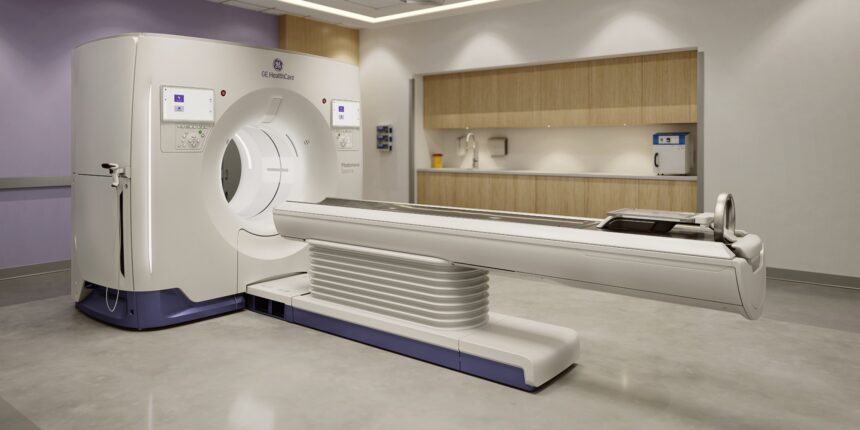
GE HealthCare this week announced FDA clearance for Photonova Spectra, the company’s first photon-counting CT scanner. While GE isn’t the first vendor with a commercially available PCCT scanner, it’s hoping to differentiate the system by highlighting the combination of ultrahigh-resolution scanning with spectral imaging.
Photon-counting CT represents a huge leap forward in CT instrumentation that’s not only driving new clinical applications but is also helping radiologists perform routine CT exams with better resolution and lower radiation dose.
- PCCT scanners directly convert photons to digital data, instead of using conventional CT’s two-step energy-integrating technique, resulting in images with less noise and supporting acquisition protocols with lower radiation dose.
Siemens Healthineers brought the first photon-counting CT scanner to market with the 2021 FDA clearance of Naeotom Alpha.
- Since then, Siemens has had the market for whole-body PCCT to itself, with only niche photon-counting scanners getting FDA clearance.
But we’re here to talk about GE’s Photonova Spectra, so let’s get to it. The system is based on GE’s Deep Silicon detector technology, which uses a novel semiconductor detector material that’s particularly suited for spectral imaging.
- Spectral CT acquires images at different energy levels, which is useful for detecting disease because malignant and benign tissue respond differently to different energy spectra.
GE is highlighting Photonova Spectra’s 8-bin energy resolution, which means the scanner separates incoming photons into eight distinct energy ranges – or bins – rather than grouping them into one or two.
- This enables Photonova Spectra to deliver much more precise spectral imaging than previously possible, with better quantitative accuracy and improved differentiation between materials like bone and soft tissue, according to GE CT executive Chad Rowland.
Spectral CT has developed a reputation as a technology that’s powerful but complex, and GE addressed this issue with workflow tools that make spectral imaging “always on” and easier than ever to perform.
- GE is banking on the combination of spectral imaging with Photonova Spectra’s ultrahigh-resolution images being a game-changer for many sites considering adopting their first PCCT scanner.
The Takeaway
FDA clearance for GE HealthCare’s Photonova Spectra photon-counting CT scanner is great news for the vendor that puts it on a level competitive footing with Siemens as a CT innovator. But it’s also good news for imaging providers, giving them another option for delivering to patients the benefits of PCCT – lower radiation dose and better image quality.
|
|
AI-Powered Population Health
DeepHealth is assembling radiology’s largest portfolio of AI-enabled radiology solutions for population health. Learn more about their focus and their recent acquisition of Gleamer in this video interview.
|
|
Exploring AI Readiness in Diagnostic Imaging
In collaboration with AHRA, Philips surveyed imaging leaders to assess AI adoption, value, and barriers. The State of AI in Diagnostic Imaging whitepaper delivers expert insights and practical guidance to move AI from promise to real-world clinical impact. Check out the white paper today.
|
|
- Middle East War Affects Helium Supplies: The ongoing war in the Middle East is affecting supplies of helium, which is used to cool MRI magnets. One-third of the world’s helium supply comes from Qatar and has been unable to pass through the Strait of Hormuz due to the conflict. The shortfall could drive up helium prices in the short term, but over the long term may prompt imaging providers to consider acquiring sealed-magnet MRI scanners, which use little or no helium.
- Bayer Lands First Gadoquatrane Approval: Bayer landed the first regulatory approval worldwide – in Japan – for gadoquatrane, the high-relaxivity, low-dose MRI contrast agent it developed to reduce gadolinium exposure. The agent will be sold in Japan under the trade name Ambelvist, and will be the first low-dose MRI contrast agent commercially available in the country. Bayer is awaiting gadoquatrane’s regulatory approval in Europe and the U.S. after submitting regulatory applications in July and August of 2025, respectively.
- Deepfake Images Fool Radiologists: It’s no secret it’s getting harder to tell the difference between real and AI-generated content – and that extends to medical imaging. In an experiment in Radiology, a panel of 17 radiologists had trouble differentiating real radiographs from AI-generated deepfakes. When presented with a set of 154 images, only 41% recognized that some were synthetically created. When asked to differentiate real images from fakes, they had mean accuracy of 75%, illustrating the challenge that could occur in identifying malicious use of deepfakes.
- Radiology’s Match Day Success: Medical students remain interested in radiology residency, based on results from the 2026 Main Residency Match. U.S. diagnostic radiology programs had a 98% fill rate (identical to 2025), with only 17 unfilled PGY-2 training slots from the 1,083 offered. Integrated interventional radiology had a 96% fill rate, while radiation oncology hit 98%. One broader trend is that the overall match rate for foreign-born international medical graduates who require visa sponsorship hit a five-year low and is lower than IMGs not requiring sponsorship (54% vs. 68%).
- CT Dose Reduction Reduces Cancer Risk: European researchers reduced the cancer risk for patients getting CT scans by more than 50% by using optimized scanning protocols and deep learning-based data reconstruction. Nine imaging centers in Switzerland took a four-phase approach to dose reduction over seven years, starting with protocol optimization and harmonization, followed by replacing older scanners and then implementing GE HealthCare’s TrueFidelity deep-learning image reconstruction protocol. Across 12k exams, standard radiation risk models indicated that the project reduced radiation-induced cancer risk by 53%.
- Stronger Fluoro Radiation Standards: As the U.S. government considers relaxing occupational radiation exposure standards, a coalition of cardiac and interventional medical groups is recommending that they be strengthened in one area, catheterization labs. A new report from the coalition recommends the adoption of ALARA+, an updated set of safety guidelines for fluoroscopy-guided procedures that includes better radiation protection technologies, real-time radiation monitoring, better radiation education and training, and stronger regulatory and accreditation standards.
- Repeat CAC Scans Guide Cardiac Risk Assessment: More research confirms the value of repeat testing with CT-derived coronary artery calcium scans. In a new paper in American Journal of Preventive Cardiology, researchers acquired CAC scores for 4.2k people from the CLARIFY study and followed them for almost six years. People with CAC scores of 0 at baseline and that didn’t increase over time had no increased risk of major adverse cardiovascular events, but those whose CAC scores got higher had nearly double the risk of MACE (HR = 1.96), an effect found across CAC severity levels.
- FDA Clears Philips Rembra CT Family: The FDA this month cleared Philips’ new Rembra family of wide-bore CT scanners, which the company highlighted at ECR 2026 after introducing radiation oncology-focused versions at ASTRO 2025. The scanners include the Rembra RT and Areta RT for radiation therapy guidance, while Rembra is focused on diagnostic radiology applications where its larger 85cm bore would be beneficial, such as bariatric surgery or for claustrophobic patients. The scanners also include Philips’ new XD detector technology for higher-resolution images.
- Newer USPSTF Criteria Still Miss Lung Cancer: The USPSTF in 2021 expanded its criteria for who should get CT lung cancer screening, but the new guidelines still may be missing at-risk people. In a new study in CHEST, researchers analyzed 15k patients diagnosed with lung cancer from three longitudinal epidemiology studies, finding that only 41% to 59% met the expanded 2021 USPSTF criteria. The biggest problem was that people either didn’t smoke long enough (at least 20 pack-years) or stopped smoking too long ago (over 15 years).
- FDA Clears Portable MSK Photon-Counting CT: With photon-counting CT in the headlines this week, MARS Bioimaging of New Zealand received FDA clearance for its portable PCCT scanner for musculoskeletal extremity imaging. The company is targeting non-hospital settings like clinical offices, sports medicine clinics, and ambulatory care, where the scanner can be used for surgical planning, fracture healing assessment, and identifying implant-related complications. MARS licensed the technology underlying the scanner from Europe’s CERN research lab.
- Enlitic Signs $1.5M Contract with Penn Medicine: Data standardization and migration services provider Enlitic signed a $1.5M contract with Penn Medicine. Under the agreement, Enlitic’s Laitek business unit will migrate 71M images from a legacy archive used by the health system’s Penn Medicine Doylestown Health provider to a modernized archive running on the Enlitic platform. It’s Enlitic’s second contract with Penn Medicine.
- Final Rule on Faxes: CMS just took a major step toward swapping out fax machines and snail mail for electronic claims transactions. The “groundbreaking final rule” establishes the first-ever standards for healthcare claims attachments, enabling the electronic exchange of supporting documentation such as medical records, imaging, visit notes, and lab results. Next, CMS should tackle healthcare’s use of another archaic technology – CDs – for medical image exchange.
- Cardiac Amyloidosis Partnership: Faster diagnosis of cardiac amyloidosis is the focus of a new partnership between Viz.ai and Alnylam Pharmaceuticals, which makes RNAi-based pharmaceuticals for treating the condition. Viz.ai will develop an AI-based care pathway within its Viz Cardio Suite for identifying cardiac amyloidosis earlier that leverages echocardiography AI algorithms developed by Us2.ai. The combination will identify at-risk patients from echo exams, then enable confirmatory testing, patient referral, and track follow-up.
|
|
Cardiac CT Online Training Course
Medality’s online cardiac CT training course is designed for busy clinicians working towards Level 2 Cardiac CT certification. Endorsed by SCCT, it provides a flexible, practice-focused approach to develop your coronary CTA interpretation and reporting skills while earning CME.
|
|
- Shifting the Stage in Lung Cancer Screening: Watch this video from Riverain Technologies to learn how their ClearRead CT solution for lung cancer screening can drive enrollment, earlier detection, and seamless management of incidental findings.
- Discover the Difference in Fluoroscopy: Whether tableside or universal remote, fluoroscopy systems impact safety, workflow, and patient care. Discover the difference LUMINOS Q.namix R and T from Siemens Healthineers make in the industry.
- Five Years Into the Cloud – And Just Getting Started: John Muir Health in California needed help dealing with its data deluge, which became acute with the adoption of 3D breast tomosynthesis. Find out how they turned to Sectra and their cloud-based enterprise imaging management for a solution.
- Transform Imaging Data into Actionable Predictions: When you choose Quibim, you get more than a partner for detecting and diagnosing prostate cancer on MRI scans. Learn how they can help you transform imaging data into actionable predictions by booking a demo today.
- Bring Your Radiology AI into Your Clinical Workflows: CARPL enables healthcare providers and researchers to develop, test, and deploy their own AI models within existing clinical infrastructure. From seamless data ingestion and de-identification to model training, packaging, and live deployment, CARPL provides an end-to-end environment tailored for radiology.
- 5 Data Migration Myths You May Still Believe: Many healthcare organizations fall victim to data migration myths that derail their efforts, waste valuable resources, and put their business at risk. Learn about five common myths and how they cost you in this article from Laitek, an Enlitic portfolio company.
- The Sound of Legacy Reporting Is a Beep – And It’s Slowing You Down: True innovation should remove friction, not add it. Discover why the best reporting software feels invisible on this page from Rad AI.
- Enterprise Imaging Done Differently: Legacy radiology solutions were not designed to carry healthcare organizations into the future. From their first line of code, Mach7 Technologies was designed to meet the imaging needs of the entire healthcare enterprise. Learn more about their unique approach today.
- One Viewer for All: Achieve ultrafast image interpretation with greater efficiency and precision with Visage 7 from Visage Imaging. Visage’s one-viewer philosophy enables all end users – from radiologists to clinicians – to access powerful tools based on clinical need.
- Tackling Radiology’s Capacity Issue: Healthcare providers are under pressure from rising costs, care delays, and growing cybersecurity risks. Watch this video to discover how Mosaic Clinical Technologies delivers a future-ready imaging solution that improves continuity of care and accelerates detection for faster, more appropriate interventions.
- From Image Exchange to Enterprise Interoperability: Easily share, access, and exchange any medical image with solutions from Medicom. Deliver critical studies directly into the EHR to ease clinician burden, simplify your tech stack, and unlock the research potential hidden in clinical imaging data.
- Building an Enterprise Imaging Ecosystem: MultiCare Health System wanted to create an enterprise imaging foundation to secure its own future and that of smaller clinics and rural hospitals that need support providing patient care. Find out how they did it with Merge in this case study.
- AI Echo for Pulmonary Hypertension Assessment: Pulmonary hypertension requires careful evaluation with echocardiography, but traditional manual interpretation is time-consuming. Read this paper on how Us2.ai’s AI echo technology powered a fully automated deep learning workflow.
- AI-Empowered CT Workflow: CT systems from United Imaging are designed for high image quality and low dose, and their AI-empowered workflow enables fast and reproducible positioning, helping you image patients with confidence. Learn more on this page.
- Connected Imaging. Empowered Flow: Know those rare and indescribable moments at work when distractions melt away? AGFA HealthCare’s Enterprise Imaging Platform is designed to keep you in that hyper-focused state of mind all day long. Learn more about their solutions today.
- Why Radiology Reporting Needs a Reset: Radiologists are under growing pressure, yet many reporting tools still slow them down. Kailo Medical believes reporting should support clinical thinking, not add to the workload. Discover how their KailoAir solution can help you reset your reporting.
- Next-Generation 1.5T MRI: Echelon Synergy from Fujifilm Healthcare Americas is a powerful and affordable next-generation 1.5T MRI system featuring Synergy DLR deep-learning reconstruction, fast exam times, and patient-friendly design. Discover how it can help you achieve faster workflow and improved image quality.
|
|
|
|
|


