|
VC Funding Bounces Back, FDA Breakthroughs, and CCTA of Plaque
February 12, 2026
|
|
|

|
|
Together with
|

|
|
|
“Total capital has rebounded, signalling renewed investor confidence after a cautious period, but this recovery is uneven and concentrated rather than broad-based.”
|
|
Umar Ahmed of Signify Research, on VC funding of radiology AI firms in 2025.
|
|

|
|
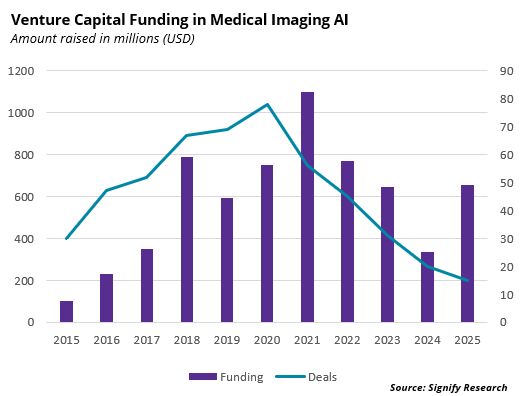
After a long slide, venture capital funding for medical imaging AI companies bounced back in 2025. That’s according to the latest report from market intelligence firm Signify Research.
VC funding of AI startups has declined steadily since 2020, when cheap money fueled by low pandemic-era interest rates spurred a boom in both the total dollar value of investments as well as the number of funding rounds getting done.
- Previous Signify reports documented the trend well, with the number of funding rounds peaking at nearly 80 in 2020 and total funding crossing the $1B mark in 2021. But by 2024, funding rounds had fallen by 64% and their dollar value by 70%.
But the numbers for 2025 show a turnaround starting, at least with respect to dollar value…
- Total funding more than doubled compared to the year before ($709M vs. $336M).
- While the number of funding rounds fell 17% (19 vs. 23).
- But the size of the average funding round grew 112% ($39M vs. $19M).
In analyzing the numbers, Signify found that while funding momentum is coming back, investors are being more selective.
- Capital is concentrating in companies that have a clear enterprise fit, a strong integration pathway, and the ability to operate within platform and imaging IT ecosystems.
Funding rounds of note in 2025 included…
- Aidoc’s haul of $150M.
- An Ultromics funding that put the company in Signify’s coveted $100M club.
- Cerebriu gaining over $10M in a Series A round.
- a2z pulling in $4.5M in seed funding for its multi-triage platform.
The report addresses turbulence in the AI platform sector, which saw significant disruption in 2025 after Bayer’s withdrawal from the market.
- Platform companies will need to move beyond AI orchestration and show they can actively improve radiology workflows and deliver better clinical decisions and measurable impact.
The Takeaway
The 2025 bounceback in VC funding for AI firms is welcome news that the correction that followed the sugar high of 2020/2021 may have worked its way through the system. AI investments in 2026 are likely to be smarter and more focused, and in companies that have demonstrated their value in helping radiologists work more efficiently.
|
|
One Viewer for All
Achieve ultrafast image interpretation with greater efficiency and precision with Visage 7 from Visage Imaging. Visage’s one-viewer philosophy enables all end users – from radiologists to clinicians – to access powerful tools based on clinical need.
|
|
Turning Clinical AI Research into Real-World Readiness
Discover how a strategic partnership between Stanford University and Radiology Partners’ Mosaic Clinical Technologies division will pioneer new methods for assessing and monitoring AI tools for medical imaging.
|
|
The Power of a Smooth Go-Live
Don’t gamble on your healthcare institution’s go-live: take control of your PACS migration with ENDEX from Enlitic. Discover how ENDEX uses AI to standardize, normalize, and cleanse your imaging metadata before migration.
|
|
- FDA Updates Breakthrough Device List: The FDA issued an update last week to its list of medical devices granted breakthrough designation. The agency in 2025 issued 164 breakthrough designations, down by one compared to 165 in 2024. Radiology has garnered 46 of the 1,246 designations (3.7%) since the program’s start in 2015. Breakthrough medical imaging devices that went on to get marketing authorization in 2025 include Naitive Technologies’ OsteoSight BMD software and InVision Medical’s InVision Precision Cardiac Amyloid AI algorithm for detecting cardiac amyloidosis on echo.
- ThinkSono Gets Breakthrough Nod: The FDA has issued 42 breakthrough designations so far in 2026, and one of them is ThinkSono’s ThinkSono Guidance AI algorithm for detecting deep vein thrombosis. The company notes that DVT affects up to 900k people a year in the U.S., and ThinkSono Guidance can help detect blood clots on ultrasound scans even if they are performed by non-expert users. The company is moving ThinkSono Guidance toward a regulatory submission in the U.S.
- AI Predicts DCIS Recurrence: Survival rates in women with DCIS are generally good, but their prognosis worsens if recurrence occurs. In a new AJR paper, Lunit’s Insight for Mammography AI algorithm predicted recurrence after DCIS surgery in 1.7k patients. If a patient had an AI risk score ≥ 74%, they had nearly 3X the risk of recurrence in the same breast (HR = 2.88). In December, Lunit filed a 510(k) application for Insight Risk, a risk-prediction tool different from the one used in this study.
- CCTA Plaque Measurements Predict MACE: Measures of plaque burden and volume from coronary CT angiography exams helped predict major adverse cardiovascular events in a sub-analysis from the PROMISE trial published in JAMA Cardiology. Among 4.3k patients who got CCTA exams, risk of MACE was significantly higher in people with total plaque volume ≥ 87 mm3, total plaque burden ≥ 35%, and noncalcified plaque burden ≥ 20% (adjusted HR = 2.07, 1.96, and 1.77, respectively). The findings reinforce CCTA’s value in predicting adverse cardiovascular events.
- CAC Helps Predict Plaque Volume: CT-derived measurements of coronary artery calcium can help predict total plaque volume, which itself is a predictor of adverse cardiovascular events. In a new paper in American Journal of Preventive Cardiology, researchers found that among 199 patients, CAC scores were the most effective among several lipid analysis metrics in improving the AUC of MESA cardiovascular risk scoring (from 0.50 to 0.91). Adding CAC and other lipid measurements to MESA scores showed high sensitivity and specificity for predicting total plaque volume (81% and 93%, respectively).
- Radiation Exposure Outliers: A study in Journal of the Society for Cardiovascular Angiography & Interventions revealed that the top 10% of high-radiation coronary cases account for over 60% of an operator’s cumulative dose. Specifically, STEMI procedures carry a sixfold higher risk of being radiation outliers, often due to emergency cases that bypass safety protocols. These findings suggest that median dose is a poor safety metric, underscoring a need for real-time monitoring and enhanced protection devices to reduce disproportionate risk.
- ACR Weighs in on Residency Funding: ACR commented on the lack of funding for new diagnostic radiology residency slots under the federal Section 126 program. The group noted that the stringent criteria for new slots – many of which are targeted at rural areas or psychiatry training programs – may make it harder for DR programs to qualify, but they should still be eligible for many remaining Section 126 slots. ACR noted it is working with stakeholders to address the radiologist shortage and secure more Medicare-funded DR slots.
- The Economics of Radiology Education: The complex economics behind U.S. radiology education were also the focus of a new JACR article. The piece explores why the growth rate for radiologist training slots from 1997 to 2025 has fallen behind total residency growth (62% vs. 93%), in spite of high demand for diagnostic radiology residency and a large number of unfilled radiology jobs on the ACR job board (1.9k positions as of April 2025). The authors suggest several proposals for non-Medicare residency funding.
- Focus Continues on Never-Smoker Lung Cancer: The challenge of lung cancer in people who have never smoked is the focus of new commentary in Trends in Cancer. The phenomenon occurs more often in women and Asian populations, with female never-smokers twice as likely to get lung cancer as male never-smokers. CT lung screening is a possibility, but to be cost-effective needs to be targeted based on risk, such as a family history of lung cancer. The FANSS trial in New York is investigating CT screening in Asian female never-smokers.
- Median’s eyonis LCS AI Gets Cleared: A new option for AI assistance in CT lung cancer screening is now available after Median Technologies got FDA clearance for its eyonis LCS solution. The software is designed to help radiologists identify suspicious lung lesions at an earlier stage, and Median noted that trials of the software found high sensitivity and specificity (93% and 92%, respectively). With clearance in hand, Median is now preparing for eyonis LCS’s commercial launch in the U.S.
- Imaging Guides Prostate Screening Pilot Project: Screening men for prostate cancer isn’t currently recommended under most guidelines, but a pilot project in the Netherlands could change that. Four Dutch medical centers will screen 25k men using a risk-based protocol in which men with elevated PSA levels will first get ultrasound to measure the ratio between PSA levels and prostate volume. If this is abnormal, they’ll then be sent on for MRI, with tissue biopsy to follow if cases are still suspicious.
- PSMA-PET/CT Targets Prostate Treatment: Among men diagnosed with recurrent prostate cancer after surgery, PET/CT with a gallium-68-labeled PSMA radiopharmaceutical helped direct radiation therapy, with good clinical outcomes. In a trial with 113 men with rising PSA levels after surgery, PSMA-PET/CT was used to guide radiation dose escalation to areas of disease. At a median follow-up of five years, these patients had overall survival of 97%, freedom from distant metastases of 72%, and progression-free survival of 49%.
- Oxipit’s AI Expansion: Lithuanian AI developer Oxipit is expanding from its core focus on AI for chest X-ray into chest CT and musculoskeletal X-ray. The company launched CT Eye to identify pulmonary embolism, lung nodules, and lung consolidation on chest CT scans, while MSK Eye is designed to detect skeletal and joint abnormalities on musculoskeletal X-ray exams. Both algorithms support triage as well as post-report quality checks to detect discrepancies between images and radiology reports. Oxipit will highlight both applications at the upcoming ECR 2026 conference.
|
|
Driving Efficiency in Radiology
Radiology’s workforce is under pressure. Discover evidence-based strategies for driving efficiency without burning out your staff in this e-book from Riverain Technologies.
|
|
Empowering Radiologists at the Point of Interpretation
Reserve your seat at this February 12 webinar to learn how Rad AI and RSNA Ventures have partnered to deliver trusted, peer-reviewed RSNA insights directly into the radiologist’s workflow — at the exact point of interpretation.
|
|
Enterprise Imaging Done Differently
Legacy radiology solutions were not designed to carry healthcare organizations into the future. From their first line of code, Mach7 Technologies was designed to meet the imaging needs of the entire healthcare enterprise. Learn more about their unique approach today.
|
|
- AI Handheld Echo for Preoperative Assessment: Read this case study on the feasibility of handheld echo equipped with Us2.ai software for assessing left ventricular diastolic dysfunction in preoperative patients and how it compared to cart-based systems.
- One Imaging Platform for Your Enterprise: Bring radiology and all departments across the enterprise on the same page: one platform, one user experience, with no extra tools or training required. Find out what Merge has to offer on this page.
- Cutting-Edge PET/CT to Support Theranostics: Theranostics is an exciting new field that combines diagnostics and therapy. Discover how Florida Theranostics is using United Imaging’s uMI Panorama PET/CT scanner to establish a high-quality level of patient care.
- Transform Imaging Data into Actionable Predictions: When you choose Quibim, you get more than a partner for detecting and diagnosing prostate cancer on MRI scans. Learn how they can help you transform imaging data into actionable predictions by booking a demo today.
- Bring Your Radiology AI into Your Clinical Workflows: CARPL enables healthcare providers and researchers to develop, test, and deploy their own AI models within existing clinical infrastructure. From seamless data ingestion and de-identification to model training, packaging, and live deployment, CARPL provides an end-to-end environment tailored for radiology.
- AI-Centric Radiology Reporting: KailoAir is a new AI-centric radiology reporting solution from Kailo Medical that combines real-time voice dictation, AI-powered prior study analysis, and structured reporting in a seamless browser-based workspace. No installation and no compromise.
- Transform Your Workflow with Intelligent Imaging: Radiology departments face growing challenges: higher workloads, fewer staff, and tighter budgets. Discover how intelligent imaging technology from Siemens Healthineers streamlines processes, reduces stress, and improves outcomes. Access the white paper now and transform your workflow.
- The World’s Happiest Customers – 13 Straight Years: Sectra continues to top the charts when it comes to customer satisfaction. The company recently won seven Best in KLAS awards, including the 13th straight for its Sectra PACS enterprise imaging solution. Find out why on this page.
- Discover AI-Powered Radiology Screening Solutions: Visit DeepHealth at ECR 2026 to learn more about how they are transforming population health and cancer screening with innovative AI solutions. Book a meeting today.
- AI-Powered Precision Imaging: When AI meets precision imaging, healthcare teams gain back the most valuable resource of all – time. Watch this Imaging Wire Show interview with Madhuri Sebastian and Ioannis Panagiotelis to hear how Philips is advancing precision imaging powered by AI.
- Radiology Case Report: A man in his 40s presented with a known metastasis within his abdomen. Learn how contrast-enhanced MRI helped to diagnose the extent of his disease.
- Financial Planning for Radiologists: Every stage of a radiologist’s career brings new financial challenges and opportunities. Watch this on-demand webinar from Medality to learn how to take control of your future through smarter financial planning, decision-making around RVU-based compensation, productivity models, and private-practice economics.
- Reimagining Cloud-Native Cardiology Workflow: Find out how Intelerad’s next-generation cloud-based InteleHeart solution delivers an all-in-one cardiology platform that unifies viewing, reporting, analytics, and workflow orchestration.
- An AI-Powered Solution for Fracture Detection: Gleamer’s BoneView provides radiologists and clinicians with an instant and automatic second reading of trauma bone X-rays, fully integrated into the reading workflow. See how it works today.
|
|
|
|
|