|
FDA AI Approvals Surge Past 1k, Mammo Risk, and Health AI Use Lags
December 11, 2025
|
|
|

|
|
Together with
|

|
|
|
“Every diagnosis is a kind of story. To tell it well, one must see the person, not just the lesion.”
|
|
Jean-Christophe Rufin, MD, French physician and novelist.
|
|
|
AI. Cloud-native. Unified platform. These buzzwords sound great, but what do they really mean? And how are they helping radiologists achieve what matters most: faster reading and reporting of medical images? If you’re looking for a guide that cuts through the jargon, check out this downloadable eBook from OnePACS.
|
|
|
|
The number of AI-enabled medical devices granted FDA marketing authorization for radiology surged past the 1k mark in the latest update from the agency. The numbers show that radiology’s share of authorizations remains stable at just over three-quarters of total approvals.
The FDA regularly releases the list in what’s become a closely watched barometer of both total approvals as well as which medical specialties are most active in AI.
- Radiology has historically garnered the lion’s share of approvals – perhaps no surprise given the discipline’s early adoption of both digital image management and AI – with the first authorization granted in 1998 (for ImageChecker mammography CAD from R2 Technology/Hologic).
The new list tracks authorizations through the end of September 2025, and indicates the agency has…
- Authorized 1,356 AI-enabled devices since it started tracking, up 8.5% since its last report.
- Approved 1,039 AI-enabled radiology devices, with imaging accounting for 77% of total medical authorizations since 1998.
- Radiology secured 75% of total authorizations from June to September (83/110), compared to 78% from January to May 2025, 73% for all of 2024, and 80% for 2023.
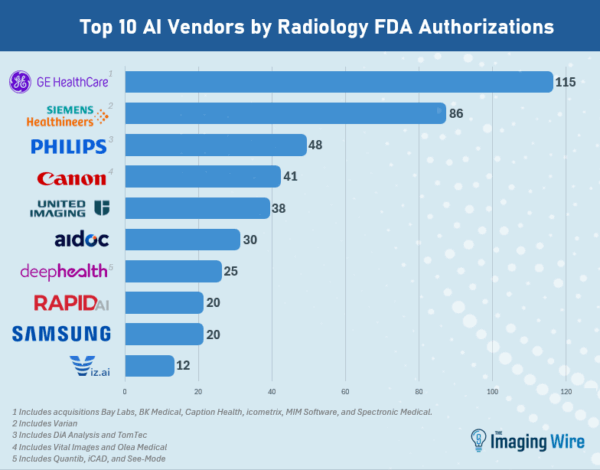
- GE HealthCare retains the top spot as the company with the most radiology AI authorizations, at 115 (including recent acquisitions Bay Labs, BK Medical, Caption Health, MIM Software, icometrix, and Spectronic Medical).
- Next is Siemens Healthineers at 86 (including Varian), then Philips at 48 (including DiA Analysis and TomTec), Canon at 41 (including Vital Images and Olea), United Imaging at 38, and Aidoc at 30.
As always, it’s worth noting that the FDA’s list includes not only standalone software applications, but also imaging equipment that might have AI applications embedded into it, such as a mobile X-ray system with AI algorithms for detecting emergent conditions.
- Also, the agency noted that it is exploring ways to identify and tag AI-based devices that use foundation models and large language models. The FDA has yet to approve an LLM-based medical device.
The Takeaway
The new numbers indicate that radiology’s dominance of medical AI continues. But they also show that the FDA has returned to a regular twice-yearly cadence of updating its list of AI-enabled medical devices after a break of nearly a year – news that’s welcome to AI developers.
|
|
Mobile X-Ray Designed for Going Places
The Philips Radiography 7000 M mobile radiography system was designed for going places. Read how technologists at the University of Vermont Medical Center rely on its long battery life to go a whole shift without re-charging.
|
|
It’s Time to Make AI Adoption Simple
Gleamer unifies a fragmented AI landscape into a single, simple, powerful platform. Discover an AI ecosystem where everything is designed to be intuitive, consistent, and scalable, making AI adoption simpler than ever.
|
|
- FFR-CT Predicts Cardiac Risk: New data from the FISH&CHIPS study in the U.K. underscores the value of Heartflow’s FFR-CT AI software for predicting future cardiovascular events in patients with suspected stable coronary artery disease (angina). Data presented at EACVI 2025 this week found that among 7.8k patients getting FFR-CT analysis, after three years those with severely reduced fractional flow reserve had over 5X the rate of myocardial infarction than those with normal FFR-CT (5.2% vs. 1%).
- Lunit Files for Mammo Risk AI: The emerging AI-based breast cancer risk prediction segment is about to get more competitive after Lunit filed for 510(k) clearance of Insight Risk, an AI algorithm that predicts five-year breast cancer risk. The algorithm was developed by Prognosia, the Washington University School of Medicine spinoff that Lunit acquired earlier this year. Experts believe risk predictions based on AI analysis of screening mammograms could be more accurate than clinical criteria like the Tyrer-Cuzick model.
- Lung Screening Lags in Alabama: CT lung cancer screening rates in the U.S. are approaching 20% nationally, but one state that’s still lagging is Alabama. A new analysis in JACR examines barriers in the state, finding that of 67.3k people meeting 2013 USPSTF criteria, only 2% got screened. Lack of insurance reimbursement and distance to screening centers affected screening rates, while qualitative interviews with patients revealed that fatalistic attitudes and the stigma around smoking prevented many from seeking out screening.
- Riverain Partners with VIDA: Riverain Technologies will provide its ClearRead CT cardiothoracic image analysis software to VIDA Diagnostics under a new partnership. ClearRead CT will be made available to researchers through the VIDA Intelligence Platform, software that gives pharmaceutical science teams a centralized approach for managing imaging-based biomarkers during clinical trials.
- Bayer Expands Centargo Injector Options: Bayer’s Medrad Centargo CT contrast injector now supports a wider range of contrast packaging after receiving FDA 510(k) clearance for single-dose vials. Centargo already supported imaging bulk packages for Ultravist, Isovue, Optiray, and Omnipaque, and the clearance gives users the flexibility to administer single-dose contrast vials if needed without having to open another bulk package.
- Mammo AI for DBT Screening: Most large-scale studies of breast screening AI have used 2D mammography, but a new study in AJR found AI useful for DBT screening as well. Hologic’s Genius AI Detection 2.0 solution was used to analyze 7.5k DBT screening exams, finding 32% of cancers missed by radiologists and detecting and localizing 90% of radiologists’ true-positive detections. AI was more likely to detect cancers that were initially found to be negative but were detected on later workup.
- Imaging Bills Introduced: Two bills that affect medical imaging were introduced in U.S. Congress in November. The Find It Early Act would require health insurers to pay for additional screening exams required for women with dense breast tissue or other cancer risk factors. Meanwhile, the Health Tech Investment Act was introduced in the House of Representatives as a companion to a bill already in the Senate. The legislation would simplify the Medicare coverage pathway for FDA-authorized AI medical devices.
- a2z Raises Seed Round: AI startup a2z Radiology AI raised $4.5M in a seed funding round. The company was founded in 2024 by Harvard professor Pranav Rajpurkar, PhD, and technology executive Samir Rajpurkar and is developing a platform for analyzing CT images. In related news, the company received FDA clearance for a2z-Unified-Triage, an algorithm that flags and prioritizes seven urgent findings on abdomen-pelvis CT scans simultaneously.
- AIRS Medical Launches SwiftSight: AIRS Medical launched SwiftSight at RSNA 2025. The AI-based solution supports quantification and reporting of brain MRI scans, and complements the company’s SwiftMR software for reducing MRI scan times. SwiftSight takes SwiftMR data and gives radiologists additional analysis tools, such as by tracking brain health over time with quantitative data regardless of make or model of MRI scanner. It also includes features to help patients gain insight into their MRI scans.
- Imagion Targets December IND Submission: MRI contrast developer Imagion Biosystems is on track to file an IND this month for its MagSense HER2 imaging agent after receiving positive clinical results from a trial with Wayne State University. Wayne State researchers successfully reduced the MagSense dose to one-third of that used in a Phase 1 study, selected optimized MRI sequences for better workflow and faster scan times, and tested quantitative imaging techniques. After the IND submission, a Phase 2 study is expected to start in early 2026.
- Imaging Biometrics Expands GE Alliance: Neuroimaging software developer Imaging Biometrics expanded its distribution relationship with GE HealthCare to include two additional solutions, FTB Express and QSMetric. The alliance previously included Imaging Biometrics’ IB Neuro and Delta T1 Maps products, and the new additions will give users access to additional tools for analyzing brain MRI scans. Separately, Imaging Biometrics released a new version of its IB Clinic image processing software suite that includes new automation features.
- WellSpan Scales Up with Aidoc AI: WellSpan Health expanded its relationship with Aidoc to deploy the company’s AI solutions at additional hospitals. WellSpan will now deploy Aidoc across all nine of its hospitals and 250 other sites in Pennsylvania and Maryland that serve over 1M patients. The companies first partnered in 2022.
- Rayus Settles Data-Sharing Lawsuit for $18M: Teleradiology provider Rayus Radiology paid $18M to settle a class-action lawsuit that charged the company with sharing patient data with third parties like Facebook and Google without patient consent. Participants in the settlement are eligible to receive a $25 cash payment.
- Konica Minolta Debuts DR Systems: Among the RSNA 2025 highlights at Konica Minolta Healthcare Americas were KDR FMT and KDR FMT+, two new floor-mounted digital radiography systems. Both systems feature Konica Minolta’s tube-mounted control interface for better patient workflow, with table support for patients up to 700lb and an included wall stand. KDR FMT is fully manual, while KDR FMT+ is a motorized system with automatic detector tracking. In other news, Konica Minolta announced a partnership with ASCEND Cardiovascular to develop an enterprise image management system for cardiology practices.
- DeepLook Signs Partners: Breast imaging visualization firm DeepLook Medical signed new partnerships for its DL Precise tumor morphology visualization technology. The new partners are Ikonopedia, Incepto, Pintail Strategic Advisors, and TestDynamics, and the companies will integrate DL Precise with their own AI and reporting applications.
- Healthcare AI Use Lags, But Is Growing: Healthcare lags other industries in adopting AI, but it’s picking up steam. A new study in JAMA Health Forum analyzed AI deployment in five business sectors from September 2023 to May 2025, finding at the start of the study fewer than 5% of healthcare organizations were using AI, but the percentage began growing in December 2024 and reached nearly 10% by the study’s end. Still, healthcare lagged the other four sectors in AI adoption through the study period.
|
|
Every Image Tells a Story
Intelerad’s enterprise image management solutions are empowering radiologists and patients while transforming radiology workflows. Learn about the technologies they highlighted at RSNA 2025 for empowering imaging professionals.
|
|
Learn a New Subspecialty in 5 Minutes a Day
Become a faster, more confident radiologist with expert-led online video courses from Medality. Gain simulated practice with the largest collection of curated, scrollable DICOM cases available anywhere. Browse their library of radiology courses today.
|
|
- The Next Generation of Universal Remote Imaging: Step into the next generation of universal remote imaging with LUMINOS Q.namix R from Siemens Healthineers. Designed for intuitive operation and patient comfort, this award-winning system sets a new standard in fluoroscopy. Explore its precision and efficiency.
- A Next-Generation Oncology Ecosystem: Quibim launched their next-generation oncology ecosystem platform at RSNA 2025. Find out how QP-Prostate provides a comprehensive, end-to-end management workflow for prostate cancer care, supporting clinicians from the earliest stages of image acquisition through diagnosis, patient management, and follow-up.
- Presenting Unboxing AI: Check out CARPL’s video series, Unboxing AI, featuring experts discussing AI and its future in radiology. The next episode on December 11 features Larry Sitka of PaxeraHealth – reserve your seat today.
- Elevating Breast Cancer Detection: Breast Suite from DeepHealth is a new package of AI-powered solutions delivering increased breast cancer detection rates, risk stratification tools, and viewing and reporting workflow acceleration. Find out how it can benefit your practice today.
- A New Era of Imaging Technology: MosaicOS is the cloud-native and AI-native operating system from Mosaic Clinical Technologies designed to expand capacity, cut reporting time, and deliver faster, smarter patient care. Discover how it can improve your radiology operations today.
- Interpretation Efficiency in Radiology – A Critical Strategy: Healthcare institutions are at a critical stage, where an emphasis on interpretation efficiency needs to be a priority. Check out this white paper from Visage Imaging and Signify Research on strategies to optimize your interpretation efficiency.
- AI Innovations in Lung Disease: Check out this on-demand webcast to hear from Riverain Technologies and GE HealthCare executives as they discuss AI applications developed to detect lung nodules, in particular how AI can be integrated into PACS.
- Cut Repetitive Manual Tasks: Discover how Rad AI’s radiology reporting software helps you speak less and say more by reducing dictation times up to 50% and words dictated up to 90%. Join 9 of the top 10 radiology practices using Rad AI to improve efficiency.
- AI Handheld Echo for Preoperative Assessment: Read this overview of an ASE 2025 paper on the feasibility of handheld echo equipped with Us2.ai software for assessing left ventricular diastolic dysfunction in preoperative patients and how it compared to cart-based systems.
- AI-Centric Radiology Reporting: KailoAir is a new AI-centric radiology reporting solution from Kailo Medical that combines real-time voice dictation, AI-powered prior study analysis, and structured reporting in a seamless browser-based workspace. No installation and no compromise.
- Workflow Orchestration to Revolutionize Imaging: Intelligent teleradiology solutions can combat radiologist shortages with smarter workflows that reduce burnout and improve patient care. Find out how workflow orchestration solutions from Merge are making it possible.
- Optimize Radiology Workflows: Harness cloud and AI technology to help your radiology teams unlock insights, increase efficiencies, and improve patient care. Learn more about an integrated approach to AI in radiology in this e-book from Microsoft.
- A Passion for Change: United Imaging’s passion for change was on display at RSNA 2025 with the launch of new products across multiple modalities, including the new uSonique ultrasound family shown as works-in-progress. Find out what drives the company on this page.
- Connected Imaging. Empowered Flow: Know those rare and indescribable moments at work when distractions melt away? AGFA HealthCare’s Enterprise Imaging Platform is designed to keep you in that hyper-focused state of mind all day long. Learn more about their solutions today.
- Enlitic’s RSNA 2025 Highlights: What were RSNA 2025 highlights at Enlitic? Chief Strategy Officer Steve Rankin explains the company’s approach to data standardization as well as its recent emphasis on data migration thanks to its acquisition of Laitek.
|
|
|
|
|


