|
Lung Screening Leads RSNA, Breast Cancer Risk, and Photon-Counting CT
December 1, 2025
|
|
|

|
|
Together with
|

|
|
|
“So #RSNA25 kinda snuck up on me. I was too busy sitting here counting up my RVUs to make sure I work just enough to keep my job.”
|
|
Body Rad Gal.
|
|
|
|
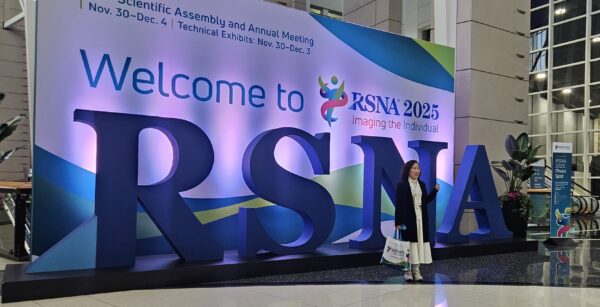
Day 1 of RSNA 2025 is in the books, and new research into CT lung cancer screening dominated the scientific sessions at Chicago’s McCormick Place.
Lung cancer screening is drawing attention as screening programs go into effect internationally.
- In the U.S., lung screening is hampered by low completion rates (18-19%), but providers are finding that participation can be improved with aggressive identification and outreach to eligible patients.
Some highlights from Sunday (with handy session numbers to help you follow along) include…
- The ScreenLungNet AI model predicted three-year lung cancer risk from CT lung screening scans with AUCs from 0.93-0.94 (S4-SSCH02-1).
- In a study of 2.6k patients with lung cancer, only 36% met 2021 USPSTF lung cancer screening criteria, and just 5% actually got screened. Only 23% had data on their smoking history in the EMR (S4-SSCH02-2).
- Risk assessment scores were used to perform CT lung screening of lower-risk people every two years rather than annually, reducing screening’s harms without missing many cancers (S4-SSCH02-4).
- Compared to the landmark NLST study, a real-world CT lung screening program had fewer benign surgeries (12% vs. 18%), lower complication rates (24% vs. 32%), and better recurrence-free survival (HR = 0.60) (S4-SSCH02-5).
- CT radiation dose was reduced 51% and contrast iodine use 61% through a triple-optimized protocol that included 80-kVp scanning, GE HealthCare’s TrueFidelity deep learning reconstruction, and low-iodine adaptive contrast injection (S2-SSCA01-1).
- Using AI for automated patient positioning and scan range in CT exams cut positioning time 41% with 10-13% lower radiation dose and no discernible impact on image quality (S4-SSIN01-1).
- Measures of adiposity acquired opportunistically from coronary artery calcium CT scans using HeartLung Technologies’ AI-CVD algorithm predicted adults at risk of diabetes in a study of 2.9k people (S5-SSCA02-6).
- The Promedius AI algorithm for osteoporosis assessment of chest radiographs had an AUC of 0.84 in a study of 1k adults from three countries (M3-SSCH03-1).
- A real-world study of 2.1k patients found that DeepTek’s chest X-ray AI algorithm had an AUROC of 0.95 for detecting any of 13 clinically significant findings (M3-SSCH03-2).
- Researchers presented a feasibility study of a compression-free spectral DBT mammography system, finding spatial resolution close to state-of-the-art systems (S4-SSPH02-6).
- Researchers presented their protocol for MRI scanning of patients with cardiac implanted electronic devices. Over 10 years they scanned 7.3k patients with no major adverse events (S5-SSCA02-1).
- Adding MRI data to a multimodal transformer AI model improved its ability to predict five-year breast cancer risk in intermediate- and high-risk women (S2-SSBR01-6).
The Takeaway
RSNA 2025 is off to a great start. Be sure to check back with Thursday’s newsletter for more radiology news from Chicago, and follow along on our social media channels for ongoing video updates.
|
|
A New Era of Imaging Technology
MosaicOS is the cloud-native and AI-native operating system designed to expand capacity, cut reporting time, and deliver faster, smarter patient care. Discover how it can improve your radiology operations by visiting Mosaic Clinical Technologies at RSNA 2025 booth #7108.
|
|
What Would You Do with an Extra Hour?
Rad AI Impressions automatically generates your report impressions in your own voice, from your dictated findings. Radiology teams already use Rad AI to give radiologists their time back. See what you could do with yours. Book your RSNA meeting today.
|
|
Connect Every Pixel to the Patient Story
Mach7 Technologies is soaring above silos at RSNA 2025 with an imaging architecture that unifies your data, takes your EMR to new heights, and transforms images into insights. See how with a demo at booth #3351.
|
|
- AI for Breast Cancer Risk Prediction: In a study presented at RSNA 2025, Clairity’s AI algorithm for predicting five-year breast cancer risk from mammograms was more accurate than breast density alone. In a study with 245k mammograms, women classified by Clairity Breast as high risk had 4X the incidence than average-risk women (5.9% vs. 1.3%), while density alone showed a smaller gap (3.2% for dense vs. 2.7% for non-dense breasts). Clairity received FDA de novo clearance for the algorithm earlier this year.
- GE’s Photon-Counting CT: GE HealthCare filed a 510(k) application for a photon-counting CT scanner called Photonova Spectra. The scanner is based on GE’s Deep Silicon semiconductor detector material, which is designed for enhanced spectral imaging to better characterize materials like tissue composition. GE is also touting the scanner’s wide detector coverage, 0.23-second rotation speed, and eight bins of energy resolution. Once cleared, Photonova Spectra will compete with Siemens Healthineers’ Naeotom Alpha PCCT scanners.
- ‘Alarming’ Jump in Younger Breast Cancer: Another RSNA 2025 study documents the “alarming” increase in breast cancer in younger women that’s been detected in other studies. Researchers tracked 1.8k breast cancers occurring from 2014 to 2024 at seven outpatient centers in New York, finding that 20-24% of all cancers were in women aged 18-49. The findings suggest risk-based screening might be better than the age-based guidelines currently in use.
- Imaging Biomarkers Predict Disease: Research using imaging biomarkers to predict future disease is a hot topic at RSNA 2025. Researchers presented findings from a study using an AI algorithm to measure adrenal gland volume from chest CT scans, finding the measurements correlated with salivary cortisol levels, a measure of stress. In another RSNA study, 3D MRI mapping of the gluteus maximus muscle in the buttocks revealed that greater muscle shape was linked to lower levels of type 2 diabetes, while aging, frailty, and prolonged sitting were linked to thinner muscles.
- Muscle Composition Linked to Brain Age: In another biomarker study presented at RSNA 2025, researchers found that MRI measurements of visceral fat – fat deep in the abdomen around vital organs – can be linked to brain aging. In 1.2k healthy people at an average age of 55, AI was used to analyze T1 whole-body MRI scans, finding that a higher ratio of visceral fat to muscle was associated with older brain age. On the other hand, subcutaneous fat had no association.
- More RSNA 2025 Headlines: In other hot topics at RSNA 2025, researchers used a DTI-ALPS MRI protocol to discover that boxers who sustained repeated head impacts had changes in the glymphatic system, which removes waste from the brain. And another study used MRI scans of people with knee pain to find that some injuries like ACL tears were more common in men than women, but older women were more prone to injuries that lead to joint degeneration over time.
- Gleamer’s AI Evolution: French AI company Gleamer is using this week’s RSNA 2025 to highlight its evolution beyond its core market of AI-based fracture detection. The company is unifying more than 11 AI solutions covering X-ray, CT, MRI, and mammography into one platform, powered by the GleamerOS system. Gleamer is also debuting a radiology reporting solution called AutoReport, as well as a voice-to-report application that’s launching in 2026.
- Kailo’s New Reporting Platform: Kailo Medical is launching a new web-based radiology reporting platform called KailoAir at this week’s RSNA 2025. KailoAir uses large language model AI technology to enable radiologists to create structured reports and includes features like real-time voice dictation, AI-generated summaries of prior reports, and built-in error detection. It also integrates with clinical systems like the company’s KailoFlow and third-party RIS/PACS.
- Avandra’s Image Sharing Acquisitions: Data aggregator Avandra Imaging boosted its position in the medical image sharing segment with not one but two acquisitions. In the first purchase, the company bought DatCard Systems, a supplier of DICOM distribution solutions based in Irvine, California. It also purchased Sorna, a supplier of automated data distribution software in Eagan, Minnesota. Avandra emerged from stealth in late 2024 and raised $17.8M earlier this year.
- Samsung Launches Ultrasound Scanner: Samsung Medison is launching a new ultrasound scanner at this week’s RSNA 2025, the Samsung R20. The system uses the company’s Advanced Imaging Engine that integrates hardware with beamforming software for better image clarity, and also includes over a dozen AI-powered tools for tasks like real-time exam guidance, workflow automation, and automated measurements. It also includes ergonomic improvements for user comfort and efficiency.
- Aidoc Files for Foundation AI Model: Aidoc filed for FDA marketing authorization for an AI algorithm powered by its CARE foundation model, which previously had received Breakthrough Device designation from the agency. The CARE Abdomen triage algorithm is a multi-triage medical device designed to detect and prioritize a double-digit number of abdominal conditions in a single package. A pivotal study in support of the FDA submission found it had 97% sensitivity and 98% specificity for a wide range of abdominal findings.
- Metrasens’ New MRI Safety System: MRI safety developer Metrasens is debuting Metrasens Vantage, a new system to provide entry control to zone IV areas of MRI scanning suites. Vantage is designed to prevent the introduction of ferromagnetic objects into MRI rooms, using magnetic sensing, personnel movement tracking, and door status monitoring. The system’s context-aware alerts reduce false alarms and prevent fatigue that can undermine staff vigilance.
- Fetal Ultrasound Detects Abnormalities: Imaging news is also happening outside the cozy confines of McCormick Place. In a new study in PLOS Medicine, U.K. researchers found that hospitals that performed fetal ultrasound scans earlier in pregnancy – before 16 weeks – had higher early anomaly detection rates than those that scanned later (40% vs. 28%). Advances in ultrasound technology have enabled earlier anomaly detection, but many hospitals still wait until the second trimester to perform screening exams.
- CMS Boosts CEUS Payments: CMS is nearly doubling the Medicare reimbursement for contrast-enhanced ultrasound scans for non-cardiac applications, from $170.02 to $358.35. It will also reassign non-cardiac CEUS to the same APC 5572 billing code used for contrast-enhanced CT and MRI scans. The changes go into effect in January.
- AI Validation Service Launched: U.K. healthcare AI company Newton Tree launched a new service to help AI developers validate their algorithms. The company’s Global AI Evaluation Service performs technical validation, performance testing, and budget impact and is designed to help AI vendors enter new markets quickly by providing independent algorithm assessments. The service is available in the U.S., U.K., and Europe.
- Bracco’s Expanded Contrast Indication: Bracco Diagnostics received an expanded indication from the FDA allowing its Max 3 MRI syringeless contrast injector to be used with bulk contrast packaging in 30mL and 50mL formats of its Vueway gadolinium agent. Bracco and Subtle Medical also recently received approval in Brazil for their AiMIFY AI reconstruction software for MRI scans.
- OEMs Post Strong Q3 Numbers: Medical imaging OEMs finished strong in the third calendar quarter of what many acknowledged has been a challenging year due to global macroeconomic issues. Revenue growth was reported for Siemens Healthineers‘ Imaging division (+6.5% to $4.29B), GE HealthCare Imaging and Advanced Visualization Solutions divisions (+5.8% to $3.65B), Philips Diagnosis and Treatment division (+1% to $2.4B), Fujifilm Healthcare division (+8.7% to $1.72B), Canon Medical Systems (+0.4% to $846M), RadNet (+13% to $523M), Hologic Breast Health division (+4.8% to $394M), Guerbet (+2% to $229M), and Varex Medical division (+5.5% to $152M).
|
|
Interpretation Efficiency in Radiology – A Critical Strategy
Healthcare institutions are at a critical stage, where an emphasis on interpretation efficiency needs to be a priority. Download this white paper from Visage Imaging and Signify Research on strategies to optimize your interpretation efficiency.
|
|
Experience the Future of Radiology
Visit Enlitic at RSNA 2025 booth #7730 to experience the future of radiology and see how the company is revolutionizing radiology data migration with its Laitek acquisition. Schedule a meeting today.
|
|
Transforming Chest Imaging at RSNA 2025
Learn how solutions from Riverain Technologies like their ClearRead AI technology are transforming chest imaging. Visit them at booth #4711 or schedule your meeting today.
|
|
- Merge – North Hall, Booth #6100: From first click to final read, Merge accelerates your workflows with imaging solutions designed by people who think like you. Book a meeting at RSNA 2025 to get your own live demonstration.
- United Imaging – South Hall, Booth #1929: Get ready for an unforgettable experience at RSNA 2025, where United Imaging will unveil major innovations that can reshape the future of medical imaging. Visit them to see their comprehensive multimodality portfolio.
- Microsoft – South Hall, Booth #1311: Harness cloud and AI technology to help your radiology teams unlock insights, increase efficiencies, and improve patient care. Visit Microsoft at RSNA 2025 to learn how you can optimize your radiology workflow.
- AGFA HealthCare – South Hall, Booth #2565: Experience a new era of diagnostic imaging in the AGFA HealthCare at RSNA 2025 in which every click, case, and connection is designed around how you work. Request an on-site demo today.
- Kailo Medical – South Hall, Booth #4555: Visit Kailo Medical at RSNA 2025 to discover augmented reporting that produces worksheets and reports in 45 seconds, and learn about their new KailoAir AI-based reporting platform.
- CARPL – South Hall, Booth #5732: CARPL helps healthcare providers realize the value of the entire AI ecosystem and drive financial, operational, and clinical ROI. Book a demo today or visit them at RSNA 2025.
- Quibim – South Hall, Booth #4906: QP-Prostate from Quibim is your advanced solution for detection and diagnosis of prostate cancer from MRI scans. Visit Quibim at RSNA 2025 to experience live demonstrations of QP-Prostate’s latest capabilities. Book a demo today.
- DeepHealth – South Hall, Booth #1329: Visit DeepHealth at RSNA 2025 to learn how their integrated, cloud-native solutions can unify your imaging experience. Book a meeting today.
- AI Handheld Echo for Preoperative Assessment: Read this overview of an ASE 2025 paper on the feasibility of handheld echo equipped with Us2.ai software for assessing left ventricular diastolic dysfunction in preoperative patients and how it compared to cart-based systems.
- Siemens Healthineers – South Hall, Booth #2529: Whether tableside or universal remote, fluoroscopy systems impact safety, workflow, and patient care. At RSNA 2025 discover the difference LUMINOS Q.namix R and T from Siemens Healthineers make in the industry.
- Radiology Case Report: A female in her 40s without symptoms presented for screening mammography. Discover how information from contrast-enhanced MRI led to a finding of carcinoma.
- Intelerad – North Hall, Booth #6113: Check out Intelerad at RSNA 2025 to learn how their solutions are empowering radiologists and patients while transforming radiology workflows. Schedule a meeting today.
- Gleamer – South Hall, Booth #4936: Visit Gleamer at RSNA 2025 to experience a milestone moment that will reshape AI’s role in medical imaging. Expect more than a sneak peak: Expect the future.
- Philips – North Hall, #6730: Join Philips at RSNA 2025 to see revolutionary new innovations in MRI, CT, and informatics. Don’t miss your chance to witness breakthroughs that will redefine what’s possible at 10:30 am on Sunday November 30.
- Medality – South Hall, Booth #1140: Visit Medality at RSNA 2025 to learn how they are at the forefront of radiology practice growth and training as the simulated learning platform that everyone loves. Book a demo today.
|
|
|
|
|


