|
Imaging at AHA 2025, AI Replacement Rebuttal, and Mobile Lung CT Screening
November 10, 2025
|
|
|

|
|
Together with
|

|
|
|
“Whether AI becomes a cliff or a launchpad for radiologists depends less on the technology itself than on our collective mindset and willingness to evolve. Those who embrace change, cultivate new expertise, and align technology with clinical purpose will not be replaced: they will lead.”
|
|
Amine Korchi, MD, and Gennaro DeAnna, MD, responding to an article on who will benefit from AI.
|
|
|
Low-dose CT lung cancer screening is gaining momentum worldwide, but clinicians still face obstacles in getting eligible people screened. One tool that can help is mobile lung cancer screening, in which a CT scanner installed in a mobile truck provides screening services where they are needed. We talked about this new concept in this edition of The Imaging Wire Show with Lary Robinson, MD, of Moffitt Cancer Center and Liv Egan of Siemens Healthineers.
|
|
|
|
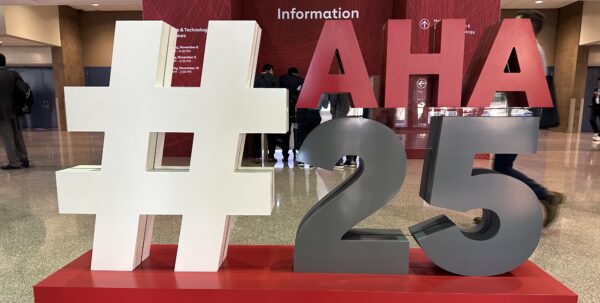
The 2025 American Heart Association annual conference wraps up today, and cardiac imaging has been a major focus in New Orleans. In particular, research has highlighted imaging’s power to predict future cardiac events – and guide treatment to prevent them.
Coronary artery calcium scoring with CT is a great example, as CAC scores can predict not only cardiovascular but also all-cause mortality.
- Another common theme at AHA 2025 has been opportunistic screening, in which data from imaging exams acquired for other clinical indications can be used to detect osteoporosis, cardiovascular disease, and other issues.
Check out the items below for some of the hottest imaging topics at AHA 2025, and for a deeper dive into non-imaging news from New Orleans, be sure to visit our Cardiac Wire sister site.
News from the show’s first three days include…
- A massive study of 40k people found that those with CT-derived CAC scores greater than 0 were 2X-3X more likely to die from any cause than people without any CAC – and more died of causes other than cardiovascular disease. Also, 8.5% of patients had other significant findings.
- Community health personnel on a Native American reservation were trained to perform point-of-care screening echocardiography assisted by Us2.ai’s AI algorithms.
- Us2.ai’s algorithm was also used with transthoracic echo in the SCAN-MP study to detect transthyretin amyloid cardiomyopathy, a cause of heart failure.
- Treadmill stress tests fell short compared to CCTA in screening older master’s athletes for ischemia that could lead to sudden cardiac death.
- A program in Brazil that used echocardiography to screen schoolchildren for latent rheumatic heart disease led to lower prevalence rates after 10 years (2.5% vs. 4.5%).
- Patients with hypertrophic cardiomyopathy who had higher levels of myocardial fibrosis on cardiac MRI were almost 6X more likely to have adverse events over eight years.
- HeartLung Technologies’ AI tool predicted CAC presence on CT scans in 2.1k participants in the MESA study with higher AUC than other tools (AUC = 0.73 vs. 0.68).
- Another study used HeartLung’s AI to analyze CAC scans to detect myosteatosis – a sign of systemic metabolic dysfunction – which predicted atrial fibrillation and heart failure.
- A program promoting CAC scoring to an urban population brought in people for screening who might have been missed through physician referral.
The Takeaway
This week’s news from AHA 2025 shows medical imaging’s contribution to early detection of cardiovascular disease – the leading cause of death worldwide. CT-based CAC scoring has especially promising potential, not only for heart disease but also other conditions through opportunistic screening.
|
|
It’s Time to Make AI Adoption Simple
Visit Gleamer at RSNA 2025 booth #4936 to experience a milestone moment that will reshape AI’s role in medical imaging. Expect more than a sneak peak: Expect the future.
|
|
Every Image Tells a Story at RSNA 2025
Visit Intelerad at RSNA 2025 booth #6113 to learn how their solutions are empowering radiologists and patients while transforming radiology workflows. Schedule a meeting today
|
|
- Rebuttal to AI Replacement Theory: A controversial article published in July made a provocative proposition: Based on past cycles of industrial automation, radiology AI’s productivity benefits would mostly be enjoyed by “employers, investors, and AI vendors, not salaried radiologists.” That theory was eloquently rebutted this month in an editorial that also reviewed automation history but came to different conclusions. Radiologists who are willing to change and evolve will indeed benefit from AI, much as artisans of the past evolved into elite workers following automation.
- Shortcomings in FDA’s AI Review: Meanwhile, a new article in JAMA Network Open raises questions about the FDA’s regulatory review process for radiology AI algorithms. Researchers reviewed submissions for 924 radiology AI devices cleared under the 510(k) pathway, finding that for 717 devices with submission documentation, only 5% underwent prospective testing, just 8% were tested with a human operator, and 29% included clinical testing. With the FDA focusing on safety, healthcare institutions may need to test for themselves whether AI algorithms are actually useful in clinical practice.
- Lunit Retires Volpara Branding: Lunit retired the branding for Volpara Health Technologies, the mammography IT software developer it acquired in 2024. The former Volpara business will now operate under the Lunit brand as Lunit International and will lead Lunit’s business activities in the U.S., Latin America, and Oceania. Lunit is moving its global sales organization into these regional hubs, leaving its headquarters in South Korea to focus on AI research and new product development.
- MRI Leads Imaging Payment Declines: Amid widespread concern over lower 2026 Medicare payment rates, a new study in Clinical Imaging documents a steady decline in Medicare reimbursement for medical imaging over the past two decades. From 2003 to 2025, inflation-adjusted overall imaging reimbursement fell, with MRI leading the way with a 77% decline while CT payments fell 69%. Declines for ultrasound and X-ray were less severe. Shorter exams like abbreviated MRI could help offset fixed costs and maintain patient access.
- MRI Shows Impact of Heavy Drinking: MRI showed heavy drinking’s toll on the brain in a new Neurology study. Researchers performed scans on 1.2k people, finding that those who were heavy drinkers (≥ three drinks per day) had higher adjusted odds ratio for severe white matter hyperintensities (aOR = 3.04) and hypertensive cerebral small vessel patterns (aOR = 1.82). The findings suggest that heavy alcohol consumption exacerbates the severity of acute intracerebral hemorrhage and accelerates long-term pathology of cerebral small vessels.
- CCTA Improves Cardiac Risk Prediction: Adding data from coronary CT angiography scans to other risk factors modestly improved prediction of cardiac events in a new study in JAMA. Researchers in Sweden added CCTA data to coronary artery calcium scores and traditional risk factors in 24.8k people followed for almost eight years. The combination reclassified 14% into higher-risk categories with a slight improvement in risk discrimination (0.779 vs. 0.764), with most of the improvement in low-risk people.
- Fujifilm Launches Clamshell Ultrasound: Fujifilm Sonosite launched Sonosite MT, a new version of its point-of-care ultrasound technology in a clamshell design. The scanner can be used on or off a stand, with a lightweight and portable form factor that supports its use across clinical settings. Sonosite MT also sports an all-touch user interface with a buttonless monitor and control panel that can be easily cleaned. On the software side, it includes the Synapse Synchronicity workflow manager for streamlined clinical operations.
- Gradient Partners with DataFirst: In an alliance to promote data sharing for AI algorithm development, Gradient Health and DataFirst partnered to improve access to de-identified imaging data. Imaging providers working with DataFirst will be able to make their data available through Gradient’s Atlas platform, which gives AI developers access to millions of de-identified cases with metadata. The partnership should provide new revenue opportunities for DataFirst customers.
- Coreline to Debut Updated AI at RSNA: AI company Coreline Soft plans to debut an updated version of its AVIEW chest AI software at RSNA 2025. Coreline is calling AVIEW 2.0 “an integrated diagnostic ecosystem” for thoracic imaging that combines lung cancer screening, coronary artery calcium scoring, and COPD quantification into a single package. Clinical testing showed the new version has 89% faster throughput and 60% shorter interpretation time compared to the previous generation.
- Women Get More Inappropriate Imaging: Female patients are more likely to be referred for inappropriate imaging requests. That’s according to results of the MIDAS study in European Radiology that tracked the appropriateness of 61.2k imaging orders at three academic hospitals in Germany. The rate of inappropriate imaging requests was higher in women than men (7.32% vs. 6.08%) and women had a higher odds ratio for inappropriate imaging (OR = 1.22). Unnecessary imaging leads to higher healthcare costs and possible unnecessary radiation exposure.
- AI Detects Pediatric Elbow Fractures: Gleamer’s BoneView AI solution helped emergency physicians in France detect pediatric elbow fractures in a new paper in EJR. Researchers used BoneView to analyze elbow radiographs of 755 children and calculated how much it improved clinician accuracy when added to their own interpretations. AI assistance improved sensitivity by 21 points (99% vs. 77%) but specificity dropped (64% vs. 88%). The error rate was below 5% when AI and emergency physicians agreed.
- deepc Debuts Agentic AI Infrastructure: AI platform company deepc held a launch event last week to debut AIDA, an infrastructure to support the deployment of AI agents across healthcare enterprises. AIDA is built on an orchestration layer that connects AI models, workflows, and data sources into one network designed to make AI algorithms easier for clinicians to use.
- RevealDx Gets CE Mark: RevealDx received MDR CE Mark certification in Europe for its RevealAI-Lung algorithm for characterizing lung nodules on CT scans. RevealAI-Lung generates a Malignancy Similarity Index score to help radiologists develop follow-up recommendations, and the company says it can identify up to 45% of malignant nodules when they first appear. RevealAI-Lung does not yet have FDA clearance.
|
|
Building the Future of Radiology
Visit Medality at RSNA 2025 booth #1140 to learn how they are at the forefront of radiology practice growth and training as the simulated learning platform that everyone loves. Book a demo today.
|
|
Radiology Case Report
A man in his 40s presented with a known metastasis within his abdomen. Learn how contrast-enhanced MRI helped to diagnose the extent of his disease.
|
|
Discover What’s Next in Radiology at RSNA 2025
Join Philips at RSNA 2025 in booth #6730 to see revolutionary new innovations in MRI, CT, and informatics. Don’t miss your chance to witness breakthroughs that will redefine what’s possible at 10:30 am on Sunday November 30.
|
|
- Cut Repetitive Tasks: Less repetition. More focus. Rad AI reduces dictation time by up to 50% and words by up to 90%, freeing you to focus on what matters most: your patients, your practice, and your life. Book a demo at RSNA.
- The Future of Fluoroscopy Is Here: The future of fluoroscopy has arrived. The LUMINOS Q.namix fluoroscopy systems from Siemens Healthineers are available on the U.S. market. Discover why they have already earned the prestigious Red Dot Design Award for intuitive design and user-centric innovation.
- AI Handheld Echo for Preoperative Assessment: Read this overview of an ASE 2025 paper on the feasibility of handheld echo equipped with Us2.ai software for assessing left ventricular diastolic dysfunction in preoperative patients and how it compared to cart-based systems.
- Reimagining Radiology with Apple Vision Pro: Discover how Apple Vision Pro is helping to pioneer what’s possible in radiology in this special event in Chicago during RSNA 2025. Hear from key opinion leaders and Visage Imaging executives on how spatial computing is transforming radiology.
- New-generation Platform for Managing Multi-Omics Data: QP-Insights from Quibim is a new-generation advanced platform for the management, storage, and analysis of large-scale multi-omics data and medical images for clinical studies and research projects. Learn more on this page.
- Book a Demo with CARPL at RSNA 2025: CARPL helps healthcare providers realize the value of the entire AI ecosystem and drive financial, operational, and clinical ROI. Book a demo today or visit them at RSNA 2025 booth #5732.
- Opportunistic Detection of CAC and Pulmonary Nodules: Achieve a newfound certainty of search for thoracic CT when using ClearRead CT from Riverain Technologies. It’s a natural addition for opportunistic CAC scoring and nodule detection, or as part of a CT lung cancer screening program.
- Connect Every Pixel to the Patient Story: Mach7 Technologies is soaring above silos at RSNA 2025 with an imaging architecture that unifies your data, takes your EMR to new heights, and transforms images into insights. See how with a demo at booth #3351.
- Experience the Future of Radiology: Visit Enlitic at RSNA 2025 booth #7730 to experience the future of radiology and see how the company is revolutionizing radiology data migration with its Laitek acquisition. Schedule a meeting today.
- A New Standard of AI-Powered Care: Visit DeepHealth at RSNA 2025 booth #1329 to learn how their integrated, cloud-native solutions can unify your imaging experience. Book a meeting today.
- Reshaping the Future of Medical Imaging: Get ready for an unforgettable experience at RSNA 2025, where United Imaging will unveil major innovations that can reshape the future of medical imaging. Visit them at booth #1929 to see their comprehensive multimodality portfolio.
- Reimagine Imaging Innovation: Experience a new era of diagnostic imaging in the AGFA booth #2565 at RSNA 2025 in which every click, case, and connection is designed around how you work. Request an on-site demo today.
- Meet Merge at RSNA 2025: From first click to final read, Merge accelerates your workflows with imaging solutions designed by people who think like you. Book a meeting at RSNA 2025 booth #6100 to get your own live demonstration.
- Optimize Radiology Workflows: Harness cloud and AI technology to help your radiology teams unlock insights, increase efficiencies, and improve patient care. Learn more about an integrated approach to AI in radiology in this e-book from Microsoft.
- Abdominal Ultrasound Worksheets and Reports in 45 Seconds: Visit Kailo Medical at booth #4555 at RSNA 2025 to discover augmented reporting that produces worksheets and reports in 45 seconds, improving accuracy, boosting efficiency, and delivering better outcomes for patients and providers alike.
|
|
|
|
|


